Nnedi Okorafor is one of the most powerful voices in Science Fiction & Fantasy, her debut novel Who Fears Death won the World Fantasy Award, her novella Binti just received the Nebula Award (and a Hugo Award Nomination) and The Book of Phoenix a standalone “prequel” to Who Fears Death has received nearly equal acclaim. In The Book of Phoenix, Okarafor combines the pure power of story, set in a near future which “should” be more utopic considering the diseases that have been cured, but is more dystopic for its treatment of humans and the dark sciences performed on those unfortunate souls.
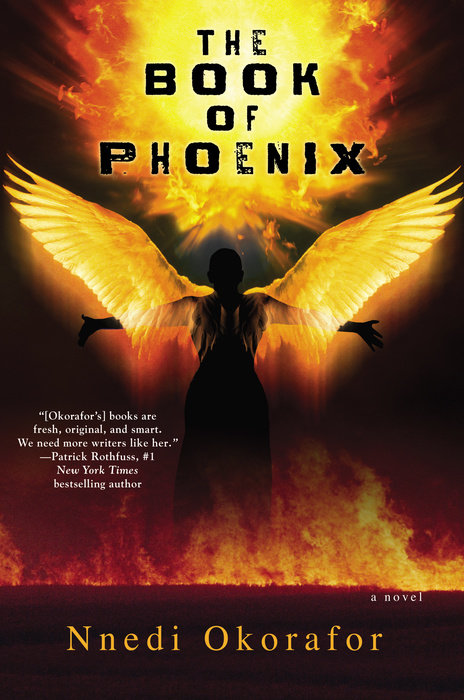
Okorafor starts the story in a bit of jarring fashion…she shows what appear to be tribal people of the past in their low level of technology village stumble onto an electronic reading device. On it, a character discovers “The Book of Phoenix,” which It tells of a young woman (only 2 years old, who looks like, talks, and thinks like a fully formed adult of 42 years) and her escape from her captors in the ominously named Tower 7 and her subsequent tour of the world and rise to fame (or infamy).
Phoenix, our heroine or more appropriately, central mythic figure, is an “accelerated human.” She is more than human, having genes from other species spliced into her own. She is subjected to several tests that threaten her life, which confound some of those conducting those tests. She doesn’t know any other life, though her friends Mmuo and Saeed soon open her eyes to her potential. Saeed takes his life when he learns something, which finally sets Phoenix into action. When she escapes Tower 7, it isn’t exactly a sneaky escape. Not only is the tower destroyed, Phoenix dies.
With a name like Phoenix, she was bound to return but the world is not ready for what she is about to reveal. In her second life, her back begins to itch a great deal and she is hunched over. When she comes across a couple whose African origins are very similar to Phoenix’s, her wings sprout and she flies away only to be chased by her former prisoners. She also discovers a man with wings who flies much like her.
The journey Phoenix undertakes is nothing short of mythological, and the credence for this is heightened because “The Book of Phoenix” is a tale found by characters who lived many, many (hundreds?) of years after her story takes place. So within this short novel (under 250 pages), Okorafor packs a wallop of power, character and story. The excruciatingly ugly things to be said about racism and sexism, the power of hope and revenge, the driving force of love, a mystery of character. So many things layered upon each other for a haunting and potent novel. With all those wonderful things, Okorafor also conveys who cool it would be to fly, the awesome power of what an actual phoenix might be. A quote midway through the novel that spoke to me (as I’m sure it did to many fellow readers and biblioholics) also speaks to this point so elegantly:
I love books. I adore everything about them. I love the feel of the pages on my fingertips. They are light enough to carry, yet so heavy with words and ideas. I love the sound of the pages flicking against my fingers… Books make people quiet, yet they are so loud.
The Book of Phoenix is a novel where one person can affect the world, can change the world irrevocably if the reader who bookends “The Book of Phoenix” is any indication. It is not quite post-apocalyptic, it is hovering on the edge of apocalypse for many reasons, including the remark about a “cool 80 degrees” setting it firmly within a post climate change world. It is a mythic novel that conveys how history can both elevate and wear away the past. It is a novel where story is of utmost importance. The Book of Phoenix simply made me say WOW.
Bravo.
© 2016 Rob H. Bedford
Trade Paperback | May 2016 | 240 Pages
http://nnedi.com/ | http://nnedi.com/book-phoenix
Review copy courtesy of the publisher, DAW