“I still wasn’t sure whether England was in Europe or not; I had the impression that the English would have quite liked to be in Europe so long as they were running it, but weren’t particularly bothered otherwise.”
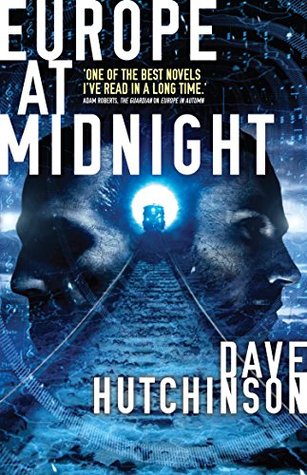 I hope you will forgive me if this turns a little political, but more than once while reading the Fractured Europe Sequence I’ve paused, looked away from the page, and thought, “Can Dave Hutchinson predict the future?” The ugly word Brexit has taken the media by storm, signalling The End Of European Civilisation As We Know It, yet the ramifications (or at least the motives, as outlined above) are right here in black and white: first in the excellent Europe in Autumn, then in its sort-of sequel, both published long before Britain’s seemingly fateful referendum shook the continent. So where does Hutchinson think we’re heading?
Europe at Midnight opens with Rupert, a young academic thrust into a position of power following the violent overthrow of the previous government. However, this setting is as strange as it is mundane: he lives on the Campus, a university the size of a city, ringed by mountainous terrain which no citizen is permitted to cross, a rule long enforced with lethal intensity. The crimes of the past have left many dead and there are secrets everywhere, trivial and terrible, some forever lost, some seemingly just beneath the surface. There is a secondary puzzle, though, one which Rupert never gives voice to. In contrast to the stuffy Englishness of its occupants, the environment seems more like Eastern Europe in the grip of Cold War scarcity and mismanagement, the population perpetually sick and slowly starving.
Where is the campus, exactly?
As the new Administration’s Professor of Intelligence, it falls on Rupert to prise what answers he can from the surviving former leaders — of whom there are few — about the sinister activities taking place under their watch — of which there were many. But the business of building a civil society from the ruins of a fascistic one soon begin to take increasingly oppressive and dangerous turns. Some old loyalties maybe be stronger than the new, and Rupert’s investigation threatens an enemy he can’t even comprehend, let alone identify… at least not without redefining everything he’s ever known, a possibility he cannot be allowed to realise.
Elsewhere, specifically in London, a government agent named Jim is urgently charged with investigating what seems a run-of-the-mill random stabbing on a rush-hour bus, made notable only by the unusually formal good-manners of the victim, plus his claim to have “seen a map”. Flashing identification that bears neither his own name nor the department he actually works for, Jim finds himself negotiating inter-agency politics in pursuit of the attempted killer, one who managed to vanish without trace in a city of countless surveillance cameras.
Jim’s masters seek to uncover a conspiracy that none of them really believe in. He finds it as implausible as they, yet the disappearing killer and his softly spoken victim hint at its veracity. Europe has long been a splintered continent, but now there are sometimes six-hundred competitors or more in the Eurovision Song Contest — in a world as psychotic as that you’d think there was nothing left that could surprise… but as the lines Jim and Rupert follow begin to cross and tangle, both have their eyes opened to a truth beyond credulity, one so valuable to their enemies that no number of deaths are too costly a price to keep it secret.
I discovered Europe in Autumn through word of mouth and what I heard was enticing, but it came with a warning: that the direction the story took in the later stages might not be to everyone’s taste. Europe at Midnight takes that lead and runs with it, and it’s testament to Hutchinson’s skill that what seemed an unlikely left-turn in book one works like a charm in book two, which offers up a second course of thought-provoking thrills and spills that is every bit as satisfying as the first.
What also works, fortunately, is the absence of Rudy, the chef-turned-spy who dominated proceedings in Autumn. Midnight splits its focus more or less evenly between its new intelligence officers, who are similarly not quite what we might expect a professional of the espionage industry to be, but it’s risky to abandon your lead character mid-series with his story left hanging. However, the result has been to establish a deeper awareness of this unique world, one that Rudy — as a latecomer to a long, slow, strategic game — might never convincingly be able to deliver alone.
The gradual revealing of the Fractured Europe Sequence’s secret conceit started me thinking of Jean Baudrillard’s Simulacra and Simulation (popularly remembered now for donating the words “the desert of the real” to The Matrix, amongst other things). In particular is the notion of an empire which created a map so perfectly detailed that it was as large as the Empire itself. In Baudrillard’s concept, the people begin to live in the map instead of in reality; and, when the empire itself starts to fall, it becomes more important to them to maintain the nature of the map that has been so carefully created than the world that inspired it, which is allowed to crumble.
What Rudy discovered, and what Jim and Rupert now see for themselves, has strong parallels in this kinds of idea. Europe at Midnight expands on the transition begun in Autumn, moving from a science fiction of social philosophies like patriotism, nationalism, imperialism and independence to a science fiction in which abstract philosophy is played out as real. It also reflects one of the notorious features of the pro-Brexit campaigns: nostalgia for an idealised past, which — were it actually transposed onto the present — would be far from the wonderland it is held up to be.
Hutchinson’s countless European dystopias feel liveable. His handful of utopias border on hellish. The question of which will persevere isn’t answered here, but the foundation for the third book in the series is strongly laid, and I look forward to reviewing Europe in Winter in a couple of weeks.
Review by Andrew Leon Hudson – SFFWorld.com © 2016