
 I write standalone novels and short stories, flash fiction and blogs. I’ve also completed a trilogy.
Had I known about writing what I know now, I doubt I would have chosen a trilogy as my first project. (Although, since I’m currently planning out a fantasy duology, I’m not sure. I certainly haven’t been put off.)
Standalones are tidy. They have a beginning, middle and end. You start with a hook, expand in the middle and hurtle to an end that answers any questions you raised. In terms of structure, everything is clear. Even in series, to a certain extent, the same is true. Each book stands alone, although it may take themes and events from earlier books or build for later books.
Characters, too, follow a linear path in a standalone – the character from the beginning of the book builds to the one at the end. Their arc is prescribed and easy to follow, if not to always to tie into the plot.
But trilogies aren’t like that. Trilogies have a structure within a structure; their characters must have arcs that satisfy across all three books. Quite why they’re so popular in science fiction and fantasy, I’m not sure – they aren’t as prevalent in other genres – but I think (with no evidence to present, whatsoever) that it may be to do with the epic nature of sff. The worlds are grand, the character scope often immense. In sff, often we’re trying to tell one great big story – and trilogies lend themselves well to a sprawling tale.
 Which is not to say that a trilogy should consist of one book cut into three. Why did GRRM bring out two volume books rather than two new books in ASOFAI? Because the questions raised in the first volume were not answered until the last. A book cut into convenient sections is not a trilogy: it’s a three-volume book.
But, what a minute, you say – many trilogies have questions in book one not answered until book three. Why else are so many of us following Pat Rothfuss in the hope of the announcement of Doors of Stone’s release.
Let me step back from tying myself in knots.
There are two key strands in a trilogy, which it is important for a writer to have a grasp of:
- The trilogy arc – what does the whole story tell? When I got back the first edits of Abendau’s Legacy I got the line from my editor I hoped for. I had tied down all the loose ends in the books. I had remembered to answer the questions I had asked. Some of those strands were laid down in book one, some in book two, some – but fewer – in book three. Those strands were in the character arcs, in the world development and in the plotline.
- The books’ arcs – within the trilogy, and what makes it three separate books, have three individual stories. They might take place over a specific point in time, they might link to the other two books, but each one will have a start, middle and end like any other story.
If we take something like Lord of the Rings, the trilogy arc is set in book one. The Ring must be destroyed. That is the purpose of the three books. But in book one, the fellowship must be formed and the quest embarked on – that’s the purpose of that book. We don’t expect to see the resolution the the Ring’s destruction in book one. We understand that’s the big picture, the culmination of the full story, the will-it/won’t it that will keep us reading. Which means we’re okay for questions to remain around the Ring. We’re not okay if the Fellowship has not been formed, or having an unanswered question about how the hobbits escaped the shire. Those answers belong in book one.
I like to think of a trilogy as a life. It’s the full story, the rounded understanding. Within our life, we have stages and stories. Our childhood. Our adult relationships. Getting older. Each stage can be its own book – but the true, complete, story only gets told over the combined volumes.
What does that mean for writing it? Firstly, you have to be organised. Which I’m not especially. Some writers swear by Schrivener, some have world-building documents. I have the copies of the first two books within easy reach of the computer and a photographic memory, plus a few scribbled notes.
For me, completing book three’s draft before I published book one helped – I knew what I had to support, at least in outline. That didn’t mean I kept the ball in the air all the time – one key relationship in book three would have benefited from a little more visibility in book two. Keeping editorial continuity with both the editor and copy-editor, helped too. To change editor mid-trilogy would, I think, be very jarring.
 Where a trilogy does provide a challenge is in structure – and that challenge lies with the second book. The first book sets the world, story and characters – there is plenty to be getting on with in it. The third holds the climax, answering questions, with characters already bought into. But the second—it has nowhere to go. It is a book that doesn’t begin or end anything and, as such, stands in danger of wallowing.
Of all my three books, I found two most fun to write and, I think, the paciest to read. I think it was because it was the freeing from the process of ensuring I met all needs. Two needed to entertain, to build on one and lead into three. To do that, it needed to standalone in a way the other two don’t – the start and the end of the trilogy felt, to me, like a mirror. Book two formed some of the glass in that mirror, and some of the critical developments of both plot and character but it didn’t have to reflect into the other books in the same way.
So, what does a writer need to embark on a trilogy? I also think confidence is a big thing. A trilogy is a huge undertaking. It’s taken me five years of work – and I write quickly. The confidence to know your world, characters and story is big enough is vital. Most people build to that confidence via smaller projects, and that makes sense. But in sff we are so used to the trilogy structure that many writers really do just start with that epic series or trilogy they’ve had in mind.
If that is the case, I think stickability is another good behaviour to have. If you are embarking on the steep learning curve that is learning to write, and you are also trying to fit that learning into a huge, time-consuming project, it’s going to take time. And work. And a lot of knockbacks. If you’re prone to flitting between projects, if you find it tricky to maintain interest for a long period of time, a trilogy might not be the best place to start.
But if you do have the confidence to have a go, the ability to seek and act on feedback, and the tenacity to keep going, I hope the rest will flow. If so, go forth with your big arc, your little arcs, your growing characters. Enjoy the difference in feel as the work matures.
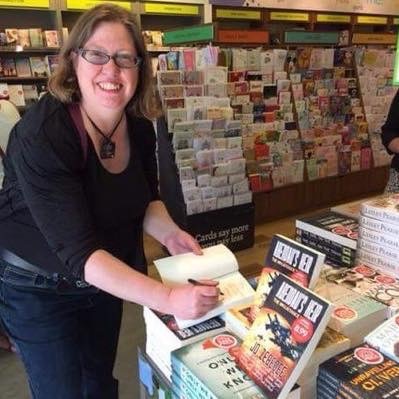
Jo Zebedee writes science fiction and fantasy. The final book of The Inheritance Trilogy, Abendau’s Legacy, is released on October 24 2016. She is also the author of Hugo-nominated Inish Carraig, set in Belfast after an alien invasion, and the upcoming fantasy Waters and the Wild. She’s also a regular blogger on www.jozebwrites.blogspot.co.uk.
More about her can be found on www.jozebedee.com, including links to free short stories, and to her newsletter, and she’s on twitter at @joz1812.




Great interview! Love her books!
Thank you so much. My day is made. 😀