 Small but Mighty returns to the Kansas-based Hadley Rille Books for H. M. Goodchild’s The Crooked Path. Released this September, The Crooked Path offers readers a dark fairytale set prior to the events of Harriet’s high fantasy novel After the Ruin.
Welcome to SFFWorld, Harriet, by now you know how this works, so can you tell us more about The Crooked Path without quoting the publisher’s blurb?
It’s a story of someone who wants something more out of life than simply being a craftsman, and ends up blundering into something absolutely huge. My aim was to deal with the aftermath of the world-threatening power struggle between two powerful magical beings. In the world of my books’ setting, that struggle happened a long time ago and was (mostly) resolved. But its resolution left some loose threads and my protagonist gets thoroughly tangled up in one of them.
The Crooked Path has a substantial vein of mythology worked in to it. Was there a particular lore which inspired this novel?
Several, in fact. The core of the central story in The Crooked Path is taken from a Greek myth, a myth that has been worked and reworked in folk stories across Europe for centuries. I expect readers will have come across it in some form, whether that be in The Golden Ass or East of the Sun, West of the Moon: it’s the tale of the girl who drives away her own true love from fear or curiosity and has to win him back through trials and tribulations. Stories link together, the familiar acts as a bridge to the unknown. The Crooked Path is not a simple retelling of a myth or fairy tale – it is woven together from three stories set in three different times and places – and the Classical motif is worked across with other, more northern influences. The most important of these are folk songs. I listen to huge amounts of folk music. Some of these songs are ancient, some relatively modern, some tell of encounters with the supernatural, others describe historical events, but all exist at the boundary between the real and the unreal: the supernatural ones, like Tam Lin (Child Ballad no. 39), are set in real places and the historical ones like Lord Ellenwater (Child Ballad no. 208) are full of omens and foreboding. All are shaped by the oral tradition, so there isn’t a definitive version, any more than there is a definitive version of a myth. Each singer and each story teller takes what she wants and puts her own particular spin on it. The folk songs give a mood, a dominant note for a character, perhaps, or an image to play with in the text, as well as a sense of place. There’s also something of the pattern of folk songs in the way I structure the prose, the use of repetition and rhythm for effect, for instance, or the way one scene echoes another. Each chapter of the book has a verse from a folksong as an epigraph. Something from that song will be reflected in the following text, and all the songs together could be used as a playlist: consider it a type of cross-form intertextuality. The other ‘lore’ that inspired the story is not mythological at all but scientific. In my everyday life I’m a circadian biologist trying to understand how animals, and more especially plants, deal with the difference between day and night. Plant biology is quite different during the night, and this is transmuted into fantasy in the book in the form of the firstborn tree. I’d like to think this is the first fantasy novel whose plot turns on a point of chronobiology!
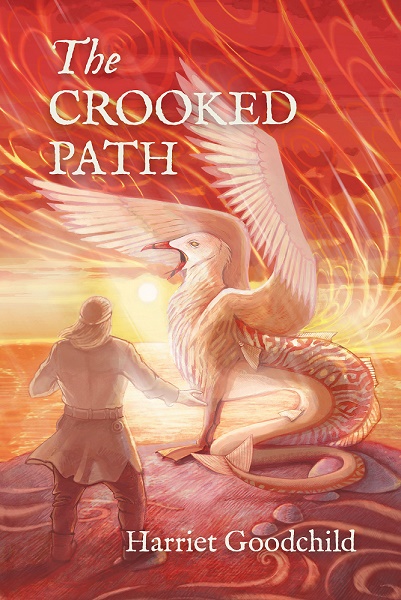
Tell us more about the magical creature on the cover.
I’m so glad you asked about that! In its own words:
‘I had my beginning on the day when men first saw how great the distance was between what they were and what they wished to be…I am the desire to fly with the gulls in the high sunlight and the longing to swim with the fish in the deeps of the sea.’
It’s the embodiment of a dream and a wish, a creature that occupies the liminal spaces between the solid, everyday world of the protagonist – he’s a potter and a woodcarver – and the impossible world of the dreams he’s had and the stories he’s been told. Except, of course, this being a fantasy novel, those two worlds are only a step apart, the creature is real and all those stories true. It acts as a guide and a gate-keeper. I call the version on the cover a sea-wyvern, since, like a wyvern, it has two legs, wings and a tail. It’s not that I imagined a sea-wyvern when I was writing, it’s certainly never called one in the book, but I don’t think what I imagined matters. At that point there were as many versions of this creature as potential readers of the book. When I write, I don’t include detailed descriptions of what people – or creatures – look like, preferring to supply enough to create an impression and leave the reader to fill in the rest. It was only when Hadley Rille chose to put the creature on the cover that a translation into something solid enough to be real was necessary.
And who created the cover art?
A wonderful artist called Yana Naumova. She created the cover art for my first novel, After the Ruin, and so was the obvious and only choice for The Crooked Path. Yana works very much within the northern, fairy tale tradition – she’s Russian – and appears to have an intuitive understanding of how to translate my understated descriptions of people, creatures and places into something that looks right. She created the creature from a bare minimum of description: ‘half a fish and half a bird with an open beak and a thrashing tail and long, strong, feathered wings’. That was a challenge for Yana. I’d deliberately written the creature to be biologically impossible. Words are easy; translating a creature with the tail of a mackerel and the head and wings of a herring gull into an image is not. Beyond the creature, the cover of The Crooked Path shows a sunset, because the day to night transition is thematically important in the book. It’s a book about boundaries and opposites – sunrise and sunset, land and sea, air and water; the challenge for Yana was to make these elements work together. And she nailed it. You can find more of Yana’s work on her DeviantArt page.
Is there a particular scene in The Crooked Path that you enjoyed writing? I enjoyed writing the whole book, so it’s mean of you to make me pick out just one scene! But I can, and I shall. It’s a scene in which Allocco exerts his authority over his son that comes near the beginning of Chapter 8. The pleasure of writing that particular scene lay in its details, ink drying on a page, an unspoken name… It moves the plot on, yes, but it’s largely a character study of the relationship between father and son. All my books are standalone, and they don’t need to be read in a particular order, but their stories do interlink with each other. Allocco’s treatment of, and attitude towards, his son has important consequences, not only in this book but also in other stories including After the Ruin. Although this scene is fairly short it needed to accommodate two different groups of readers, those who’ve read some of my work and those who haven’t (yet!). I liked being able to include nods towards those other stories and to the existence of someone who, because of those other stories, is absent from this one. But mostly I like it because of Allocco. One shouldn’t have favourites among one’s characters but I do, and I always enjoyed writing Allocco. His tragedy is that he let himself be consumed by hatred.
What are you reading at the moment?
I usually have several books that contrast in tone and content on the go at once. At the moment I’m reading two books picked up at Fantasy Con. The first of these is Hal Duncan’s Testament. It’s a book in which individual words matter; a reader is constantly aware of the nuances and shifts in meaning that follow from using one word rather than another. By doing so it makes one think about texts and translations of texts. Is there a definitive version? What lies behind commentaries on a text? What’s the agenda? Such ideas interest me. My second Fantasy Con book is Jilly Paddock’s To Die a Stranger, a sci-fi spy thriller about artificial intelligence; I’ve read several of Jilly’s books and enjoyed them all. I’m also reading Shirley Jackson’s We Have Always Lived in the Castle, a good, unsettling dose of American Gothic.
Hadley Rille says that they are proud to give True Heroines™ a home. Who is your heroine and why?
She is Liùtha. Of all the characters in the book she is the one who changes most. Her version of The Crooked Path is to decide how far she will go to get what she wants. She’s presented at two different stages of her life, first when she is very young and very naïve, and later when she is older, embittered by experience and by those who took advantage of her naivety. By the time she meets the potter, Liùtha is in conflict with herself: she knows what is necessary, and she’s learnt the cost of it the hard way. In fact, she’s well on the way to being another Allocco, thinking only of herself.
Who edited The Crooked Path?
It was edited by Terri-Lynne DeFino, the fantasy editor at Hadley Rille. Terri and I had worked together before on After the Ruin, and understood each other’s working style. She’s very good at pointing out the places where a little more is needed, or a little less. What I particularly appreciate about her approach to editing is that she never attempts to solve a problem or to rewrite the text but is unerring in her ability to identify that there is a problem or that a spot of rewriting is necessary. I admire her hugely; she was working on this book at a very difficult time in her life and, somehow, never faltered. Thank you, Terri. Before a book leaves the author for the editor, it can be helpful to have it pass by a reader, someone who can say Yup, that’s ready or Hmm, not yet. My very good friend, Louisa Tsougaraki, read the manuscript several times before I sent it off for editing. There are a couple of scenes that I didn’t realise needed to be included until Louisa pointed them out!
Thank you for taking the time to answer our questions Harriet, could you tell us where we can find out more about your other work?
You can look at the ‘My Books’ page on my blog where you’ll find a description of all my stories and also links to other interviews.
And finally, where can we buy your books?
You can order the paperbacks of The Crooked Path and After the Ruin from your local bookshop. They, and the e-book editions, are available online from the usual sources. My two books of short stories are e-book only and in the Kindle Unlimited programme. This is my UK amazon page. This is the US:Amazon & Barnes & Noble
Save
Save
Save