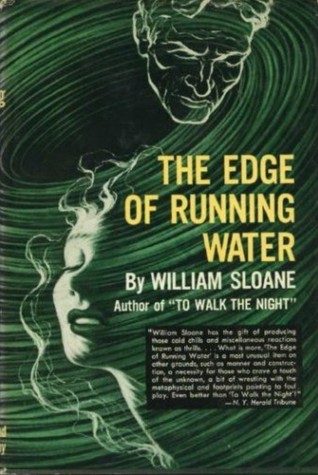
 As part of our Countdown to Hallowe’en, our SFFWorld Horror expert, Randy M., gives us his take on the second classic Horror novel from William Slone.
The man for whom this story is told may or may not be alive. If he is, I do not know his name, where he lives, or anything at all about him, except that there is something which it is vital for me to tell him. It is a strange, clumsy method of communication, this expedient of writing an entire book without even the certainty that it will come into his hands, and yet I can see no other way of warning him. There is, I think, a good chance that it will succeed. Someday, perhaps in a bookstore, perhaps in a library, he may come on a copy of this narrative. Or someone he knows will innocently mention it in his hearing, and he will be impelled to seek the book out and read it. People somehow manage to learn of the things that are supremely important to their lives or work. What troubles me is not so much the possibility that he will never come on this message as that it may already be too late.
When middle-aged electrophysicist Julian Blair loses his young wife, Helen, he cannot bear that he will never see her again and delves into dangerous research. Years later, after leaving his position and secluding himself, he summons his friend and former protégé, Richard Sayles, to Setauket Point in Maine to tap into Sayles background in investigating the electric currents of the brain. Unable to find previously recorded empirical evidence for the existence of life after death, Blair has done his own research and with information from Sayles his work reaches its final stages.
Drawn into his mentor’s apparent insanity, Sayles and Blair’s young sister-in-law, Anne, try to deflect Blair from his course. But Blair is adamant and Sayles and Anne are left to contend with the locals, already put off by the outsider with strange ways, now outraged by the suspicious death of one of their own, a woman who had been Blair’s housekeeper.
Parts of The Edge of Running Water follow the trajectory of typical commercial fiction of the 1930s and 1940s, including a rather sweet romance between Richard and Anne. In some fiction from that time period the love story intrudes and annoys contemporary readers, but Sloane wasn’t one to get sappy, keeping it at a low-boil and sometimes finding charming ways of portraying it:
Anyone else reminded of a scene in The Creature from the Black Lagoon?
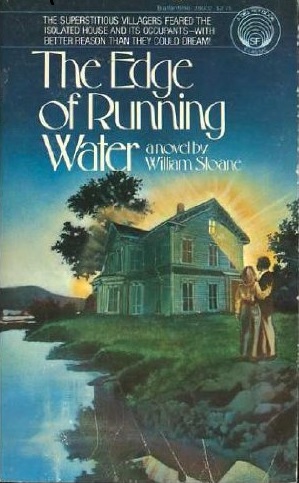 Mainly the novel revolves around its mysteries: What caused the death of the local woman? Who is Mrs. Walters and what hold does she have on Blair? What is Blair doing in his lab? What does he expect from the machine he is building? Only in the final pages do we see the potential of Blair’s machine, and those scenes, written in Sloane’s plain, direct prose are quite effective.
With only two published novels, it’s probably too much to say Sloane had a pattern, but the novels have some parallels: For instance, each begins with the narrator travelling, by train in The Edge of Running Water, Richard Sayles having been summoned by his friend, and by chauffeured car in To Walk the Night as Bark returns home to tell Dr. Lister the details of Jerry’s death. We enter the world of each novel after some significant events have already happened, Sloane drawing us in as his protagonists try to piece together a picture of what they have faced and are facing.
More importantly both novels take the form of mysteries the reader is likely to solve ahead of the protagonist. Besides Sloane’s narrative hints, for contemporary readers this stems from growing up in an s.f. world, having seen or read works using similar narrative strategies. Sloane was writing for an audience on the brink of that world, Edge was published nine years after the discovery of Pluto, a year before the first use of penicillin on a human, and six years before the first use of an atomic bomb. While Sloane may have been aware of pulp magazines, I haven’t come across anything suggesting an affiliation at that time and his books were published for a general audience, not just the s.f. readers of the day. Set in the time of publication, the characters in his stories make the kind of assumptions and intuitive leaps that would have been common then.
I’m at a loss to guess how contemporary s.f. and/or horror readers will react to Sloane’s novels, but I found both enjoyable, older works that weren’t written for sixteen-year-olds of the time, and dealing intelligently with their premises while building to their final scenes and execut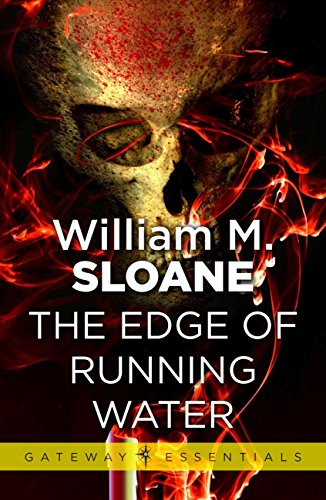 ing them effectively.
The Edge of Running Water was adapted into the movie, The Devil Commands, released in 1941, directed by Edward Dmytryk and starring Boris Karloff. I haven’t seen it but I’d like to hear if anyone else has and what they thought of it.
Another novel of similar interest:
The Case of Charles Dexter Ward by H. P. Lovecraft
While several publishers have been reissuing older horror novels and collections – NYRB Press with the Sloane novels and The Other by Thomas Tryon (a fine novel), Penguin with works by Shirley Jackson, Ray Russell, Charles Beaumont, Clark Ashton Smith and Thomas Ligotti – Valancourt Books have been reissuing a good deal of obscure horror (and some s.f., notably Christopher Priestly). I haven’t read any of the following, all originally published around the same time as Sloane’s novels, but their reputations make them of interest: