
As part of our Countdown to Hallowe’en, our SFFWorld Horror expert, Randy M., gives us his take on a classic Horror story.
Certainly this was one of the “high places” that men of the ancient world had felt to be holy, whether in Palestine or in the American desert. Even when houses had stood on the mesa top, this must have been a still place, aloof and plainly not a part of the business of human living at all. So they had hewed a stone and put it where I could lie for century upon century, here on this height, under the sky and swept clean forever by the great winds. An altar, yes, and in a place where they had felt that the immensity of the universe touched the immediacies of the earth on which they live. This stone was their ebenezer; it marked their recognition of the something more than they could put a name to, a memorial to the tremendous force or will that had created the earth and the stars.
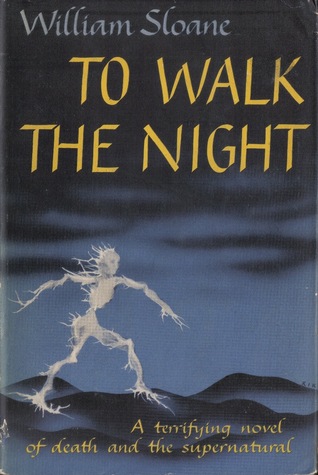
— from To Walk the NightDifferent people, different reactions: On first meeting Selena, Jerry Lister is drawn to her beauty and held by her intelligence and intensity. His friend, Berkeley Jones, Bark to his friends, has a different reaction: Fear.
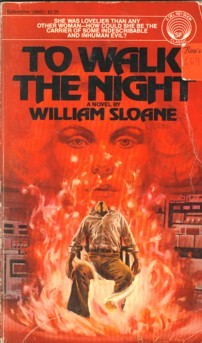
Alumni visiting campus for their team’s football game against their biggest rivals, after the win Jerry and Bark walk to the observatory, certain the confirmed bachelor, math professor, Walter LeNormand would be there. Jerry, a math whiz himself, had studied under LeNormand, eventually becoming his student assistant and friend about the time LeNormand published a radical theorem that challenged common belief, even Einstein’s theory of relativity. No one answers their calls when they enter but on reaching the upper floor of the building they see LeNormand sitting in a chair, head back, engulfed in flames. And neither is certain LeNormand is already dead.
Their efforts to save LeNormand fail. The investigation into cause of death indicates homicide, but no evidence suggests how or, really, why.
And then they meet LeNormand’s bride of three months. Physically perfect as a statue, Selena’s expression and behavior also seem statue-like and she appears unaffected by her husband’s death.
Not long after meeting her, Jerry brings her to New York with the ultimate goal of marrying her. Studying her, Bark finds she watches how others behave and adopts their gestures and inflections, she seems able to tell what someone is thinking, and she is acutely aware he doesn’t like her. Something about Selena doesn’t seem natural. No one on campus had met her before the marriage, no one knows her history and she doesn’t talk about her past.The more Bark sees of Selena, the more difficult it is to not recall the fate of her first husband.
I first read To Walk the Night when Ballantine (Del Rey imprint) reissued it in 1980. After years of reading Lovecraft and some of his early imitators, I found it rather slow; okay, but nothing more. Distanced from my younger self and his influences, I like it more, drawn in by Sloane’s use of conversational English to propel his narrative and, when he determined to do so, his creation of what Lovecraft called “cosmic awe,” as demonstrated by the quote above. Further, the romance between Jerry and Selena moves at a reasonable pace and isn’t hobbled by the romantic conventions of 1940’s fiction, if anything working against those conventions to a degree, and affords a chance for the reader to watch Selena develop. Further I find Sloane’s humor entertaining and his observations interesting: Maybe I’m underestimating s.f. writers of the ‘40s, but with the possible exception of C. L. Moore, I can’t think of one I’ve read who would have framed Bark’s observations of Selena when he and Jerry first meet her in quite the same way. His assessment of her clothing and her presentation of herself seems on point for the time period, and his disquiet at the conclusions he tries not to draw comes across convincingly and, whether or not Sloane meant it as such, come across as a critique of then current conventions. Lastly, the flow of Bark’s earnest recreation for Dr. Lister of all he’s experienced pulled me along, his anxiety for the safety of Jerry and now for Dr. Lister palpable and real.
According to IMDB, To Walk the Night was adapted with the same title for the TV show Robert Montgomery Presents in 1951. I haven’t seen it, but Geraldine Fitzgerald was one of the stars, which makes seeing it appealing.
Also by William Sloane:
The Edge of Running Water (Del Rey/Ballantine, 1980; included in The Rim of Morning, NYRB Press, 2015)Other horror novels from the 1930s and 1940s:
Night Has a Thousand Eyes by Cornell Woolrich
Conjure Wife by Fritz Leiber
Darker Than You Think by Jack Williamson
Share this post: on Twitter on Facebook on LinkedIn





I was really delighted to find a post pushing William Sloane. He’s so little-known, and yet his writing is just outstanding. “The Edge of Running Water” is one of my favs, a truly brilliant novel.
Many other writers of “cosmic horror” are more familiar to modern audiences, but Sloane was one of the best. He deserves a wider readership, for sure.
Thanks Tyler. If it helps, Randy looks at The Edge of Running Water soon. Must admit, Sloane is an author I’d never heard of until Randy mentioned him. Have added his books to the pile now, though!
Hi, Tyler, and thanks. The two novels Sloane wrote are well-crafted and well-written. There have been several writers and critics over the years who have praised them and yet, as you say, his readership has been comparatively small. It’s good to see him back in print and it’s interesting to me that NYRB Press, a prestigious paperback publisher mostly concerned with more mainstream work, was the one to do so. I hope that bodes well.
Randy