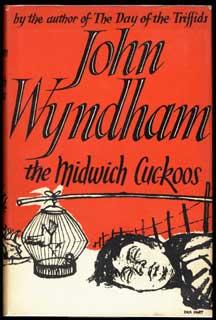
 As part of our Countdown to Hallowe’en, our SFFWorld Horror expert, Randy M., gives us his take on the 1950’s classic SF/Horror novel from John Wyndham.
One of the luckiest accidents of my wife’s life is that she happened to marry a man who was born on the 26th of September. But for that, we should both of us undoubtedly have been at home in Midwich on the night of the 26th-27th, with consequences which, I have never ceased to be thankful, she was spared.
Sometime after 10:17pm on the 26th of September everyone in Midwich, England, falls asleep. At about 5:30pm on the 28th, the residents begin to wake up. Between these times, people entering within a defined area around the town fall asleep instantly, which causes several traffic accidents and eleven deaths, at least by exposure. Janet and Richard Gayford are among those who enter the area the next day and are immediately stricken. A passing military officer sees them drop and has them pulled out with a pole. Richard is our narrator.
A retired military Major living outside of Midwich had discovered and reported this as a probable gas attack and so the military came to Midwich, notably Richard’s old army friend, Major Bernard Wescott, to determine the extent of what is happening and its probable cause. Included in the military investigation are fly-overs determining how high the affected area reaches, pictures from which indicate something of unusual shape, something that had registered on radar, on the ground near the Abbey ruins; something that isn’t there by the time everyone awakens.
Even after Midwich returns to normal, or as close as possible after such an incident, Military Intelligence continues to take interest in the town, and more so when it becomes clear that all women who were within the area affected and of child-bearing age are bearing children.
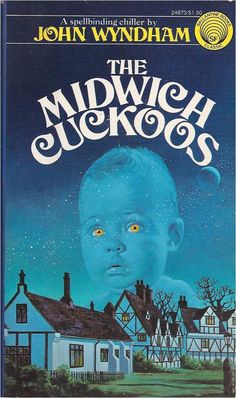
John Wyndham is best known for this novel, The Day of the Triffids and The Chrysalids. In the 1960s these, among other works, came to be called, “cozy catastrophes,” a derogatory term for those British novels from the late 1940s through the 1950s whose premise was a catastrophic event that demonstrated how the British would bear up under them. Arguably products of reaction to World War II – perhaps similarly to the Japanese monster movies in which monsters destroy Tokyo – the characters in Wyndham’s Cuckoos and Triffids display the stiff-upper-lip that allowed Brits to survive the war but which was part of what the later New Wave writers reacted against.
But calling them “cozy” glosses over the step-by-step logic detailing the probable actions and behaviors, repercussions and consequences of Wyndham’s premise: In my edition, in less than 190 pages Wyndham convincingly portrays the British government stifling news of the event (reasonable given the forms of communication at the time and the location of the town), Midwich residents accepting the event and moving on, then coping with the mass pregnancies as leaders of the community manage the situation and help unmarried women who, true to the time, felt shame, some even acting self-destructively in reaction to that shame. The eventual births of the babies, their rearing and accelerated growth are rendered economically, and their difference from us fully displayed. Moreover, Wyndham manages this with a good deal of wit, letting the humor of the characters play with the oddness of the event, then gradually darkening the tone as the full import of these children, who communicate with each other without speech and who can force adults to do their bidding, become more threatening.
Aside from the Gayfords, Wyndham’s characters more or less fit types, from the British eccentric to the high-hat old lady to military stiffs, but the characters are well-rendered all the same, from Major Wescott (comic relief) to Dr. Willers (sensible doctor, and his progression through the book rings true) and Reverend Hubert (ineffectual, mostly, but struggling to keep his flock together and help them) to Gordon Zellaby and his wife, Anthea. Zellaby, who becomes the main protagonist, is one of the British eccentrics, introduced as erudite but perhaps a bit flighty, his frothy conversation hiding an observant and thoughtful mind; in my reading experience he seems distantly related to Lord Peter Wimsey. Within the scope of the story these characters convince and compel, their conclusions and actions believable and believably portrayed. Another thing that struck me about the book is that while the wives of the main male characters have roles within the social limitations of the era, Wyndham treats them as individuals, some less able to cope with the situation, some more so, and several intelligent, brave and insightful.
The Midwich Cuckoos has been filmed twice under the title, Village of the Damned (1960; 1995) I haven’t seen the second version, directed by John Carpenter and starring Christopher Reeve and Kirstie Alley. The 1960 version, in black and white, starred George Sanders and Barbara Steele and was directed by Wolf Rilla, a name I don’t recognize at all, but who did a fine job. As I recall the movie, there are some changes, but the adaptation catches the tone of the book, its occasional humor but also the growing sense of unease the villagers feel around the children, and the children’s lack of emotion.
More dark s.f.:
Mimic; 1997, dir. Guillermo del Toro; starring Mira Sorvino, Jeremy Northam; based on “Mimic” by Donald Wollheim (a truly weird short s.f. story; while the scan goes past page 129, the story ends at the bottom of page 122)
They Live!; 1988,dir. John Carpenter; starring Roddy Piper, Keith David, Meg Foster
Unearthly Stranger; 1963, dir. John Krish; starring John Neville
I Married a Monster from Outer Space; 1958, dir. Gene Fowler Jr.; starring Tom Tryon, Gloria Talbott (Married is better than the title sounds)
The Crystal World by J. G. Ballard
Cat’s Cradle by Kurt Vonnegut
The Midwich Cuckoos by John Wyndham (1957; Ballantine/Del Rey, 1980)