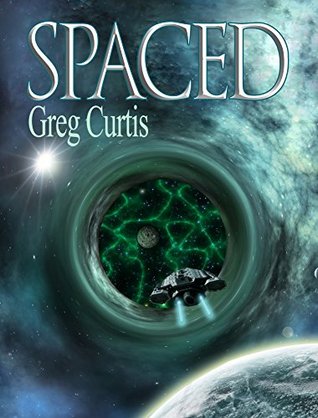
Will we eventually take technology to far? Spaced by Greg Curtis was released by Tickety Boo Press earlier this year and we’ve had the pleasure to talk to him about the book and his view on the future.
First of all, can you in your own words tell us a bit about Spaced?
Spaced is first and foremost a space opera. I grew up reading endless space opera and loved it. Everything from The Skylark and Lensmen series of EE Doc Smith, to Rendezvous with Rama by Arthur C Clarke. For me space opera has that perfect blend of an action story and a theoretical “what if?” exploration of speculative fiction. And as they say write what you know – so I do!
In Spaced I wanted to have a hero struggling to find his way home, which for me is always a fascinating battle. One where the enemies are not necessarily actual physical enemies, but rather the practicalities of the return and the doubts in your head. Ones that you can’t simply beat up with a sword or a laser, but which you have to struggle with every day.
But of course before I could get my hero Carm into this struggle, I first had to get him lost – way lost. And so I began with an old philosophy riddle. If everything came from nothing – where is that nothing? And how close is it to the something we know? From there you get the translation drive, which is simply a variation on the old jump drive of Battlestar Galactica, or Harry Harrison’s cheddite projector, but with one key difference. It doesn’t have any range limitations. Literally it can toss you anywhere in the entire universe in a heartbeat. And if you don’t have the coordinates back you are literally as lost as it is possible to be.
The other half of the story is to find out as Carm battle’s to find his way home, how he ended up in this mess in the first place. If he wasn’t a terrorist bomber, who was and why? That of course Carm couldn’t work out since he was no longer in known space. So I had to create another hero – a detective assigned to answering those very questions, Detective Samara.
And from there the book became two stories working side by side, with Carm trying to find his way home, and Detective Samara trying to get to the bottom of the mystery, until finally the two threads tie together.
You have a bit of a loner in Doctor Carmichael Simons and also to some degree in Detective Samara I guess. Can you tell us a bit about your main characters? Did they end up as you originally envisioned or did they change a lot during the writing?
With Carm I had him fairly much pegged as a loner from the start. Clever but slightly maladjusted, and needing to be both of those things to do the work he does. In essence he is a gold miner from a western, updated a thousand years or so. So he’s a man who’s comfortable with his own company, self assured in his ability to survive, not the greatest lover of authority, a born explorer, and somewhat cynical. But he’s not a complete loner. He has a small cadre of people like him who he shares time with when he can – the rest of the deep spacers as I called them. I like to think of them as a sort of Victorian explorers’ club, going out on their wild rides into the unknown, coming back and meeting up with their colleagues, then telling tall stories about what they’ve done and getting completely drunk.
Detective Samara did however change a little during the writing. I started out wanting her to be a hard edged, no nonsense, detective from one of the cop shows we all watch. A Dirty Harriette without the penchant for killing, but with all the cynicism. But as I wrote her she changed. She started out in the traditional role, hating her boss because he chewed her out and living all those other cliches, but little by little she evolved. She acquired a civil rights lawyer for a father and with that an appreciation for the other side of the law. For the rights of suspects etc. She also grew from the role of simple detective solving crimes and arresting the bad guys, into a true police officer, there as the Americans would say, to protect and serve, even at the cost of her own life. It’s easy I always think – well easier anyway – to go out and be brave when you have a gun in your hands and a good chance of winning. It’s much harder when you’re facing down an army with a pop gun in your hand, and almost no chance of victory. It takes real courage. But that was her journey in Spaced. To do what was right no matter the cost.
What new challenges did you set for yourself with, Spaced?
With a lot of my writing, especially the space operas, my main challenge is in creating plots that are both deeply complex and yet at the end make perfect sense. I love to turn things around. To make the bad guy actually the good guy. To make an unknown character or characters the true enemy. I also love to set up red herrings. To let readers think that the bad guy is this man and he’s doing what he does for these reasons. And Spaced is no exception to this.
Hopefully the reader will start out with just this great mystery on their hands. A terrorist bombing that makes no sense. And then as the plot gathers, they’ll start to think – well it’s the androids. Then it’s the person who builds the androids. Then they’ll start to wonder why it’s him. What motivates him.
With Spaced there are a lot of layers to the onion that need to be peeled before you find the truth. And as the writer my challenge is to weave all these layers together in a way that will leave the reader at the end thinking “aha!” So that was what it was all about!
This is a world with the Mesh and citizens reporters where almost nothing can be hidden. Do you feel you have drawn a lot of inspiration from today’s hot topics related to surveillance and tech?
Definitely the mesh is the future of the internet as I see it. I tried to tie a whole lot of internet movements together in forming it. Privacy is of course the big one, where it becomes more and more difficult to guarantee your privacy on line, as the internet grows in ever more unpredictable ways. A month or two ago we just had the largest world wide hack where a number of companies were attacked and almost levelled. And the way it was done was through the so-called internet of things – the IOT as it’s called. Lots of little, net connected devices like cameras and fridges, that were used as trojans.
At the same time we’ve had years now of people not just trying to bring down the system, but stealing information in ever larger amounts, often for the purposes of theft and perhaps for political gain and international advancement. Which leads us to an internet which is becoming ever more a wild, wild west, and where security becomes less and less certain.
So with the mesh, the only security on it, is perversely not to be connected at all. To completely unplug. Store data on drives that cannot be accessed. And as for privacy, there is none. Which means that the only security a person has in this future world is to live their lives as if they were always being watched – because they are always being watched. Not by the governments – but by millions / billions of curiosity seekers, all powered by the belief that they have the right to know – everything.
We also are at the beginning of a trend in body modification where people are starting to try and place bits and pieces of tech in their bodies. Everything from bar codes to cameras. Which is where the mesh heads in Spaced come from. People who have now not just done these basic things we’re talking about, but actually buried information technology in their brains – with typically unpredictable results.
What do you think about the future of humanity, will we eventually take technology to far?
Of course, it’s inevitable that we will take technology too far, just as we always have done. And so we have environmental degradation from pesticides like DDT, global warming from the burning of fossil fuels, the possibility of nuclear annihilation etc. That’s simply who we are as a people. But at the same time we are also a people who usually in time, can pull ourselves back from the edge. DDT is no longer used. The ozone hole is being repaired thanks to our no longer using CFC’s. The nuclear countdown has been largely halted. And in time I hope, we will back away from the problem of global warming.
Can you tell us a bit about what led up to Spaced being published by Tickety Boo Press?
Actually that’s rather an exercise in good luck and good timing. I had written Spaced, and was preparing to send it down to my usual editor when she was unable to do it. Which of course left me in a bind, with a book I wanted to publish, but wasn’t sure when I would be able to. Not unless I changed editors, and personally I feel very blessed to have the editor I do. So did I simply wait, or hunt down another editor?
Then Tickety Boo announced that they were looking for space opera’s and I decided to write to them. It was a big step for an indie like myself to look at going trade, to place my work in someone else’s hands and hand over the responsibility for publishing it, and yet I thought it was also important for me to try it. Every control freak has I suppose at some point got to let go at least once!
Luckily for me they said yes, and the rest is history as they say.
How did you start writing? Was there a particular book or moment in your life that spurned you on?
Writing was a sort of slow growing affair for me. I started out as a reader of sci fi and fantasy, devouring every paperback I could find until I hit university, and then slowing a little. But in university I started to do technical writing for various theses etc. I won’t tell you how many years that lasted for! But the one thing I did learn during that time was that I liked writing – even if I can’t spell for faeces!
Then in the early nineties I bought my first computer – a pentium seventy five – and suddenly I started writing. It became an obsession for me from that moment on. Along with playing Civ II!
You also write Fantasy. How different do you find writing in different genres and do you have a preference?
Actually I don’t have a preference. I write fantasy – urban and epic, sci fi, and even some Christian / angelic fiction. I’ve also got some detective fiction on my machine that I may one day finish off and publish. For me they are all the same. They are simply stories that I immerse myself in and write. And though this will seem odd, sometimes I don’t even know what genre a story is until some way down the track.
I am what many what’s often called a pantster – writing by the seat of my pants, with no outlines, no plot, no idea where a story is going until it’s actually got there. I once actually tried to write a plot outline, and I discovered to my shock that I could actually do it. In fact I was utterly impressed with what I created, and thought it would make an excellent story. Until I started writing it. And then I realised that I couldn’t actually write to a plot. Literally within a page I was writing a completely different story. And every time I rewrote the plot outline to match the new story, I immediately went off script again. That is simply who I am as a writer.
So for me it’s not about the genre. It’s about the characters, what do they do in a given situation? What feels right to them? It’s about the world build. What would this world be like given these basic parameters? It’s about the situation. How did my characters get here? How will they get out of here? Those are the key elements that drive my writing.
What has been most surprising to you in your writing and publishing career so far?
There have been many milestones on my writing journey that have amazed me. Finishing my first book – don’t worry, it was terrible but you’ll never see it! Publishing my first book. Getting my first reviews. My first royalty cheque. But the one that stands out most in my mind is the day I first held a copy of one of my books in my hands. Holding a copy of Maverick in my hands was literally mind blowing. It’s a completely different thing to seeing it online. And it’s definitely an experience I would recommend to all aspiring authors.
What’s next? Do you have plans for a sequel to Spaced or do you also have more new and exciting projects you are working on?
Actually I just published another epic fantasy – The Wolves of War, four days ago, and currently I’m in the post publishing slump. Going through all the edits, the battles with Amazon and CreateSpace etc, the formatting and so forth, simply wipes me out. Writing the books is actually easy compared to that. So for the last couple of days I’ve been playing Skyrim and binge watching Monarch of the Glen – I loved Hector!
As for what’s next I don’t know. I never know. I have probably around two hundred books in various stages of completion on my computer, and I might start completing any one of them – or several. Or I might start something completely new. Did I mention that I’m a pantster?!
* * * * * * *
Interview by Dag Rambraut – SFFWorld.com © 2016