Royal twins, a crooked advisor, warring nations, elvish creatures, and a dark reawakening evil are all familiar ingredients in epic fantasy. With Stina Leicht’s voice telling a story comprised of these ingredients, in addition to dashes of flintlock / gunpowder and a slightly different setting, Cold Iron is a smart start to The Malorum Gates, a series that looks to be a refreshing splash in the large pool of Epic Fantasy and answers her own question, “What if Tolkien was American?”
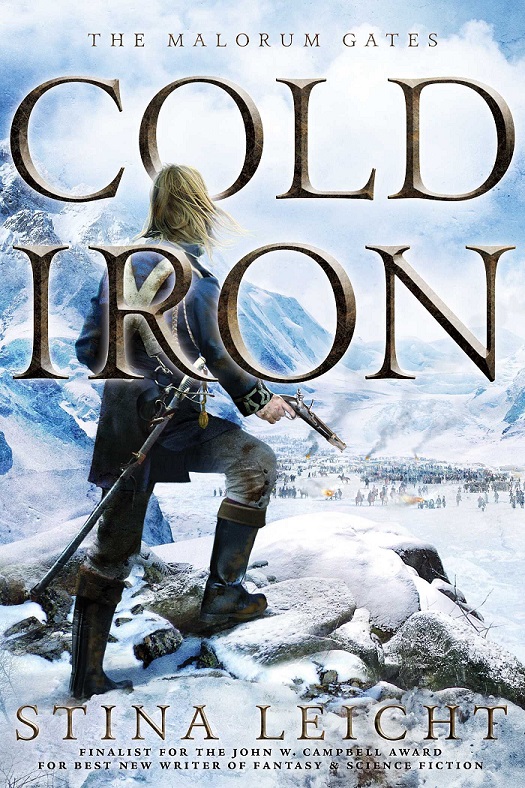
Fraternal twins Nels and Suvi move beyond their royal heritage and into military and magical dominion in this flintlock epic fantasy debut from a two-time Campbell Award finalist.
Prince Nels is the scholarly runt of the ancient Kainen royal family of Eledore, disregarded as flawed by the king and many others. Only Suvi, his fraternal twin sister, supports him. When Nels is ambushed by an Acrasian scouting party, he does the forbidden for a member of the ruling family: He picks up a fallen sword and defends himself.
Disowned and dismissed to the military, Nels establishes himself as a leader as Eledore begins to shatter under the attack of the Acrasians, who the Kainen had previously dismissed as barbarians. But Nels knows differently, and with the aid of Suvi, who has allied with pirates, he mounts a military offensive with sword, canon, and what little magic is left in the world.
Leicht tells the story through threee main characters, the twins Nels and Suvi respectively the prince and princess of the Kainan nation of Eledore, and the sorceress in training Ilta. Suvi is the acknowledged heir to the throne of Eledore, currently occupied by her father King Henrik Ilmari, while Nels is not thought of fondly by his father since he has no magical abilities. The Ilmari family are part of the Kainen, elf-like humanoids possessing magic, slightly taller than humans and a touch reminiscent of Steven Brust’s Dragaerians (of the Vlad Taltos novels), to combat the non-magical Acrasians who utilize firearms. Despite Suvi being the heir, Henrik’s brother Sakari (and the twins’ uncle) is trying to undermine Henrik’s power, manipulating people and events so he can sit upon the throne.
For the Kainen, blood holds much weight, as does death and the rituals involved with both. For example, when a soldier (the only group of Kainens who can use weapons and kill) falls in battle, Nels picks up the fallen soldier’s sword in self-defense, breaking the long held tradition. This of course does not go unobserved and Nels is shunned by his father.
While the king and his heirs comprise a significant portion of the conflict of the novel, the magical elements in play fuel much of everything else going on in the novel. In a parallel to the succession of the Throne of Eledore, there’s a pending succession for the strongest magic-wielder of the land, the Silmaililla. An evocative, Tolkienish title for sure, these practitioners of magic are almost like druids in their connection to the land. Especially Ilta, the young healer who finds herself romantically drawn to Nels. Ilta is the granddaughter of the current Silmaililla and is drawn ever more into the conflict between the Kainen and humans.
Where the storylines of Nels, Suvi, and Ilta soon draw together is the conflict between Eledore and the non-magical inhabitants of Acrasia. Nels is on the frontlines of the battle, Suvi finds herself at sea, in conflict with yet another race, the Waterborne, who have at least some issues with the Eledorians. And, oh yeah, Suvi has to swat away assassination attempts so she has a lot on her plate.
Leicht does a lot of things well in this novel, including giving her characters a great deal of weight, sympathy, and empathetic motivations. Nels struggles constantly with his feelings of inadequacy because of his father’s rejection, this is a common emotion many people feel and have to deal with throughout their lives. In Nels’s case, he knows his father disapproves, his father flat out told him. Complicating matters is that Nels knows his uncle is perhaps at the root of his country’s problems and his father barely acknowledges Nels as a person, and therefore dismisses anything Nels has to say.
Suvi deals with many gender issues because of her earned and high placement in the military. Her enemies express surprise at a woman holding such a prominent role of leadership. For me, she is the stand-out character, from her dedication to her family, her strong-willed belief in what is right, the strength she both embodies and the respect other characters give to her. Her chapters felt the most compelling compared against Ilta and her brother, her path was a more refreshing change of pace compared to the paths other two characters followed, which are more expected in Epic Fantasy.
Cold Iron is a long novel and as I said, some of it was a bit uneven. I didn’t dislike what Leicht was doing with Ilta and Nels, just that it felt as if she enjoyed writing Suvi more than the other two main POV characters. The only other issue I had was that Uncle Sakari wasn’t much more than the trope-ish nefarious advisor. That said, I don’t know that expanding his character too much further beyond this mold would have served the larger plot more anyway, though a little more fleshing out would have been appreciated.
With the title of the series The Malorum Gates referenced only a few times in the novel, there are hints at the Old Ones who lie behind those gates, dark almost Lovecraftian terrors viewed as mythical creatures waiting to be unleashed that may have little care for the conflict between the Acrasians and Eledorians. Like the best series opening novels, Cold Iron brings a conflict introduced in the beginning to a close while leaving judicious hints of larger forces and elements at play. Leicht has a nice series going with this one and I look forward to where she takes these characters in Blackthorne.
Recommended.
© 2017 Rob H. Bedford
July 2015 | Saga Press
Trade Paperback | 688 Pages
http://www.csleicht.com/
Excerpt: http://www.simonandschuster.com/books/Cold-Iron/Stina-Leicht/The-Malorum-Gates/9781481427777
Review copy courtesy of the publisher, Saga Press