 Nancy Kress is one of those authors who’s been writing for over four decades, writing about 30 SF novels and quietly collecting awards – to date, by my reckoning, six Nebulas and two Hugos. The last of these Hugos was awarded in 2014 for the novella which makes up the first part of this expanded novel.
Nancy’s reputation has been built on her skill in writing technically realistic hard science fiction stories, often set in a fairly near future. Her fiction often involves genetic engineering, and, to a lesser degree, artificial intelligence. The hardness of the SF in her work is based upon extensive research which gives the impression that her stories and the topics within them are possible.
With this in mind, Tomorrow’s Kin’s begins in a way that readers of her earlier writing and Sir Arthur C Clarke’s Childhood’s End will recognise – the arrival to Earth of aliens – but then, like the best of Clarke, transcends from this to something new and contemporary.
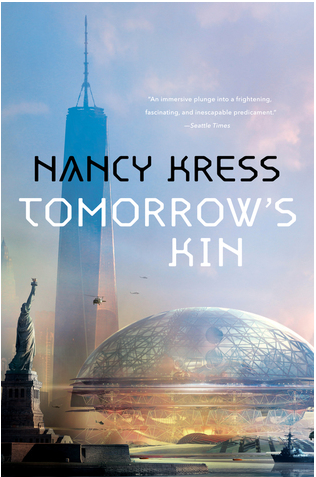
From the publisher: “The aliens have arrived… they’ve landed their Embassy ship on a platform in New York Harbor, and will only speak with the United Nations. They say that their world is so different from Earth, in terms of gravity and atmosphere, that they cannot leave their ship. The population of Earth has erupted in fear and speculation.
One day Dr. Marianne Jenner, an obscure scientist working with the human genome, receives an invitation that she cannot refuse. The Secret Service arrives at her college to escort her to New York, for she has been invited, along with the Secretary General of the UN and a few other ambassadors, to visit the alien Embassy.
The truth is about to be revealed. Earth’s most elite scientists have ten months to prevent a disaster–and not everyone is willing to wait.”
So: based on this outline we have a traditional style SF novel, with, in Analog/Asimov’s Magazine style prose, the plot of a gifted scientist holding part of the key to Humanity’s Uplift – something which I think Clarke would have pleased by, even if her own view is somewhat different:
“She was a workman scientist who had delivered a workmanlike job of fairly routine haplotyping.” (Chapter 2)
What Kress does to add to the plot is introduce her daughter and her two sons – all different from each other in temperament and manner. Elizabeth is the argumentative daughter who believes that the USA’s isolationism is the only way to secure a manageable future and works for the Border Patrol. Ryan is the most popular of the trio – athletic, sociable, a family person who cares for the environment and works for a wildlife organisation concerned with the invasion of invasive botanical species. By contrast, Rory is the youngest and most wayward rebel of the family. An addict to ‘sugarcane’, he lies, steals and generally drifts his way through life from one sofa to the next.
Marianne’s meeting with the alien Denebs (not from there, but the nickname stuck) has led to a revelation with global consequences. Although this is Humanity’s first contact with aliens, they are not as alien as we may think, which is why Marianne is involved. There are other, badder aliens in the universe and the Denebs are here to warn us. (I wasn’t quite sure at this point why the inscrutable aliens had waited eighteen months before having this first meeting, but all will be revealed later.) In Pern-like style, on the way to Earth in a matter of months is a deadly cloud of spores that, if allowed to settle, could lead to events that could wipe out life on Earth.
This news has an effect on Marianne’s work and her family. Whilst we are counting down until the extinction-event, the disparate members of the family deal with it in their own different ways.
The second part of the novel shows the reader what happens when the spores arrive on Earth and the real meaning of the Deneb’s appearance on Earth. With her trusted assistant and bodyguard Marianne travels all over the USA defending the alien’s actions, which in a changing world has consequences for those around Marianne. Marianne leaves her job to work for eccentric billionaire Jonah Stubbins, who is determined to build a spaceship to travel to the alien’s planet.
The third and final part refocuses on Marianne’s family and how they cope with a changed Earth. All of them have different degrees of involvement with the aliens. Jonah is determined to build a spaceship based on alien plans to allow travel to their original planet, World. Marianne’s work now involves working for the slick yet enigmatic Jonah, although his own motives are never that clear. She also spends time with her grandchildren Colin and Jason, who spend time with her at Jonah’s construction facility. There are other children there too – feisty Ava and slow, withdrawn Luke, and together they form a band of outsiders, all with special talents.
In some ways this novel is typical Nancy Kress. If you know her work, you know what to expect. It is a well-crafted novel that starts slowly but drags you in, a tale of science and scientists, trying to solve world-changing problems.
Sometimes expanding novellas by fixing them up into bigger novels doesn’t always work. Stories that worked well in brief become flabby and unfocused. Here Nancy has managed to expand the original story and make it worth doing so.
Here the characters are given room to breathe and whilst some of them are still a little sketchy (I suspect they may be more important later) the focus on the people is enough to make you feel that you get to know the main characters, and Marianne in particular. Marianne is not perfect and she makes mistakes, but this creates the impression of realistic characters. Though most of this focus is concentrated on Marianne, as the book progresses other viewpoints are brought in to expand the story. By the last part of the book Nancy manages to create convincing viewpoints from the youngest characters, which are very effective.
It is clear by the end of the book that other things are about to happen – it is the first book in a trilogy, I understand – but there is enough of an ending for readers to feel satisfied which what they’ve read up to this point. It’s a read that echoes the best of the traditional scientific science fiction.
For all of the novel’s scientific rationale, it is noticeable that it is the people that gives this story a surprisingly emotional resonance. We are aware of the bigger proceedings which underlie the plot but often without detail. It reminded me of the style often used by Arthur C. Clarke.
In short, Tomorrow’s Kin is a great alien-first-contact novel that has a pleasing amount of serious science to tell a surprisingly human story. Readers of Analog and Asimov’s Magazine will recognise its style and its quality.
Tomorrow’s Kin by Nancy Kress
Published by Tor Books, July 2017
Book 1 of the Tomorrow’s Kin Trilogy
349 pages
ISBN: 978-0765390295
Review by Mark Yon