 For those who like big, fat, immersive and meaty SF, combined with touches of Fantasy, this one ticks all the boxes.
From the publisher: ‘Hadrian Marlowe, a man revered as a hero and despised as a murderer, chronicles his tale in the galaxy-spanning debut of the Sun Eater series, merging the best of space opera and epic fantasy.
It was not his war.
On the wrong planet, at the right time, for the best reasons, Hadrian Marlowe started down a path that could only end in fire. The galaxy remembers him as a hero: the man who burned every last alien Cielcin from the sky. They remember him as a monster: the devil who destroyed a sun, casually annihilating four billion human lives–even the Emperor himself–against Imperial orders.
But Hadrian was not a hero. He was not a monster. He was not even a soldier.
Fleeing his father and a future as a torturer, Hadrian finds himself stranded on a strange, backwater world. Forced to fight as a gladiator and navigate the intrigues of a foreign planetary court, he will find himself fighting a war he did not start, for an Empire he does not love, against an enemy he will never understand.’
This is one of the most enjoyable SF debuts I’ve read in a long while. Think Dune mixed with Gene Wolfe’s Shadow of the Torturer series, but for a contemporary readership. The book sprawls though Hadrian’s youth and shows us his slide from nobility to warrior, adventurer and antihero and brings us up to the point where he earns the name ‘Sun Killer’.
The first part of the book shows us Marcus as a young man being tutored with his brother Crispin in the family home – a huge castle type edifice, obviously. Like Dune, it’s a science-fictional world but with a fantasy-esque setting – characters are referred to as ‘Sir’, there’s scholars, clerics and warriors, but also atomic weapons and signs of an AI takeover in the past, which reminded me rather of Frank Herbert’s series. In Empire of Silence there’s also a three-hundred year old war going on between humans and the alien Cielcin. Whilst the war seems to be far away, Marcus’s father is attempting to continue his extraction of uranium for spacecraft fuel, a profitable enterprise but one with little regard for the slave-type workers. As the eldest son he rather expects to be the family heir but, to his shock, finds that his more compliant younger brother is being groomed instead. Disillusioned, Marcus runs away to space to escape the family and make his own way in the world rather than rely on the family business.
This then leads to the second phase of the novel, as our hero finds himself in the wider world. Before being exiled to a position in the religious Chantry, which he hates, Hadrian’s mother arranges for him to be smuggled away to a new life. Of course, things do not go well, and Hadrian finds himself abandoned and penniless on a backward planet. The only way he can manage to leave the planet is by earning enough money to buy a spaceship. He does this by fighting in the local gladiator arena, and whilst there encounters his first real Cielcin, a prisoner in the arena’s cells.
The Cielcin are not the horrors that propaganda would portray. Instead, in the final part of the book, Hadrian finds that they are intelligent and complex, wanting peace in the centuries-long war as much as the humans. Hadrian finds himself defending the enigmatic aliens against their human enemies, which leads to a set up with a cliffhanger ending.
This is a book not afraid to mix things up. There are Roman-esque fights with laser weapons, space battles, strange aliens, swordfights and capes, strange aliens and space marines. Old fashioned weapons mix with new, and this future history combines Renaissance-style societies with Romanesque architecture, and hints at future AI apocalypses and ancient cultures. Whilst it is related to that old idea of civilizations falling and rising over a long history, and the societal fragmentation that can occur over light-years, it does seem at times that this is a plot with everything thrown in.
You like medieval-esque Fantasy? How about a society that still has knights, Dukes and call each other ‘Sir’, surrounded by Renaissance-baroque architecture? That fights with swords and blasters?
Or for SF fans, how about seeing planets at war, with aliens and armoured soldiers, so beloved by lovers of Star Wars?
OK. The book scores low on originality, although it’s done fairly well. I might go as far as saying that it’s actually rather impressive, even if there are times when seasoned readers may recognise themes from other films and novels (Dune’s battle shields, Star Wars’ interrogator machine, more than a touch of Alien) and the side-stories become rather convenient. But for readers who want battles in space with swords, buddy bromances, space aliens, galactic politics and yes – even romance, this is a heady concoction. Whilst it may be a little too self-conscious, it’s also ambitious and, though it overreaches itself at times, the overall cumulative effect is rather good. The ending leaves it clear that things are about to get bigger and messier.
It’s been a while since I’ve been able to immerse myself into a big SF book. Whilst not without issues, Empire of Silence is so engaging that I’ve been able to overlook its faults. It won me over. This is one not to think about too deeply, but instead just enjoy the ride.
Empire of Silence is clearly a debut, but celebrates all of the joy and the sheer enthusiasm of old-fashioned Space Opera, by mixing up lots of elements that readers will know and love. Whilst there are times when it overreaches itself, and there some contradictive coincidences that may make the reader wince, generally it’s a book that’s a lot of fun, engaging enough to allow the reader to ignore its deficiencies.
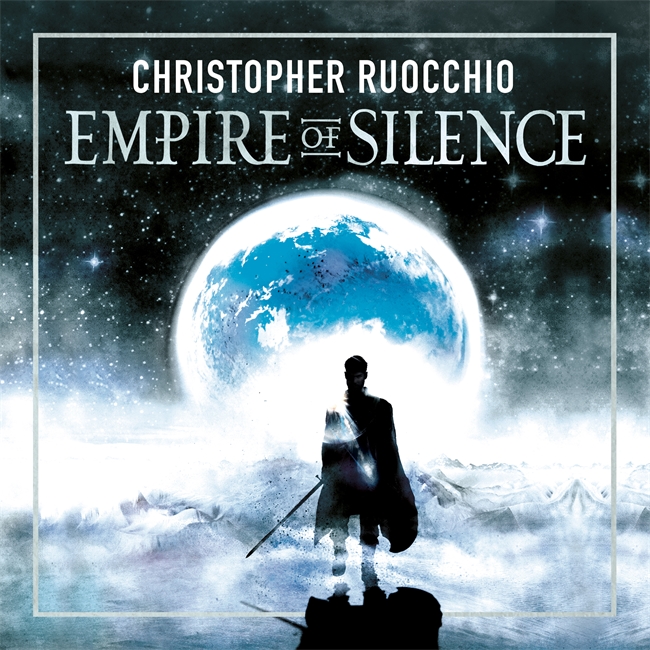
Empire of Silence by Christopher Ruocchio
Published by Gollancz, June 2018
624 pages
ISBN: 9781409168195
Review by Mark Yon