
 “Kids were giggling and shoving each other, and the smell of pickles drove all the oxygen out of the room. Abby forced herself to look at the dead bodies. Their skin was covered in bristles and their toenails were thick and yellow. Their dusty gray skin was peeled back to reveal layers of beef jerky muscles …”
- From the chapter titled, She Blinded Me with Science
Imagine being prisoner in your own body, without volition, choice, autonomy, a passenger as someone else guides your actions and speech perhaps in ways you would never consciously sanction. As a literary concept possession has a powerful attraction as metaphor for, among other things, psychosis or even the wrong politics. It’s a premise that can be science fictional (Robert Silverberg’s “Passengers”, Robert A. Heinlein’s The Puppet Masters, Jack Finney’s Invasion of the Body Snatchers) but the greatest literary success has come from an ages old horror of being possessed demonically.
William Peter Blatty in The Exorcist approached possession with complete seriousness; so long as the reader found Regan and her mother believable, the actions and speech of Regan possessed were terrifying and the reader was convinced of the possibility of a great, soul-stealing evil, of the actual, material presence of demons at least for the duration of the novel and, later, movie. More recently, Paul Tremblay in A Head Full of Ghosts engaged with Blatty’s novel merging his tale of possession with an exploration of what constitutes insanity and a pitch black satire of reality TV and the potential destructiveness of extreme Christian faith, and leaving ambiguous whether or not there was a demonic possession while leaving open the possibility of other kinds of possession.
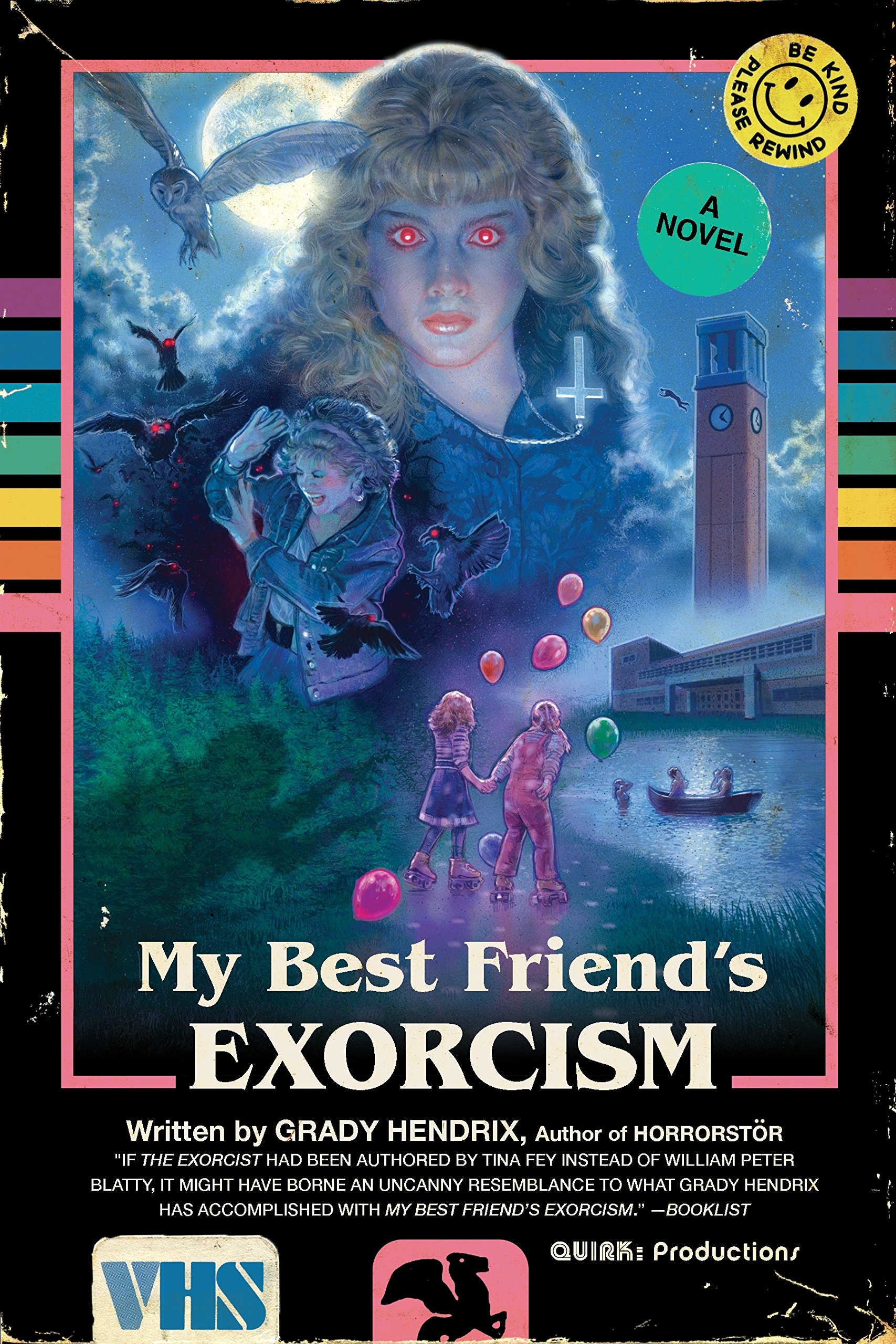
In My Best Friend’s Exorcism Grady Hendrix entertainingly takes a different tack: The possession is presented seriously, but the life around the main characters, two teen girls, Abby and Gretchen, is initially presented airily as being somewhat absurd. MTV, Madonna, Devo, “Greed is good”, The Breakfast Club, Back to the Future, the Brat Pack, big hair and mullets … how can a story set in 1980s America not have elements of the absurd? An absurdity heightened and also made dangerous by the social strata surrounding Albemarle Academy and its surroundings in Charleston, South Carolina. Hendrix embraces all this – each chapter has the title of an ‘80s hit song – and goes from there.
Abby and Gretchen have been friends since Abby’s tenth birthday when Gretchen was the only one of her classmates to show at her birthday party after they all said they would come. Though Gretchen is the new kid in town they bond – in scenes in a roller skating rink that show Hendrix’ flair for comic characterization – and for the rest of grade school, they are best friends. By their teens, they have acquired a posse, adding Margaret and Glee, but always when things get hard, Abby and Gretchen come back to each other.
And in junior year their lives get very hard. Out of school for the summer and staying for the weekend at a beach house owned by Margaret’s parents the four girls try LSD and Gretchen wanders off, lost for hours, only to be found by Abby dazed and grumpy, confused and scared, in a spot in the surrounding woods with a bad reputation. Abby is concerned for Gretchen, and gradually becomes scared for her and maybe of her. Bad things happen to Margaret and Glee, and while they don’t seem to recognize the source, Abby does. But Abby, for all she was born and raised in Charleston, is an outsider, coming from a poor family and only in this school because of a scholarship she could easily lose if the powers that be notice and dislike her actions. Who believes a poor kid when the rich kids call her a liar? What is Abby willing to risk to save Gretchen?
Hendrix writes well, beginning with a breezy, good-natured tone that darkens as events proceed. While the focus remains mostly on the girls, we meet surrounding characters who are deftly sketched in, like Wallace Stoney, Margaret’s hound-dog boyfriend; Abby’s mother, overworked trying to keep the household together since her husband lost his air traffic controller job when President Regan went union busting; Gretchen’s deeply religious and Republican father and mother; and various denizens of Albemarle, all deftly sketched in and contributing to a sense of the community Abby and Gretchen spring from. Part of the fun stems from Hendrix’s knack for summarizing a character with a few choice lines, as he does with Major, the school’s principal:
“Major was always disappointed in everyone. It was his sole emotional state. He was thick-waisted and gray: gray hair, gray skin, gray eyes, gray tongue, gray lips. He had attended Albemarle as a boy and been either a teacher or the principle for more than three decades, and in all that time he’d been disappointed in every single student who’d passed through his doors.”
By the time we reach an encounter between Major and Abby’s mother we have a strong sense of who each is, of how they’ll interact, and then we learn more.
If you’re looking for a good summer book, something for the beach or the back porch that won’t insult your intelligence, one that’s tense and sometimes scary and sometimes funny, with characters you may even come to like and admire as they come of age, keep My Best Friend’s Exorcism in mind.
MY BEST FRIEND’S EXORCISM by Grady Hendrix
(Quirk Books; 2016)
336 pages
ISBN: 978-1594749766
Review by Randy Money





I read this book last year and absolutely loved it as did my wife. I was lucky enough to snag a signed copy (of the version posted above).
Hendrix’s PAPERBACKS FROM HELL is a must have.
Coincidentally, Rob, I’m on with a review of Hardbacks From Hell at the moment…..
I look forward to your review, Mark. Rob, it is an enjoyable romp and now I have to get his earlier novel, Horrorstor. I’m miffed at myself because I had it in my hands several times without buying it.