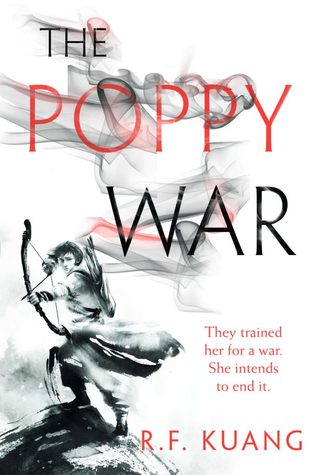
 So this one grabbed my attention from the start. Initially, it sounds like an Asian Hogwarts, a story of ‘girl outsider makes good’, a rousing tale of success against challenge.
And to begin, it does feel a little like that. The first half of the story is nothing particularly new. Told mainly in the first-person, it is that of Fang Runin (Rin), a young orphan working as a slave for a gangster family in the rural backward Southern province of Tikany. By working all of her spare time, she manages to pass the prestigious entrance exams to the countries elite military academy in Sinegard.
There she struggles against all the challenges that social class, and her classmates, set her against.
What the book does in the second half of the novel, after the initial set up, is send Rin down a path that leads her to new experiences and ideas – a world of Lore, where, under the guidance of Jiang, a maverick mentor, she finds that taking poppy seeds opens her up to a realm of Gods left pretty much unnoticed for centuries. This leads her to a greater destiny….
At first glance. it feels that the book could be marketed as a YA book. There are reasons for this – the author is in her twenties, the lead character is a teenager, and there’s a lot about being at school and the difficulties of passing exams. I’m not entirely sure myself, for reasons that I will explain later, but with such a synopsis, I can see why teenage readers will find it attractive. It is full of things that many teenagers will not have limited knowledge or experience of – love, drugs, independence, relationships, for example – and by writing about such matters creates a glimpse into a possible future, and how some may choose to live their lives.
And rather like a difficult teenager, the first part of the book feels like it sits at that point between childhood and adulthood. There’s mention of sex (but nothing too explicit), and heartfelt swearing (the f-word and others), and all those issues of being at school and whilst at school – friends, enemies, relationships, bullying, physical changes, difficult teachers, scary adults, drugs – all in an Asian setting.
This may sound attractive – and there’s a lot to like in this first part of the book, admittedly – but it’s not without its issues. Like a typical teen (if there is such a thing), for me the beginning of the book lurched from one emotion to another. From the start The Poppy War is very much an ‘all or nothing’ kind of book – there are no half-measures. Our heroine is not just good, she is the BEST – the top of the class in her small province, and elsewhere. As the book progresses, this full-on attitude continues. Urban life is not just scary, we have to have Rin’s arrival in Sinegard highlighted by the killing of a child by a carriage in the streets, killed because it is easier to do so than allow the child a potential disability claim in the future, to show the reader how BAD it is. (Worse mutilations and killings happen later in the book, partly for the same reason.) This extremism is continued in the characterisation – we don’t just love our heroes – we LOVE them, we don’t just hate our enemies, we HATE them, and so on.
My fear at the beginning was that this would be a book that simplifies viewpoints to the point of being bipolar, with little subtlety, few shades of grey.
Pleasingly, though the book moves away from this quite quickly. The second half of the book settles things down a little and moves the plot away from the predictable. The plot steps up a gear as Rin finds that she is involved in a war. When the Mugan Federation invades Nikara, Sinegard is under siege and the academy closed. Rin finds herself using her new-found skills to defend the city of Khurdalain as a Cike, one of the super-elite ninja warriors (‘the freak squad’) trained to do the Empress’s bidding. Her friend and fellow student, Altan, is her commander and one of the few survivors from the island of Speer, which was wiped out in the last Poppy War. His command of the Cike leads to Rin discovering about her past and her future, developing abilities she didn’t know she could have, and becoming a shamanistic conduit between the Pantheon of Gods and humans.
The book is also a story with its parallels in history – the evil Empire is (rather obviously) China, with the Mugen Federation Japan, and ‘little island’ Speer perhaps Taiwan. For all of the brutality, it is rather sobering that similar events have occurred in real life – for example, the destruction of Nanking in the 1930’s is allegedly the ‘inspiration’ for some of the events in the war in the later part of this novel.
At the same time, The Poppy War is also a very angry book. Rin faces racism, class war and prejudice and deals with them all, often with a smack in the face. As she trains to become one of the elite, she struggles with her emotions, betrayal, torture and (again, rather teenage-like) the general unfairness of everything to the extent that by the end of the book The Poppy War feels like one long proverbial scream in the wind, a railing against the world.
This is also true of the book’s ending. It is the cumulation of choices made throughout the book – good, bad and sometimes impossible – with consequences for Rin and her friends that are not always positive. There is resolution, but the usual ending which leads to the next book in a proposed trilogy.
In short, The Poppy War is not for everyone. It is, in essence, a bildungsroman story of teenage drug addicts and their importance on a Fantasy world. Whilst there is undeniably a pace and a drive in the plot, it is also brutal and unsubtle, unremitting in its anger and its viciousness. But I can see this one generating the buzz that Twilight once did. For all of its Fantasy setting, with its talk of Gods, most importantly, it’s also an encapsulation of adolescence in a Grimdark fantasy setting. And it is miles away from Harry Potter.
The Poppy War by R. F. Kuang
Published by Harper Voyager, May 2018
544 pages
ISBN: 978-0008239800
Review by Mark Yon