
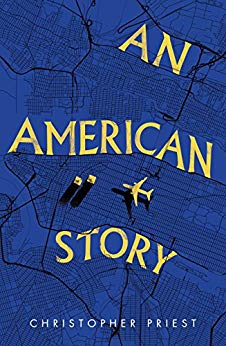
 Christopher Priest’s last few novels have settled into a disconcerting pattern of late. Always well-written, his books are known for a preciseness of prose where every word and sentence counts (even when you do not realise it.) What he then does is stealthily construct a world of truths and half-truths, of twisted versions of reality which read so well that they often deceive.
I see it as a peculiarly British thing, where major events are downplayed or given as a matter of fact, so much so that you sometimes don’t realise what has been said or written until you go back and read it again. Christopher is a master of this deception and sideswiping, capable of creating a charming response to someone’s face whilst at the same time knifing them in the ribs.
In The Adjacent (2013), he managed to muddle space-time, make England part of the Islamic Republic of Great Britain and destroy Notting Hill. In The Gradual (2016), he examined the consequences of time travel in the fictional setting of his own making, The Dream Archipelago. This time around, he’s again travelling the timelines and telling a tale that will be memorable to many, set in the near future and at various times in the near past (although for me it’s hard to think that it has been nearly twenty years.)
As has become typical in a Priest tale, the story is told in the first person from someone who may be an unreliable narrator. Set in the near future, Ben Matson is a freelance science and mathematics writer whose story flits from a time when Scotland has separated itself from Britain to become part of Europe and the streets of London have armed police on the streets, to real events of nearly two decades ago.
On the surface, it is a story that begins with Ben narrating how he is reminded, when reading an obituary of a famous if somewhat aloof Russian mathematician, of Lil, an American ex-girlfriend who seems to have been killed in the 9/11 terrorist attacks in the USA.
“Reimagining the real incident as an invented one brought home to me the relevance of fiction, of telling a story, when the truth is inconvenient, too complicated to explain or is simply something you wish to hide. Stories can be told.”
As this is a Christopher Priest story, it is not long before seemingly disparate events diffuse and are connected. What Chris does supremely well is set running a series of stories at different places in time which are charming and disarming but over the course of a novel combine and intertwine. They are written in such a way that they seem real, even if they may not necessarily be. To me they often seem like a literary equivalent of the traditional “shaggy-dog story” where things seem to happen all over and never end where you think they will.
Much of the fun of reading a Priest novel is trying to work out the connections, to join the dots, as it were. In his novels, Christopher often plays with the ideas of reality, of things being not what we think. Once again, when reading, we question the reliability of the narrator and the narrative.
“It was the first act of fictionalising, one that would lead to many more.”
And what works is that Chris embeds these untruths in such a normal-sounding narrative that the reader is lulled into complacency, where everything seems ordinary, but is not.
Along the way we discover more about Lil and her ex-husband, about lies and half-truths and enough conspiracy theories about what happened on the 11th September 2001 to make even the most cynical reader wonder what happened. (Chris points out his research at the end of the novel, and although he is not a believer in such things, points out where such things are discussed.)
By the end, things are resolved, and what seemed unimportant becomes more significant than we realise. The ending, like the solution to a puzzle, has been there all the time, and you realise that Chris has done it again.
For some readers this may be a difficult read. I must admit reading it brought back memories from that day, as if it was yesterday, not nearly two decades ago. Chris does well to describe those emotions of confusion and incomprehension that existed for the next few days – I remember that it was a tough day on the Forums as well as across the world, and this book reminds you of that.
But what it also does is what any good book should do – it makes the reader think, raises issues (here on security and the nature of freedom) and is both thoughtful and entertaining at the same time. This is one that I keep thinking about after I’ve read it.
An American Story by Christopher Priest
Published by Gollancz, September 2018
320 pages
ISBN: 978-1473 200 579
Review by Mark Yon


I found this in my local library and, being impressed by Priest’s ‘The Space Machine’, I gave it a go. By page 62, I gave up. Priest is a conspiracy theorist of the first order and this novel is merely an attempt to spread his foolish, unscientific notions to his readers. I’d leave it in the circular file were it not for its being a library book.
Hi Simeon. If I remember right, Chris has stated in the Afterword that he is not a believer personally in the ideas mentioned, a ‘conspiracy theorist’as you say, but in a book that is really about what is real and what is not it does look like something he could use -in a fictional way. That’s how I saw it, anyway.