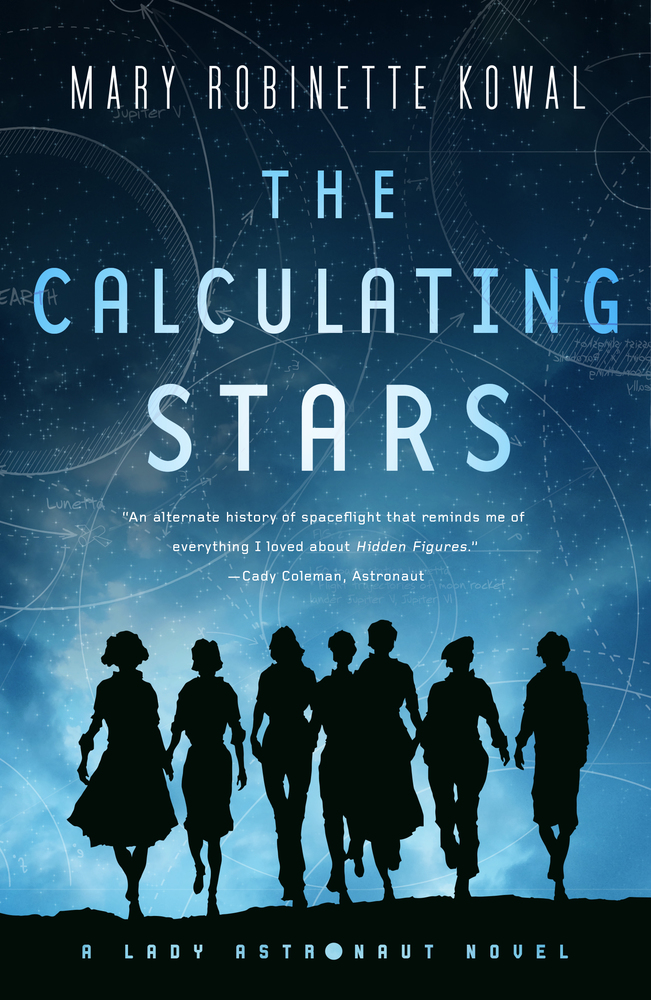
In 1952, the space race is in its infancy and the world is changed, one may say shattered, when a meteor crashes into the ocean off the East Coast of the United States. Elma York and her husband Nathaniel are in the cabin in the Poconos in Pennsylvania when the meteor strikes. The “space race” becomes more important as it becomes clear that the meteor’s long ranging effects will mirror those of the meteor that wiped out the dinosaurs.
A meteor decimates the U.S. government and paves the way for a climate cataclysm that will eventually render the earth inhospitable to humanity. This looming threat calls for a radically accelerated timeline in the earth’s efforts to colonize space, as well as an unprecedented opportunity for a much larger share of humanity to take part.
One of these new entrants in the space race is Elma York, whose experience as a WASP pilot and mathematician earns her a place in the International Aerospace Coalition’s attempts to put man on the moon. But with so many skilled and experienced women pilots and scientists involved with the program, it doesn’t take long before Elma begins to wonder why they can’t go into space, too—aside from some pesky barriers like thousands of years of history and a host of expectations about the proper place of the fairer sex. And yet, Elma’s drive to become the first Lady Astronaut is so strong that even the most dearly held conventions may not stand a chance.
Told from the first person point of view of Elma, Mary Robinette Kowal gives a personal, bird’s eye view of the global catastrophe and humanity’s efforts to survive. Elma and Nathaniel are directly involved in the salvation efforts; Elma was a WASP (the Women Airforce Service Pilots) in World War II who also happens to be a physics and mathematics genius. Her husband is no slouch either, Nathaniel is chosen to become the lead engineer in the space program.
Elma has a lot going for her – she’s brilliant, brave, personable, relatively upbeat considering the state of the world, and in a near perfect marriage. When we meet her, she is a computer, or a human calculator able to easily process complex math computations. NACA (NASA’s predecessor) utilized these computers to calculate flight data. Elma’s skill as a “computers” helped her to determine humanity needs to leave Earth before it kills the civilization. She is also Jewish and despite her strong exterior personality, has some serious internal challenges and anxieties she needs to overcome. Unfortunately, in 1950s America, women’s scientific opinions and drive to succeed aren’t exactly what is an acceptable role and outlook for women. Add to that the fact that she is Jewish and is struggling with anxiety, and you’ve got plenty of conflict with just Elma alone. Chief among the men who try to stifle Elma is Colonel Stetson Parker, a war hero with whom Elma came into conflict during World War II.
Elma soon gains notoriety for her mathematical brilliance, which gets her the moniker of “The Lady Astronaut.” Elma naively (to a degree) thinks her success as a member of WASP gives her a leg up in her drive to become an astronaut. Of course, astronauts were relatively new and were also “too dangerous” a role for women. Again, her nemeses Parker tries to keep her from seeing space. I thought the back-and-forth between Elma and Parker was great, it seems to exemplify what many women had to deal with when pig-headed men are in their way.
Added conflict comes in the racism of the era. The comparison between this novel and the historical film and book Hidden Figures is impossible to ignore and is called out by Kowal in an afterword. Elma is a bit taken a back when confronted by some of the black women computers, but soon realizes a shared plight and continues to push for what is right for them, and frankly, required if humanity is to survive.
So yeah, Kowal tackles a great deal in this novel, which is a prequel to her award winning story, “Lady Astronaut of Mars” which I haven’t yet read. All these conflicting ideals, personalities and pending doom are swirled together brilliantly by Kowal’s powerful storytelling abilities. This is such a genuinely real and honest novel and much of that comes Kowal’s voice through protagonist Elma York. On one hand, Elma isn’t always forthcoming with the details of her anxiety, even with her husband. On the other hand, with us, the reader she is refreshingly candid as she bares her soul for us. There’s a lot written about unreliable narrators, Elma is on the opposite end of the spectrum – I found her to be one of the most reliable narrators I’ve ever met.
I was completely absorbed and enthralled with Elma York, a character who immediately leapt to the uppermost reaches of favorite first-person narrators. She’s a hero, a person we can all look up to for the “faults” in her character and how forward-thinking she is. I almost think of her as Leslie Knope (from the great TV show Parks and Recreation) with Nathaniel as her Ben for their hopeful attitude as individuals and their complementary, supportive, and empowering relationship as husband and wife. Hell, if this wonderful novel ever makes it the screen, there’s your stars.
At times I was a bit reminded of Neal Stephenson’s Seveneves which takes a similar scenario, though a few decades later than the 1950s. Stephenson’s novel; while good, was a bit tied up in technical details. Kowal’s novel is more engaging, more absorbing, more plausible, and more human. Consequently, I was also listening to an old favorite while reading this book – Robert R. McCammon’s epic apocalyptic novel Swan Song. This made for an interesting game of compare and contrast two end of the world scenarios.
Ultimately, in The Calculating Stars, Kowal takes an exciting time in human history, shakes it up on a global scale, makes it more exciting, and on top of that, takes us on an extremely, intimate personal story. This is the type of Science Fiction we all need right now, such a wonderfully forward-thinking and smart novel told through the voice of an immediately classic protagonist. The best part? There’s another novel in the set coming out soon. I will be absolutely shocked if this isn’t on every SFF awards shortlist for its year of eligibility.
I loved this book so much.
Highly, highly recommended.
The Calculating Stars is Mary Robinette Kowal’s prequel to her Hugo Award winning novellete “The Lady Astronaut of Mars.”
July 2018 | Tor
432 Pages | Trade Paperback
http://maryrobinettekowal.com
Review copy courtesy of the publisher, Tor
Excerpt: https://www.tor.com/2018/05/31/excerpts-the-calculating-stars-mary-robinette-kowal/