Having helped to establish the importance of the then nascent space program, Elma York has been spending time on the moon, completing several round trips between the Earth and the Moon helping to make the moon a habitable place for humanity. The year is 1961, Elma is concluding a 90-day stint on the Moon, and humanity, through the N.A.C.A. (National Advisory Committee for Aeronautics, the predecessor to NASA in real life, but which lives on in Kowal’s alternate earth) has its sights set on Mars. The moon is just a satellite and Earth’s nearest celestial neighbor; Mars is a big red planet with an atmosphere and much larger distance separating it from Earth necessitating a 3-year journey. But that does not deter Elma or humanity. This is the second installment in the Lady Astronaut duology, I reviewed the first one, The Calculating Stars here: https://www.sffworld.com/2018/08/the-calculating-stars-by-mary-robinette-kowal/.
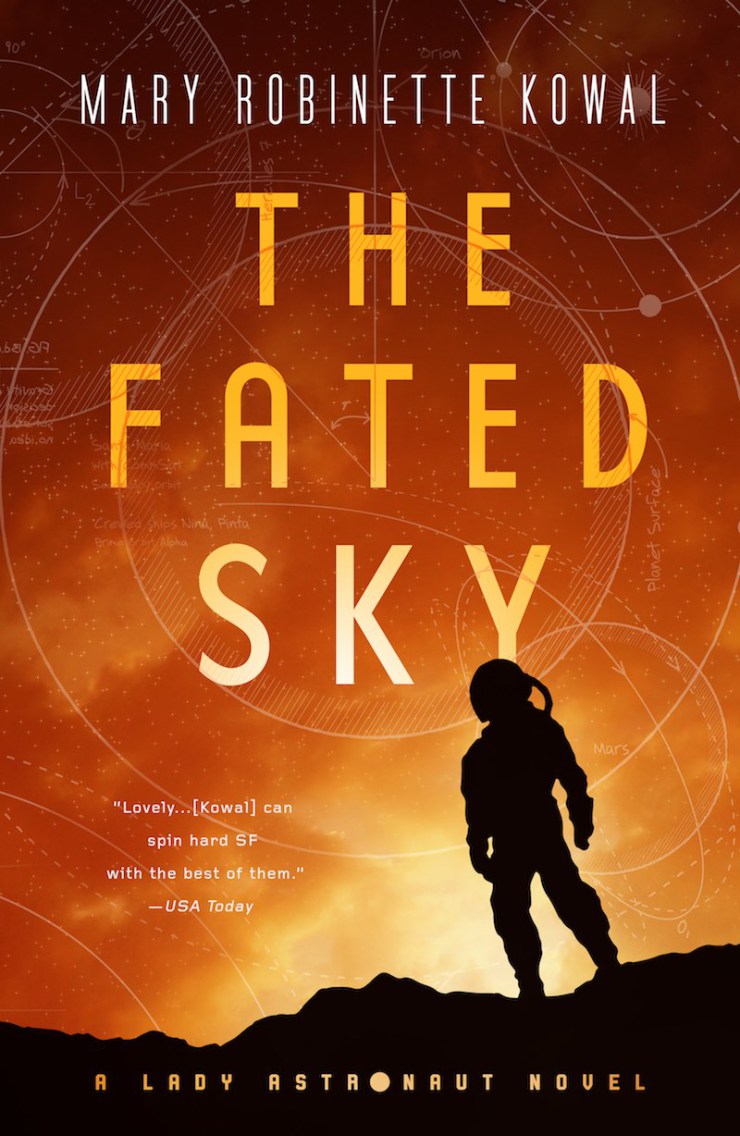
Mary Robinette Kowal continues the grand sweep of alternate history begun in The Calculating Stars, The Fated Sky looks forward to 1961, when mankind is well-established on the moon and looking forward to its next step: journeying to, and eventually colonizing, Mars.
Of course the noted Lady Astronaut Elma York would like to go, but there’s a lot riding on whoever the International Aerospace Coalition decides to send on this historic—but potentially very dangerous—mission? Could Elma really leave behind her husband and the chance to start a family to spend several years traveling to Mars? And with the Civil Rights movement taking hold all over Earth, will the astronaut pool ever be allowed to catch up, and will these brave men and women of all races be treated equitably when they get there? This gripping look at the real conflicts behind a fantastical space race will put a new spin on our visions of what might have been.
Unfortunately for Elma, one of her largest complications from The Calculating Stars, Stetson Parker, is still around and a very prominent member of the space program and is in fact leading the three-year mission to Mars. In the closed confines of a space vessel, the stressors that can sometimes be shrugged off on Earth become more stressful, the racial and gender divide can become more stark. In other words, a kettle of emotions.
The crew of astronauts bicker and fight, but they all have the same goals – get to Mars. There’s a very punchable South African astronaut whose skills and connections put him in his position, but even that exterior “good will” can last only so long in a multi-cultural group of people. Elma is always trying to keep the calm, the peace, and Kowal does this in many ways. Perhaps the most endearing is when it comes to food. Cooking meals is inherently very limited in space, but Elma is such a beacon of warmth and calm that her cooking is a physical manifestation of that warmth. There’s a brief description of doughnuts early in the novel, for example, that illustrates just how important food is and can be. I know I wanted to eat a couple of doughnuts after reading that passage.
The characterization is remarkable throughout. Nathaniel, Elma’s husband, isn’t in the novel as much as he was in The Calculating Stars. This is logical and understandable, Elma spends much of her time in space while Nathaniel is back on Earth. However, their relationship, through their coded letters, is still a highlight and a backbone of who Elma is. As I said in my review of The Calculating Stars, their marriage is probably one of the strongest, most realistic, most loving, and supportive relationships I’ve ever read in any novel.
If the Elma-Nathaniel relationship is all that is good, then the relationship between Stetson Parker and Elma York is a relationship born of enmity. Kowal; however, portrays a great deal of respect between these characters. Through Elma’s actions and words, we see how frustrating it can be to work with somebody who can both gain your respect and ire from one statement to the next. These two characters had to come to a head, especially given their unavoidable physical proximity and their prominence to the world at large on this mission.
Throughout their bickering and especially on the rare occasions where York and Parker found their thoughts aligned, I kept hoping they’d get over themselves enough to come to an understanding. That’s the thing – Parker is on many counts an almost likeable guy. Then he’ll say something that makes you want to punch him. The way Kowal brought this relationship to some natural, if stressful, steps throughout the story was extremely satisfying on an emotional level.
The journey across the Solar System, being “on the ship” to Mars is exciting and frustrating for all the reasons I’ve already highlighted. In addition to the powerful personal emotional movements of the story, Kowal contrasts that so well with what this journey means to humanity. It is hopeful, it is forward-thinking. It is a healthy dose of optimism humanity could use right now.
Sure you can jump into The Fated Sky without having read The Calculating Stars, I suppose. But really, these are two halves of a full story. Given that the short story “The Lady Astronaut of Mars” places Elma’s story well-beyond where The Calculating Stars concluded, there’s definitely more room for stories about Elma and her fictional cohorts. I’m sure I’m in the vast majority of readers of these two books who would welcome more story about “The Lady Astronaut.”
I think many of my fellow reviewers have suggested this, so I’ll just echo it – The Lady Astronaut novels are instant classics and pinnacles of what Science Fiction can and should be.
Highly, highly recommended.
August 2018 | Tor
371 Pages | Trade Paperback
http://maryrobinettekowal.com
Review copy courtesy of the publisher, Tor
Excerpt: https://www.tor.com/2018/07/16/excerpts-the-fated-sky-mary-robinette-kowal/