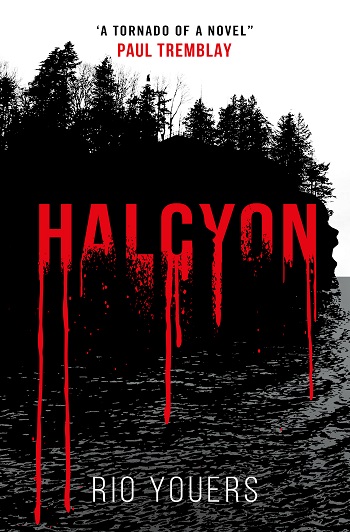
 At SFFWorld we’re pleased to interview Rio Youers. Rio is the British Fantasy Award–nominated author of Old Man Scratch and Point Hollow. His short fiction has been published in many notable anthologies, and his novel, Westlake Soul, was nominated for Canada’s prestigious Sunburst Award. He has been favorably reviewed in such venues as Publishers Weekly, Booklist, and The National Post.
—————————–
Hello, Rio: welcome to SFFWorld. To start with, can you tell us what your latest book, Halcyon, is about?
I remember pitching it to my editor with this tagline: “Better the devil you know …”
Martin Lovegrove is a regular guy, a loving husband and proud father of two daughters. Following a devastating tragedy, he decides to move his family to the remote island community of Halcyon. Just for a couple of months, he thinks—enough time to recalibrate, and distance himself from the grind and turmoil of modern-day living. Halcyon has been sold to him as kind of Utopia, a self-sustaining environment, without clocks, technology (no cell phones on the island), money, or violence.
Everything is fine for the first month or so. Halcyon really is idyllic, and Martin’s two daughters settle in well. But something seems … off. For a start, Martin doesn’t fully trust the island’s founder, Mother Moon. And he’s right not to trust her; Mother Moon is in pursuit of an Eden-like realm called Glam Moon, and she’ll do anything to find it. Her back story is intensely dark, and she harbours many secrets. It’s up to Martin, then, to uncover the sinister truth behind Mother Moon and Halcyon, before it’s too late.
Halcyon is a deep novel. It’s controversial in places, and it pulls no punches. I wanted the novel to reflect present-day America and the anxieties Americans feel. The reception has been fantastic, with excellent reviews right across the board. It was published in the USA by St. Martin’s Press, and Titan Books recently published the paperback in the UK.
Where did you start with the book – characters, setting, or plot?
The setting. Really, all I had at the beginning was present-day America, with its civil unrest, its fear and corruption, juxtaposed with this peaceful, idyllic community—a place to escape. I knew I had a story, I just didn’t know what that story was until I started digging and moving things around within that landscape. The characters came next. I thought it might be just a father and his daughters on a remote island somewhere in the Pacific, but I soon realized that I needed more. So I toyed with a few concepts, added more characters, and the story—the plot, I suppose—started to come together when I had an outline of Mother Moon (she developed as I wrote the novel, and I’d say it took two full drafts before I really understood her). Then it was a question of putting everything together, which wasn’t exactly easy. This was a difficult book to write, but I’m very happy with the way it turned out.
Do you have a favourite character?
No, not a favourite, exactly. I have a certain affinity with Martin Lovegrove, mainly because he’s a forty-something, loving family man with a dad bod. I also had a great time with Calm Dumas, an older psychic lady who says what she means and takes no crap. She was a blast to write. Valerie Kemp, aka Mother Moon, kept me guessing throughout. I found her intriguing and upsetting, but I always looked forward to the chapters where she showed up (and I think the readers will, too). I shouldn’t have a favourite daughter but, you know, I kinda do: Edith Lovegrove. She’s only ten years old, but she always displayed such incredible strength. And I want to mention Alyssa Prince, who Martin meets on the island, and who proves herself in so many ways. (Also, I named her after the musician, Prince, who passed away shortly before I wrote Alyssa’s character into the novel.)
How long have you been thinking that Halcyon would be a novel?
Halcyon concludes a two-book deal with St. Martin’s Press. After delivering The Forgotten Girl (which was book one), I sent my editor several vague pitches for a second book. We went back and forth for a few weeks, then decided on “the island idea.” I developed the pitch (with my editor helpfully chipping in), gave it a title, then started writing.
I first had the idea for Halcyon—or the shape of an idea—four or five years ago, but I didn’t know it would be a novel until deep into the first draft, when I knew for certain that I was going to reach the end.
And what surprised you once you had finished the novel?
Going back to my previous answer: I am always, with every book I write, quietly amazed that I manage to finish at all. I had written outlines for both The Forgotten Girl and Halcyon (I loathe outlines, but big publishers want to know what they’re spending their money on), but I didn’t intend to stick too closely to them. For me, an outline is like throwing a saddle on a wild horse; it may appear tame, but the story will still buck and pull and want to do its own thing. I tend to let it. This writing style is liberating and exhilarating, but it’s also nerve-wracking. You hope like hell it all comes together, but you never know when that horse is going to throw itself off a cliff.
So yeah, with Halcyon, and with every book before it, I was surprised that all of the story elements came together, and that I was able to make the seams disappear. I cantered coolly onto the ranch, not a single drop of sweat on my brow. Or that’s how it appeared. In truth, it had been one hell of a wild ride.
Do you prefer writing novels to short stories, or vice versa?
I don’t have a preference. As long as I’m writing something, being creative, letting the fiction (be it a novel or short story) evolve, I’m happy.
More generally, have you always been a Horror reader? Where did you start?
I read widely, but I don’t actually read that many horror novels. Not anymore. When I was a kid, yeah. Herbert Van Thal edited a long series of horror anthologies published by Pan Books. I devoured those. I also read John Saul, Dean Koontz, James Herbert, Shaun Hutson, Ramsey Campbell, Clive Barker. As a kid—from age eight to sixteen, I’d say—I only used to read horror stories.
Deep into my adulthood, I tend to only read horror novels and stories put out by my friends, and I’m blessed to know some of the best horror writers working today. I’m not going to name them, because I’m bound to forget one or two, but you know who they are. Oh, and I read everything Stephen King puts out, because … you know, it’s Stephen King.
Do you have any favourite books?
Of course. Asking a writer if he or she has any favourite books is like asking a boxer if he’s ever taken a right hook. The answer: yeah, too many.
Some of my recent favourites include The Girls by Emma Cline, The Fighter by Craig Davidson, Beatlebone by Kevin Barry, and Sway by Zachary Lazar.
Some of my all-time favourites include 1984 by George Orwell, Watership Down by Richard Adams, The Catcher in the Rye by J.D. Salinger, The Crosskiller, by Marcel Montecino, and The Stand by Stephen King.
But god, this is such a light list. There are so many more.
And authors?
Everybody mentioned above.
Moral dilemma time! If you had to choose, would you rather have world-wide recognition as an author, selling millions, or, instead, the quieter acclaim of your peers, knowing that whilst you have created a book that may not sell in millions, you have written a book that commands respect?
Well, at the risk of sounding like I’m blowing my own horn, I think I’ve already achieved the latter—at least to some small degree; I wrote a novel called Westlake Soul that certainly earned the acclaim of my peers, and has definitely garnered respect. It was published in 2012, and to this day I still get letters (in the form of emails and Facebook messages) from readers who say how much they love the book, and how deeply it affected them. It’s a unique, soul-punch of a novel, and one I’m desperately proud of.
So yeah, I have the acclaim of my peers. Sure. But I have to say, at this point, a bestseller—and some money, a shitload of money—would be nice.
And where next?
I’ve been focusing on novels, so I haven’t written much in the way of short fiction lately. But I will have a short story out in 2019, in an anthology called Ten-Word Tragedies, edited by Christopher Golden and Tim Lebbon. The whole book is inspired by a Frank Turner song called “Mittens.” It also features stories from Michael Marshall Smith, Delilah S. Dawson, Kelly Braffet, and many other phenomenal authors. PS Publishing is at the helm, and you know they’ll do one hell of a job.
As for novels, I’m currently working on a new thriller called Lola on Fire. I don’t want to say too much (just in case the horse runs off a cliff), but—so far—it’s fast, fun, hi-octane, balls-to-the-wall action. It’s a riot to write.
We’ll keep a lookout for that book out on the shelves soon, fingers crossed!
Thank you, Rio!
Rio’s latest book, Halcyon, is out now from Titan Books.