I’ll admit it – I like future histories.
Sometimes just a quick glance at a list of dates, extending not into the past but into the future, gives me that thrill, makes me want to read more.
What do I find attractive? I’m really not sure what it is – is it (with apologies to Santayana) that the mistakes of the future are shown in the mistakes of the past? The fact that such a timeline offers an infinite variety of possibilities? That it is somehow comforting planning in advance where we are going? The extrapolation of ‘now’ into ‘the future’? The idea of exploration and colonisation, of going forward into the future?
Or is it just the short notes: you know, examples like ‘Rise of the Saurons’ and ‘The Succession War’, that in less than half a dozen words can make me want to read more? The fact that in this fiction there are events which are worth further investigation?
Whatever the reasons, I’ve tried to pick out ten older goodies. In no particular order, then:
- Olaf Stapledon: First and Last Men. One of the 20th centuries earliest (1930) and yet one of the most ambitious, extending millions of years into the future. An admitted influence on a young Arthur C Clarke, as well as Herbert George Wells’ The Shape of Things to Come and today authors such as Stephen Baxter. Sadly, for me, both books, though undeniably influential and full of great ideas, are written in a historical narrative that seems very, very dull, and would make difficult reading for contemporary audiences. But they may be worth a look.

- Robert A Heinlein: The Past through Tomorrow (1967, but a fix-up of stories from 1939-1962.) A more contemporary timeline, with perhaps more influence (in the SF genre at least) than Stapledon. Unusually, the stories here do not tell the history of its universe and how we got here, but are arranged along it. You do not need to know or follow the History to like the stories. Most of these are written in Heinlein’s early years as a writer and as such do not reflect much of the criticisms of his later work. A little dated – some of the wise-cracking dialogue reflects its origins in the 1940’s – but still fairly readable. For me, a regular re-read. See also H. Beam Piper’s Terro-Human Future History stories.
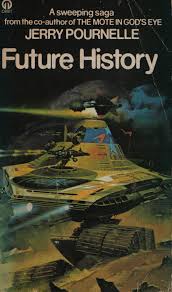 3. Larry Niven & Jerry Pournelle: The Mote in God’s Eye (Co-Dominium series) (1974). See also West of Honour (1976) and The Mercenary (1977) by Pournelle. Nominated for the Hugo and the Nebula awards in 1975 and described by Robert A Heinlein (mentioned above, strangely enough) as “Possibly the finest science-fiction novel I have ever read.” Although an entertaining story in itself, it is also part of the CoDominium future history series (see Future History, left), where many of Niven and Pournelle’s works, both long and short, fit here. See Niven’s Man-Kzin Wars too.
- Cordwainer Smith: The Instrumentality of Mankind. And ‘mental’ pretty much describes these stories – unsettling, strange, alien, stylish – but set, like Stapledon’s, along a far future timeline, to such a point in the future that human-form is no longer recognisable. Startling, confusing at first, but memorable. Not for everyone, but the stories have their own stalwart fans
- Poul Anderson: Terra / Technic History. Possibly like Heinlein’s History, a libertarian future (ie: according to Wikipedia, “a family of related political philosophies based on strong support for individual liberty, which Libertarians encourage mainly through private property ownership and guaranteed personal sovereignty”.) Here Humans spread through the galaxy and follow individual life-plans, mainly spearheaded by individuals from industry. Characters such as Nicholas van Rijn, following a trading/piratical course similar to the Dutch Renaissance of the 17th century, or Dominic Flandry, a James Bond type figure in the Terran Empire,
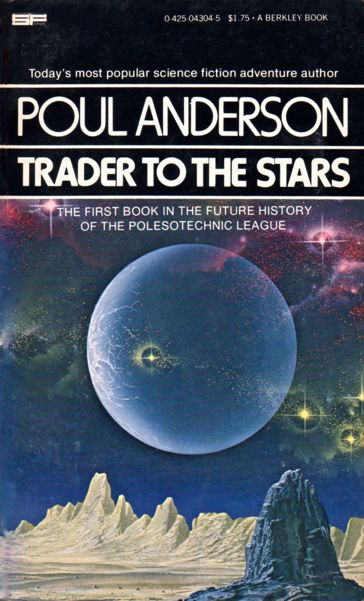 lead the way forward in progress both commercially and geographically. (A theme also shown in Ben Bova’s Privateers) The Earth Book of Stormgate (1978) though not including lots of van Rijn tales, is an intriguing collection of stories that also fits into this timeline. Good fun, easy to read, not to be taken too seriously.
- CJ Cherryh: Best shown in the Alliance/Union series, with Downbelow Station (1981) and Cyteen (1988) being my favourites. Could perhaps be extended to her Dying Earth stories, in Sunfall (1988), and the Collected Short Stories of CJ Cherryh (2004) which tell of life on a future decayed Earth. Speaking of which,
- Jack Vance:Tales of the Dying Earth (fixup collection, 2000, based on short stories and novels written 1950 – 1984.) Here however we stray into SF as Fantasy. The emphasis here is not on technology, a progress of evolution, but decline and deterioration. Lyrical – for some, too much so – but undeniably influential.
- Stephen Baxter: Xeelee Sequence (1991 – present) A series that embodies Stapledonian scales of time and space (from 476 AD to 5 000 000 AD). There are more than seven novels and over fifty short stories and novellas that tell the long tale of humanity’s expansion into space.
When there, humans encounter the enigmatic and powerful Xeelee, and an impressive range of alien species – dark matter entities called Photino Birds, who are at war with the Xeelee, the Squeem (a species of group mind aquatics), the Qax (beings whose biology is based on the complex interactions of convection cells), and the Silver Ghosts (symbiotic organisms encased in reflective shells). Several stories in the Sequence also deal with humans and posthumans living in extreme conditions, such as at the heart of a neutron star (Flux), in a separate universe with considerably stronger gravity (Raft), and within eusocial hive societies (Coalescent). Dealing with hard science and cutting-edge SF-nal ideas, this is perhaps Baxter’s most ambitious Space Opera series to date.
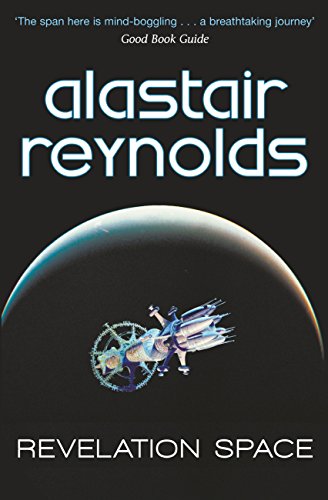 Alastair Reynolds: Revelation Space series (2000 – present) A contemporary of Baxter, similar in scale, if not in style. The Revelation Spaceseries includes five novels, two novellas, and eight short stories to date set over a span of several centuries, spanning approximately 2200 to 40 000, although the novels are all set in a 300-year period spanning from 2427 to 2727. The trilogy consisting of Revelation Space, Redemption Ark and Absolution Gap deal with a war between Humans and an inorganic alien race referred to by its victims as the Inhibitors, which exterminates sentient races if they proceed above a certain level of technology.
- Ursula K Le Guin’s Hainish Cycle (1964- 2002) A loosely connected series of stories and novels, starting with Dowry of the Angyar (1964), a story that became part of the Prologue of Rocannon’s World (1966). Though much of this is early LeGuin writing, it is always thoughtful and considered. In places the series may read as Fantasy, but that belies a history that involves genetic engineering, instantaneous communication through ‘the ansible’ and ambisexuality such as that through Ursula’s most famous novel, The Left Hand of Darkness (1969). It’s nice to see LeGuin’s early work have a resurgence at the moment – well deserved.
So here are some. There are others, of course (Kim Stanley Robinson’s Mars series, for example?) Feel free to suggest your own personal favourites!