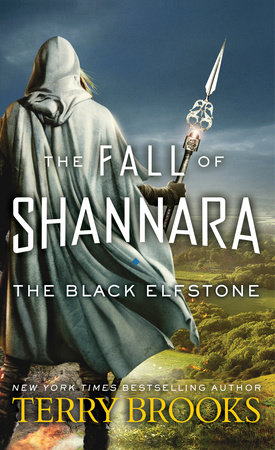
 After forty years or so of being published and having over thirty books published about Shannara, The Black Elfstone is the beginning of the end for Terry Brooks’ famous series. With Terry in his seventies, he’s decided that he will finish the series properly himself rather than have someone else do it for him.
And whilst the last quartet is set long after the first and most famous book of the lot, The Sword of Shannara, it’s not a bad place to start.
Honesty time – it’s been a little while since I’ve read a Shannara book. To be fair, it doesn’t matter too much – each set of books in the series tells enough to allow new readers to follow without difficulty – but I was wondering how things were going, and perhaps how things would end. The Black Elfstone is the first of a four-volume series to bring things to a close and is widely described as ‘the last’, although Terry may still go back and fill in occasional details afterwards.
My first thought is that how things have changed. Where the initial books were lighter in tone and style and these days would perhaps be regarded as more Young Adult, 400 years on from Shea Ohmsford and the events of The Sword of Shannara we have events happening on a much bigger scale. The Four Lands are in division geographically and politically. At Paranor, the city that is the centre for the magical Druids, their leader Drisker Arc has been replaced in a power struggle by Ober Balronen, an Ard Rhys who, unlike Drisker, seems to have surrounded himself with subservient lackeys and who seems to run the Druid’s Keep with secrets and paranoid subterfuge.
A number of events happen early in the book. The appearance of a new threat, a strange ghostly army on the borders of Paranor leads to Dar Leah, the Blade of the High Druid, being made surplus to requirements after a mission gone wrong against this new adversary.
A secondary plot involves Tarsha Kaynin and her brother Tavo in the village of Backing Fell. Tavo, who is clearly ill, is sent by their parents to live with his uncle. As she grows up, Tarsha, who has magic powers through the Wishsong, realises that to help her brother she must learn to use her magic effectively and so leaves Backing Fell to seek out Drisker, to ask him to be a mentor and so help her brother.
However, having stepped away from the politics and responsibility of the continuously squalling Druids and being content to live a simpler life in Emberen, Drusker is reluctant to do it all again, so to speak. He also has other pressing matters in that after years of living in seclusion, Drisker finds himself attacked not just once but twice by mystery assailants. When he eventually discovers that the attackers are part of an assassin’s guild, he has to travel to Varfleet to find out who they are being paid by and why.
All of these disparate plot threads eventually combine to a purpose, and this has consequences. The focus appears to be on the Black Elfstone, kept in the vaults of the Druid’s Keep in Paranor, which is where our characters end up at the end of the novel.
What impresses me most is how well this all fits together. Terry manages that skill of concentrating on telling a story that can be read by anyone, even someone new to Shannara. It involves all of the usual tropes of friendship, loyalty, responsibility and honour, but the characters are more than simple caricatures. I was surprised at how nuanced some of them were. In particular, Tavo is a complex personality that you feel both sympathy and horror for. There are things here that are quite violent and even nasty. We’ve come a long way since The Sword of Shannara.
To tell a dark tale means that the tone is often quite bleak. The end of the novel has a major event that threatens the entire world and puts our likeable protagonists in serious danger. Things are clearly changed forever through a combination of betrayal, poor decisions, indolent leadership, a lack of guidance and narrow vision, which the mysterious enemies take advantage of. The story ends with the reader not knowing who the antagonists are or why they need the Black Elfstone kept in Paramor. This, of course, means that the reader wants to pick up the next book quickly to read further. It is a tale only partly told, and you may find that you want to read further.
The Black Elfstone is the work of an author who knows what a story has to do and has the ability to tell it. It uses genre tropes to create a story that a reader wants to read, and like all good books, it draws the reader in, keeps their attention and leaves them wanting more. I look forward to reading the next in this series.
The Black Elfstone by Terry Brooks
Book 1 of The Fall of Shannara series
Published by Orbit, June 2017
ISBN: 978-0356510149
336 pages