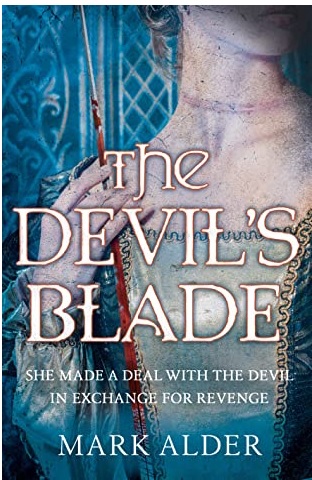
 So: The Devil’s Blade is a story that builds on traditional tropes – it’s a revenge story – but combines reality with decidedly fictional elements.
Our lead character, Julie D’Aubigny, was a real person, whose antics in 17th century France were well known at the time. By most accounts she was a multi-talented polymath who could sing, sword-fight and, if that wasn’t exhausting enough, had a variety of lovers of both sexes. In short, a bisexual, duelling, feminist opera singer seems like someone that if you made up would seem too ridiculous, but I guess that sometimes truth is as strange as fiction.
With such a variety of talents, this suggests a character ripe for an adventure story that the author clearly takes advantage of. Mind you, where Mark takes her, I suspect, is not entirely true. The Devil’s Blade begins with a young Julie, a promising young singer, heading to a meeting with gentlemen of influence who can hopefully gain her access to the levels of society currently blocked to her. This is, however, a ruse, as the men are really a group known as The Tredecim, who actually wish to sacrifice her to the Devil for their own uses. Julie is attacked and left for dead, her throat is ruined and her lover killed, so she seeks revenge on the thirteen men who wronged her – by making a deal with the Devil, no less. Welcoming the chance to gain more souls in Hell, he/she/it agrees to give Julie about a year on which to wreak her revenge on the men. If she fails, of course, her soul is his.
The rest of the book follows Julie as she attempts to reach her goal. In a plot reminiscent of Arya Stark’s kill list, Julie begins to dispose of her victims, making sure that they renounce God before dispatching them. After each death, the Devil appears to take the recently deceased soul off to Hell and gives Julie the chance to have one duelling lesson before setting off towards the next victim.
Although her voice is ruined, working behind the scenes in the Paris Opera gives Julie the means of making connections beyond her station in French society and allows her to travel in order to catch up with her intended targets. She also begins a scandalous affair with Charlotte-Marie de la Porte Mazarin de la Meilleraye, one of the aristocracy. This all leads to a big showdown at the end between Julie, the last of her quarry and the Devil himself determined to make good on their deal.
It all reads as an enormous romp, a sort’ve female version of Faust or Daniel Webster meets The Scarlet Pimpernel, which makes it great fun. Julie is a fascinating character whose lack of manners and diplomacy cut through the decorum of French society whilst her duelling skills cut through her victims rather messily. The Devil is both charming and monstrous, mercurial in his/her/its manner, which reminded me a little of the part played by Tom Ellis in the Lucifer television series.
Having said that, some, but not all, readers will appreciate the frankness of the novel’s use of florid expletives, for example:
“ “If you think you can bargain your way out of this by offering your twat…” he says. She kicks him so hard in between the legs that it’s amazing his bollocks don’t pop out of his eyes.” (Page 96)
The book seems determined to be outrageous in both the actions of the characters and what they say, tapping firmly into that Grimdark style, even if at times they sound more contemporary than what I would expect from 17th century France. It is even quite amusing at the variety of ways the characters manage to use expletives towards each other, but I must say that by the end of the novel I felt that the constant badinage actually dulled the language’s impact.
More worryingly, my biggest niggle is that throughout there was the impression that the author feels the need to make points over and over, again and again. One example is the amount of shit France seems to have and to emphasise the point how much Julie and her fellow players seem to roll around in it – the streets of Paris are shitty, the carriages are covered in it, Julie seems to spent most of her time walking through it, fighting in it, even rolling in it. I got the point, but it is a point that is repeatedly made, when really once or twice would have been sufficient. The point is made, but then overdone. Like the swearing, there are times that its constant repetitive use becomes wearying.
The ending seems a little forced, as Julie has to fight a final duel in-between performing acts in an opera, which stretched the credulity a little. Disappointingly, the ending of the book leaves things open for sequels. This would, in my opinion, have been better for being a stand-alone tale, but I realise that future prospective sales may determine otherwise.
Despite all of this, I enjoyed The Devil’s Blade. It’s an impressive step-up of talent that certain readers will like. The setting of 17th century France made a nice change from the usual medieval-esque settings of Fantasy. It is dark, very violent, very sweary but at the same time quite good fun. Although there are moments of the “one bound and she was free” stuff going on here, and the author does overdo matters on occasion – some of the presumably intentional moments of farce didn’t really work for me, for example – this one was a good read.
The Devil’s Blade by Mark Alder
Published by Gollancz, April 2020
ISBN: 978-0575129726
384 pages
Review by Mark Yon