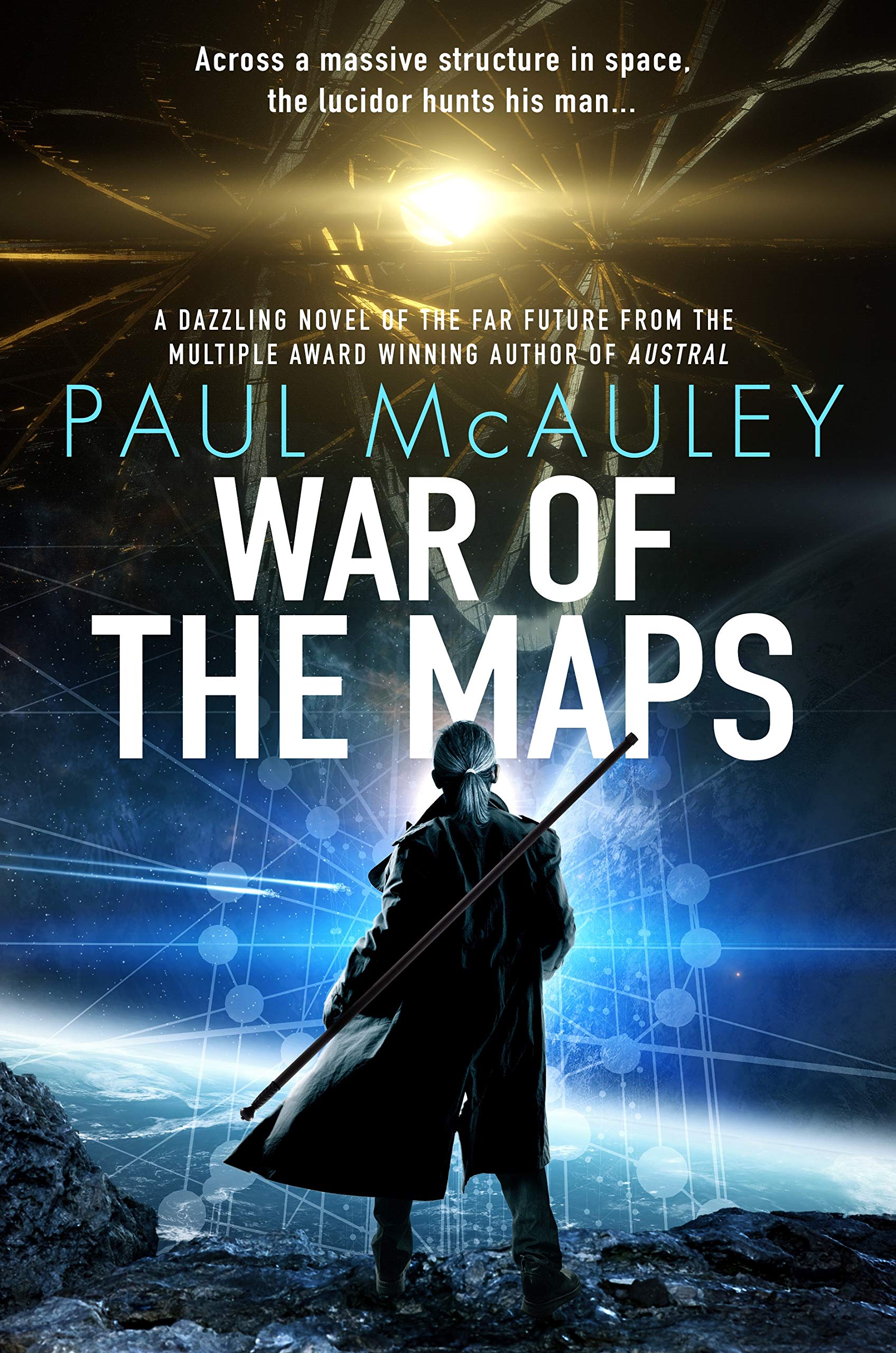
 At its most basic level the War of the Maps is a revenge tale, a story of a bad guy used by the good guys to get rid of problems. We begin with something like a science-fictional version of Stephen King’s The Gunslinger – a lone man on a horse travelling across a landscape. Thorn is a lucidor – a retired policeman on a mission. As he travels amongst the Maps looking for his quarry, we discover how he got to be a lucidor and the purpose of his quest.
Much of the novel is used to describe what this world the man is travelling through is like. There are a variety of landscapes – mountains and marshlands, industrial cities and medieval-esque markets. Initially the novel seems very much like the landscape and society of the Old American Wild West, or even Joss Whedon’s Firefly, surrounded by oceans.
Details of such environments are drip-fed through the novel as we go and we realise that in actuality this world is science-fictional. The bright sunlight beating down on our lead character is actually from mirrors above the planet. The world is really enveloped by the light of an artificial sun, and the Maps are actually places on this planet living as little kingdoms separated by vast seas generally having little to do with each other, apart from the odd skirmish or foray into each other’s different societies.
However, most of this is incidental. The main plot point is that Thorn is a man on a mission – he is hunting for the unusually named “Remfrey He”, a criminal who, for reasons that will become clearer over the course of the novel, has been set free but, due to complex politics, seems to still owes society for an atrocity he instigated. Our character, a retired lawman, is determined to make him pay.
To this aim we follow Thorn as he moves across desert to avoid assassins, helps a group of miners overthrow their slave masters, crosses seas, defends a wagon train as it travels across mountains and sails on a boat to rescue a group who may have the answer to an ongoing global issue.
The bigger picture is that Remfrey He (referred to with his full name throughout the novel) may be responsible for something that seems to disassemble genetics and recreate plants and animals into something new. A red weed seems to change women into ‘alter females’, a strange creature that seemingly loses most of its human characteristics and attacks humans. Remfrey He may have the solution to their mysterious origins – are they part of a new species designed to wipe out humans or are they a genuine adaptive response? As Thorn gets nearer to his quarry, things become stranger and we step into Jeff Vandermeer territory.
Around all of this there are also god-like intelligences that may be playing a bigger, more convoluted game, a situation made more complicated by the fact that Thorn seems to connect with one. All of this leads to a big conclusion.
War of the Maps starts slowly. Not all readers will like its languid pace, as it takes until after halfway in the novel before the lucidor’s planetary meandering begins to make sense. There is an element of ‘ignore the plot, feel the environment’ in the first half. Paul likes to describe the landscape and, as well done as it is, it can slow things down to a point where some readers may become frustrated. I did enjoy it myself.
But here’s the rub. Despite getting Thorn’s backstory drip-fed through the book, and an understanding of who he is and how he got to this, this character’s downbeat, emotionless default setting left me rather cold. At no point did I really feel emotionally connected to Thorn, the other characters he meets or their world. Instead, I read it in a rather detached, observatory manner. At times this dour mood and lack of emotion made the book, for all of its clever and detailed writing, a bit of a slog that I struggled to continue reading.
But as the plot’s bigger mysteries are resolved towards the end, the full impact of the tale becomes clear, a story that at its heart is science-fictional despite all the trappings that initially suggests that it is not.
In the end, War of the Maps for me is a conundrum – a well written, clever novel, but one which I admired rather than totally loved. It is not a disappointment – far from it – but at the same time I could not wholeheartedly recommend it.
War of the Maps by Paul McAuley
Published by Gollancz March 2020.
ISBN: 978-1473217355
432 pages
Review by Mark Yon