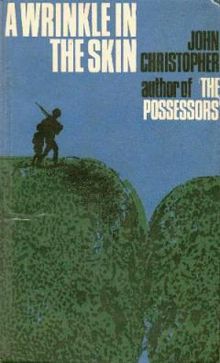
 So, this was one that came up in a discussion of post-apocalyptic novels in the Forums. Although it is not one based on viral pandemics, it does follow that similar idea of global catastrophe causing change, as did John’s other, perhaps more famous novel, The Death of Grass, reviewed here in 2009.
A Wrinkle in the Skin starts like something out of a middle-class John Wyndham novel. Matthew Cotter is a tomato grower in the balmy climate that exists on the island of Guernsey. In the first few chapters we meet divorcee Matthew who seems to be living a very pleasant life and his lovely neighbours who also appear to live in a peaceful rural landscape without too much grief or fuss.
Once all this is set up of course we then get the catastrophe. There is a major earthquake which flattens Matthew’s village into rubble. We later discover that this is one of what appears to be global earthquakes. This one is so extreme that the English Channel, the body of water separating the islands of Guernsey from the mainland of Britain, is drained.
In the next few chapters Matthew finds himself forlornly looking for other survivors. All of the buildings have been destroyed and Christopher doesn’t spare us the gruesome details of bodies in the rubble. To a readership a mere twenty years after the horrors of World War II this must bring back some dreadful memories.
After a few days Matthew finds Billy, a young boy now orphaned, and together they travel looking for other survivors and food. Unfortunately, Billy and Matthew do not meet many who are friendly. One group led by a thug named Miller has effectively reverted to slavery, with young women being kept for housework and future breeding purposes. However, Miller realises that Matthew is an educated man and sees Matthew as a viable Deputy to himself in order to survive as a group. Matthew goes along with him, but secretly is biding his time to escape. He hopes to go find Jenny, his teenage daughter living in Sussex. Eventually Matthew slips away only to find that Billy has followed him. Together they decide to walk along the now dry seabed of the English Channel to get to the mainland.
The story could go in two directions. We could have the epic sweep of descriptions around the world to show that this is a global phenomenon – for if it wasn’t, where are the aid workers from other countries? Instead the story focuses on Matthew and Billy, which makes the events seem both more personal and more understandable. They soon realise that even on the mainland there is no chance of assistance. Towns are also reduced to rubble. There are no radio messages, no aeroplanes seen – everywhere is reduced to its basics. Parts of the coast have collapsed into the sea.
However, this is not the main focus of the story. Instead we experience what is happening around Matthew and Billy. On their travels they meet other people but most of them are in shock and avoiding others, as gangs of scavengers travel around attacking other groups and stealing their food and resources. The world seems to have reverted back to barbarism, something that Christopher doesn’t flinch from describing. There is brutality, child abuse and rape. Some of the most harrowing scenes are when one of the women tells of her experiences in the hands of other men in a matter-of-fact manner.
Others deal with the stress of the situation oddly, and Christopher does well to describe some of the characters clearly in shock. Matthew and Billy meet a survivor on board a ship now stranded on the dry seabed of the English Channel. The captain is friendly and gives the travellers food, a bed to sleep in and clothes, but we later discover is a person coping with the calamity by trying to control things on the ship to an unhealthy degree. There are religious zealots ranting on the devastated streets.
In the end there is a solution, but it is one born more of resignation rather than positivity. The ending has a degree of optimism but there are some quite dark moments to get through before that.
A Wrinkle in the Skin shows us the fragility of British society – or at least society in the 1960s – and how quickly people can be reduced to their basest instincts once difficulties arise. There is no Dunkirk spirit here, no “We’re in it together” moments or sacrifice for the greater good as you might expect in, say, a John Wyndham version of the story. Instead it is a ferocious description of the survival of the strongest, something which the author does not shy away from. Even 55 years after its publication, the book can shock. When it was first published it must have been even more so.
In short, the book is an interesting and perhaps more realistic take than many novels on the consequences of global disaster. It is a story of a more innocent and less sophisticated time, but simultaneously a reminder that people survive with resilience and endurance, not long having experienced the horrors of the Blitz, Dresden and Auschwitz. It is at times harsh and brutal, and a product of its time, but still manages to engage, even if it is a case of what would have happened fifty-odd years ago.
Like most of the Christopher novels I have read, this one engages and keeps those pages turning, but also doesn’t flinch from describing brutality and horror. A Wrinkle in the Skin is a sobering reminder that global catastrophe, whatever we may think, is not a recent phenomenon. It made me feel lucky for the things I have and the relationships I’ve got, even in these difficult times, and for that alone it was worth a read.
A Wrinkle in the Skin by John Christopher
First published 1965 by Hodder and Stoughton
220 pages
Review by Mark Yon