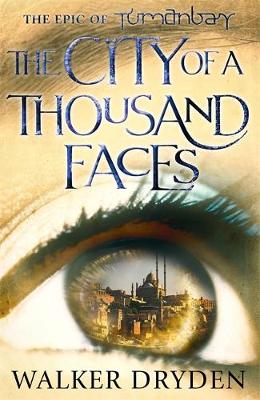
 If I said to you the words ‘Arabian Nights’ what images does that conjure up to you? If, like me, you are thinking desert sands, minarets, casbahs, sultans, Sinbad, or even Aladdin, then this may be one for you.
The background to this story is a little complicated. Walker Dryden is actually the pseudonym of two writers, John Scott Dryden and Mike Walker. They are both award winning writers and have written plays for radio and audio in the past. The City of A Thousand Faces was written originally for radio – in this case a series of four podcast series (to date) for BBC Radio 4.
The City of A Thousand Faces is set in the imaginary city of Tumanbay, ‘the greatest city in the world’, and perhaps the biggest (which rather makes me think that the title should be The City of More than a Thousand Faces…). The city is set in a place surrounded by desert and has the feel of ancient Istanbul or perhaps more like the city’s precious incarnation of Constantinople.
The story builds slowly by showing the reader the city from a number of different character’s perspectives. Each of the short 100 chapters is written from their perspectives. Gregor is the Master of the Palace Guards whose job is to find spies and traitors to the Sultan al-Ghuri, of which there are many, as well as work around the obsequious aide Grand Vizier Cadali. Away from the walls of Tumanbay there is a rebellion rising in Amber Province, and Gregor’s ‘brother’, General Qulan, as the Commander of Tumanbay’s armies, is tasked with bringing things to order by taking an army to kill the attempted usurper – Maya, the widow of a district Governor.
Back in the city, Shajah, the First Wife of the Sultan, is also up to manipulating the social side of things around the Sultan and secure her position of power, whilst the Sultan himself spends much of his time creating perfumes. There’s also Madu, the young son of the First Wife and the previous Sultan, who is approaching manhood. Shajah’s new maid, Sarah, and Daniel, Sarah’s brother, seem to be different to most of the slaves they see but may be involved in events more than Shajah realises. Sarah’s baby is being looked after by Ibn Bai, the slave trader who bought Sarah and her brother before selling them on to the royal household.
With such a varied group of characters the plot involves politics, sex, revenge, betrayal, war and even plague, which the consequences of have to dealt with by the key characters. It is perhaps less Aladdin and more Game of Thrones. It is undeniably traditional in its depiction of a male-dominated society, although the actions of Shajah make you realise that there is more to the society than you might realise. There is also slavery, the essence of many an old-style adventure story, but which keeps the society of Tumanbay functioning, as it did Ancient Greece and Rome.
To be fair, it’s not entirely original, but I guess that is not the point. The City of A Thousand Faces celebrates those old stories of derring-do, combining adventure with political intrigue and the inevitable jockeying of position for power. It reminded me of Howard Andrew Jones’s The Desert of Souls, Throne of the Crescent Moon by Saladin Ahmed or, more recently, Bradley Beaulieu’s Twelve Kings (in Sharakhai) in style and tone, evoking images of an ancient desert city with its markets and housing, albeit with the addition of caves and dungeons.
The City of A Thousand Faces is a story written for modern readers with the enthusiasm and verve of the traditional tales of Harold Lamb (an oldie but a goodie – look him up.) This is a pure adventure tale – although there are dreams and prophecies, there’s none of the occult mysticism that we would find in say Weird Tales or a Robert E Howard tale which would cover similar ground.
In terms of setting, whilst the place is clearly Arabesque, the story is rather timeless. It could be set 200 years ago or 2000, which I guess is part of its enduring charm. But it also helps that the characters here are solid, the world-building great and it’s the kind of book that cleverly drags you in until you have to keep reading. It is perhaps not a surprise that one of the writers is also a scriptwriter – there’s a filmic quality to what is here that makes me think of those old and not so old tales like Spartacus or Gladiator. It’s a story told with confidence.
If I was to quibble, I would say that the city of Tumanbay, though a very effective setting, is not as prominent as I would expect it to be in a book with the title this one has. Admittedly, there are glimpses of different areas of and around the city – both above and below ground – but I felt that the focus is more on the characters and their exploits than their locale.
Tumanbay is not as varied nor as well defined as, say, Scott Lynch’s Camorr in The Lies of Locke Lamora, where the different styles, locales and place-names made the city as much a part of the essential plot as the people within. In The City of a Thousand Faces Tumanbay serves a purpose – more generic perhaps, and actually perhaps more enigmatic as a result – but it is not as strong an element of the book as the title made me expect it would be.
Nevertheless, I really enjoyed this as a superior story of adventure and politics that will keep you entertained. The ending is one of those that will make you want to read more – and be annoyed that you have to wait for the next book. (There is an enticing extract at the end of the hardback edition.)
The City of A Thousand Faces by Walker Dryden
Published by Orion Fiction, May 2020
560 pages
ISBN: 9781409187042
Review by Mark Yon