This is the latest in an occasional series where I reread old books from an old favourite, Arthur C Clarke (1917 – 2008).
In terms of Clarke’s fiction writing, Imperial Earth was originally published after Rendezvous with Rama (1973, and reviewed HERE) and before The Fountains of Paradise (1979, reviewed HERE.) It is at the point where Clarke’s fiction output was noticeably slowing down, as time was taken in other pursuits – a permanent move to Sri Lanka took up most of his time:
“I am now leading a very quiet life—doing a lot of reading, playing with Hal Jr. [his computer]—hardly going out except for two hours of hectic table-tennis every day at the local club. I can now beat (almost) everybody in sight.” McAleer, Neil. Sir Arthur C. Clarke: Odyssey of a Visionary: The Biography.
Clarke was now in his sixties and his interest in writing fiction appears to be dwindling, something Clarke himself felt when he finished writing Rendezvous with Rama, published in 1973. It is noticeable that Clarke’s next book was a mainly non-fictional collection of essays in The View from Sirendip in 1977.
His media exposure for 2001: A Space Odyssey and the 1969 Moon landing had led to the emergence of Arthur in other roles. There was Arthur C Clarke television science expert, reporting on the Apollo 12 & 15 Moon landings for US television, which would eventually lead to Arthur C Clarke as programme presenter (his UK television series Arthur C Clarke’s Mysterious World was in development, for eventual transmission in 1979- 80). His importance as a commentator on matters such as global communications were in demand and led to Clarke travelling all over the world until he had built the country’s first satellite dish in his new home in Sri Lanka.
“I am now taking things very easy” he wrote to Tom Craven in April (1975), “basking in the warm afterglow of completing Imperial Earth.” McAleer, Neil. Sir Arthur C. Clarke: Odyssey of a Visionary: The Biography.
The plot is fairly straightforward. In Imperial Earth Clarke begins his tale on the strange environment of Saturn’s moon, Titan. We find out about the influential Makenzie family and their existence there for the first quarter of the book. In particular, the book is concerned with young Duncan Makenzie, who is given the chance to travel from his home planet to Earth in order to give a speech in a United States of America during its quincentennial celebrations of 2276. Duncan’s visit to Earth also has a second purpose in that at the same time Duncan can instigate the process for creating via cloning the next Makenzie generation to bring back to Titan.
Since I first read this one back in the late 1970s to early 1980’s Imperial Earth has been one I’ve least been tempted to reread. I’m not really sure why, because the book has many of the hallmarks of a Clarke novel. At first glance, the basic plot is a travelogue, an idea that Clarke first thought of in the 1950s and has finally brought to completion, by adding in many of the now-traditional Clarke elements in its story. In the tradition of the European ‘Grand Tours’ of the 17th – 19th century, it combines the chance for Duncan to experience different places and cultures and gain further education by doing so. This is something that is usually exciting for science fiction readers – I remember that this was the main reason for me picking this particular book to read in 1978 or so.
Moreover, and as ever with most of Clarke’s book, Imperial Earth is optimistic. It is a book meant to celebrate the coming together of humans for a greater good. It is no coincidence that whilst on Earth Duncan addresses the US Conference in 2276 – something similar to what Clarke himself will do when he appears before the US House of Representatives Committee on Space Science and Applications in July 1974 – nor is it by accident that the book was published in the US in 1976, just in time for the US Bicentennial celebrations. Although the speech given by Duncan is appropriately diplomatic, it is not that much of a leap to consider that it is also an effective summary of Clarke’s own ideas about the future of space exploration – namely that we should be looking forward, not always backwards into history.
Written at a time when Clarke was deliberately winding things down a little, you could be mistaken into believing that Imperial Earth was Clarke ‘phoning it in’. However, It’s not a workman-like piece of prose. Clarke himself was very pleased with what he wrote, seemingly writing with enthusiasm and with acclaim from both his UK and US publishers.
In Clarke’s letter to Tom Craven in April 1975 Clarke writes about Imperial Earth that “Both U.K. and U.S. publishers are delighted with it and I am pretty sure it’s the best thing I have ever done.” McAleer, Neil. Sir Arthur C. Clarke: Odyssey of a Visionary: The Biography.
I can see why Clarke was pleased with the book. There are strange natural events on Titan, quirky Mathematical enthusiasms, mentions of radical science such as ion drives and cloning and that travelogue aspect as Duncan leaves Titan and eventually gets to Earth, seeing the planet with an outsider’s pair of eyes. Such detached commentary is what Clarke does best. There’s even typical Clarke humour, as shown by the description of Duncan’s attempts to get to sleep on his first night aboard the spaceliner Sirius.
I’ve already mentioned the love of Mathematical ideas which have always been an element of Clarke’s writing. In Imperial Earth there’s a lengthy (well, lengthy for Clarke) description of pentaminoes, an element tenuously connected to the story here as they are a gift given to Malcolm by his elderly grandmother before leaving Titan. Malcolm sees the task set – to put the pieces into a shape with millions of possibilities – as a major challenge. There’s even a picture of one variation of the pentaminoes at the beginning of both editions of the book.
The gleeful description of the challenge and the attempts to solve the task reminded me of Clarke’s later books where he would run with other ideas that takes Clarke’s fancy – there is a similar description of the Mandelbrot sequence in The Ghost from the Grand Banks (1990, reviewed here) and the infamous ‘unsolvable’ Fermat’s mathematical equation is important to the plot of The Last Theorem (the last novel written by Clarke and cowritten with Frederik Pohl, published in 2008 after Clarke’s death), for example. This concept shows the author still fascinated by science and mathematics, but from Imperial Earth they begin to take greater importance.
Clarke’s interest in gadgetry is also present here in the often-used form of the hand-held MiniSec, which today we would now recognise as a mobile phone or tablet. It was quite amusing to read some detailed explanation from 1974 of how this would be used when in 2020 even toddlers use them. I think Clarke would be very pleased with this development by 2020, even when some of his other ‘predictions’ seem way off the mark. With even more prescience, the US edition warns of the perils of what we would now call social media, as it is recounted with some amusement that Duncan received a lot of explicit ‘requests’ on his MiniSec when in New York.
In fact, Imperial Earth seems to be in some ways a collective summary of Clarke’s interests and concepts at that time. There’s a very brief mention of a space elevator, to be expanded upon in The Fountains of Paradise (1979), the raising of the Titanic to be used as a museum piece, developed further in The Ghost from the Grand Banks (1990) – there’s even a chapter here with that title! – as well as Clarke’s love of the oceans, originally given in detail in The Deep Range (1957) and Dolphin Island (1963), and mention of Rudyard Kipling, a nod to the imperial British Empire that Clarke will revisit again in his Time Odyssey collaborations with Stephen Baxter (2003 – 2007). It is almost as if the book is a summary and cumulation of his work to this point, a last hurrah before retirement.
Rereading the book over forty years on, I actually think that Imperial Earth is not a fall back to old interests, but instead a determination to push for changes in Clarke’s writing, to push the boundaries, albeit in Clarke’s usual modest, quiet way. There are subtle changes here that you may miss unless playing close attention.
Other changes suggest a pushing of the boundaries elsewhere in the novel. It is no coincidence that Duncan Mackenzie is a person of colour, nor that the US President in Imperial Earth is a woman.
There’s a brief mention of zero-gravity sex, wryly observed by Clarke with the arrival on Titan of a space-cruiseship full of 500 young teenagers. There’s a homosexual relationship between Duncan and his friend Karl Helmer, a situation complicated by the arrival of attractive and young space-cruiseship-girl Calindy which enables the three of them to discreetly engage in an open relationship before Calindy returns to Earth. As a result of this, Karl has a psychological breakdown (which has consequences in this book), goes off to explore and Duncan finally settles down with Mirissa.
Hang on – Homosexuality? Threesomes? Multiple-participant orgies? Polyamorous relationships? Whilst it’s hardly the stuff of ‘bonkathon’ books or even Robert A Heinlein material (see I Will Fear No Evil, published in 1970 for comparison), it is perhaps an attempt by Clarke to take on board the free-wheeling free love of the 1970’s, or even an author determined to be more mature and less candid about such matters. It is to me a much better book than Heinlein’s.
In a Playboy Interview in June 1986, when interviewer Ken Kelley asked Clarke about Imperial Earth, which “…some U.S. school boards had banned because of references to the protagonist’s homosexual experiences—although when Kelley used the word lover, Clarke thought the word too strong. “They’d just mucked around as boys,” he insisted. “I guess I get more and more daring as I grow older,” Clarke added. Pressed to elaborate, he replied, “I guess I just don’t give a damn anymore…. Maybe that isn’t true, actually. One of my problems now is that I’m not just a private citizen anymore. I have to keep up certain standards, or at least pretend to, so that I don’t shock too many people.” McAleer, Neil. Sir Arthur C. Clarke: Odyssey of a Visionary: The Biography.
And yet, for all of its ‘shocking’ nature and its determination to stretch the author’s writing, Imperial Earth still feels like a bit of a disappointment. Whilst successful in terms of sales, it did not generate the sort of plaudits Clarke had hoped for. It is telling that it is barely mentioned in his official biography. Writing in 1978 to fellow author Sam Youd (aka John Christopher) in 1979, Clarke said in a letter:
“I had thought that Imperial Earth would be the big one… but it turned out that The Fountains of Paradise was the book, and the one I’ll be remembered by, if at all.” McAleer, Neil. Sir Arthur C. Clarke: Odyssey of a Visionary: The Biography.
Was it the shocking nature of the book? Unlikely, in my opinion. The references are generally subtle that my teenage-reader-self totally missed or forgot the references when I first read it at 14 or so. And sales were good, at least initially.
I must admit that I was disappointed by the limited number of places Duncan visits – no Mars, for example, though there is colonisation there. Many of the Earth’s cities (Paris, London) are seen virtually rather than in reality.
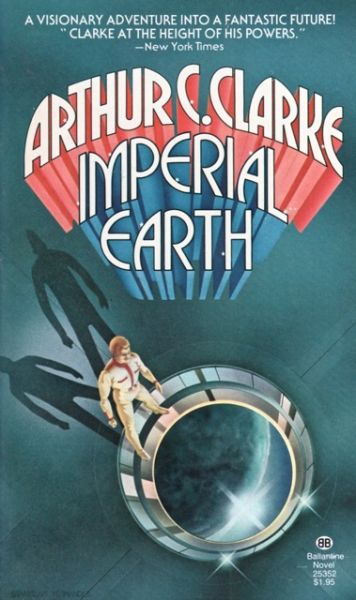
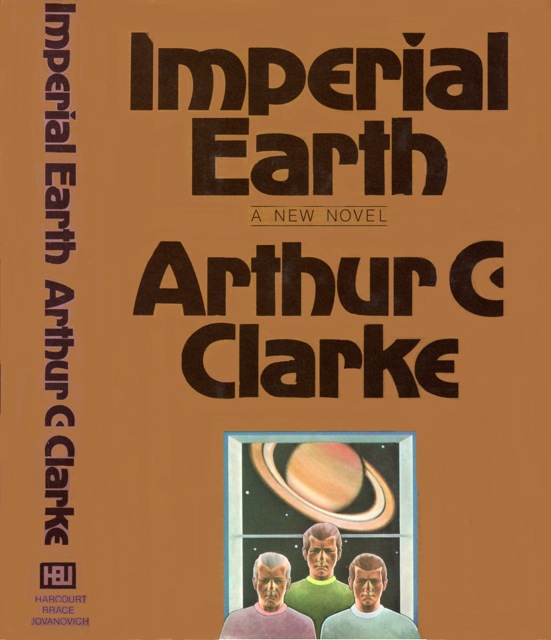
The US edition improves on this a little. I did find it interesting that Imperial Earth is one of the few examples of Clarke’s fiction where there are quite large differences between the UK and US editions. According to Wikipedia, “The original UK hardcover edition (ISBN 0-575-02011-3) has the subtitle “A Fantasy of Love and Discord” and has 38 chapters and “Acknowledgments and Notes”. The later US hardcover edition adds a quote from Ernest Hemingway, has 43 chapters, drops the subtitle, and expands the Acknowledgements and Notes.“ I remember being very disappointed by this at the time of first reading and managed to track down a US paperback copy many years later.
Were the differences a sign of a need to revise and rewrite? Not really, although the extra details add a little more depth and colour to Duncan’s experiences on Earth. The additions over five extra chapters and 18 pages simply add detail of Duncan’s visit and his observations of Washington, including a visit to the Smithsonian Museum and a simulation of the 1969 Moon landing, an intimidating trial speech to the Daughters of the Revolution and a visit to New York on a mystery tour before going onboard the resurrected Titanic. I can’t see why they would have been omitted from the UK edition, but the book is better because of them.
But then, rereading the UK edition of the novel, it is clear that Imperial Earth is a book that, despite its title, focuses on character rather than just places, perhaps more so than in his recent books. This is further emphasised by the book’s subtitle “A Fantasy of Love and Discord” which puts the focus on human emotions rather than other areas of interest. It is more about Duncan than the places he visits, which leads to a tight focus on people rather than expansive vistas of place.
Even with this new focus on character, it is possible that the characterisation is still too bland for critics. Away from the main characters of Duncan, Karl and Calindy, the other characters barely register. However, Clarke’s previous writing would mean that readers would expect that. He is a writer whose style of characterisation in the past was often brief and minimalist, the author preferring instead to make wry generalisations on observations of human behaviour. These characters are like that.
And of that title? I’m not sure that it is the best. The imperialistic nature of Earth is there in the book, but it is not overdone. I would have thought the idea of Titan moving forwards away from Earth, its imperialistic master, so to speak, resonated strongly with Americans who were about to celebrate the overthrow of the British Empire two hundred years previous? For an author born at a time when the British Empire was at its height, to make comments on such a society are perhaps most telling. Like Kipling, who was an advocate of British imperialism, Clarke’s more tempered view is not as ‘in your face’ as it could have been, but instead a plea to move on from the historical shackles of the past for that greater good.
To sum up, then, Imperial Earth is a relatively ignored novel from Clarke’s admittedly broad repertoire that deserves more acknowledgement than it seems to have got. Even fans of Clarke’s books seem to miss this one, and I’m not sure why. I enjoyed it more than Rendezvous with Rama myself.
It shows changes in Clarke’s writing that reflect an author determined to stretch his skills whilst still managing to keep much of what has been liked in the past. Undeniably, it has its flaws, but Imperial Earth is a pleasingly optimistic novel that I appreciated more on rereading, even when some of the aspects are now (45 years on) a little out of date. An unappreciated gem.
Imperial Earth (A Fantasy of Love and Discord) by Arthur C Clarke
Published by Gollancz, 1975
ISBN: 0-575-02011-3
287 pages (UK); 305 pages (US)
Review by Mark Yon