 And so to the third book in this Trilogy, what is being labelled as “The Final” Age of Madness novel. (And please note, as this is a review of the third book, there are spoilers below of the second book, The Trouble With Peace (reviewed HERE.) And as this is the third book in a trilogy, this is not the place to start. (Try A Little Hatred, reviewed HERE.)
We begin this book pretty much where Book Two finished. King Orso returns to Adua after defeating the now slightly-dismembered Leo de Brock. With the Young Lion and his pregnant wife Savine captured, Orso expects a return to past glories. However, instead of travelling home to a triumphant crowd, Orso finds himself arriving into the middle of a riot. The Great Change is happening, with the common people revolting. The old order – the Monarchy – is removed and replaced by the new order. The Breakers and Burners have continued their determination to break free of their oppressive work conditions and lifestyle and are now destroying the city and their mechanical places of work.
Suddenly the expected situations are reversed. Orso is arrested by the new regime, whilst the recently defeated Young Lion and his wife are regarded as heroes, of a sort. There is much to do. Brock, now Citizen Brock, despite his defeat by royalty, is determined to lead the people into a new age of prosperity and wisdom.
In Adua, the new order is instigated by a number of people we have met before – Risinau is the self-proclaimed intellectual leading judgement, whilst Spillion Sworbreck becomes the mouthpiece for the group in charge. To this Vick van Teufel and Tallow are added as part of the new order. Most significantly, Judge, a deranged character and designated leader of the Burners takes an important position in the kangaroo court hastily set up.
Meanwhile in the North, Rikke, now holding together a fragile Protectorate as Leader of Uffrith, is finding it difficult to preserve what she has got against Black Calder, who is preparing for vengeance after his previous defeat. Stour Nightfall is now a prisoner, but is he a valuable playing piece in the game she is playing against Calder?
And around all of this, Bayaz, with his creepy assistant Sulfur returns to show his true hand in this game of politics and power.
It’s clearly not going to end well for someone – or anyone.
Most of this book is actually not about “The Great Change”, for this has pretty much happened by the time this book starts, but what happens after. Instead, the book is really about what Adua did next. Responsibilities are gained and lost, so too fortunes and finances. In these post-Brexit or post-Trump times, we know that the wisdom of crowds is something that can be both beneficial and dangerous, something that Joe uses to great effect in this book. There’s a lot of regret about circumstances from all sides.
As ever, Joe’s combination of (VERY!) violent action and gallows humour create a dark, nasty and cynical world for his characters to be in. The characterisation remains as good as ever, their dialogue sprinkled throughout with appropriate epithets in this often unremittingly grim environment. Think Les Miserables crossed with Stalingrad in a Fantasy setting where nothing is as you’d expect.
The usual fight scenes are choreographed to the standard expected. I could see the descriptions in my head as I read, which shows the gift Joe has for action in dialogue. The brutality of the fight scenes is still wincingly graphic, and yet it all seems appropriate. Bawdy and graphic without becoming parody. Not easy to do!
And then there’s the ending. Joe has developed a reputation for plot twists towards the end of his novels, when things do not go as we expect. This one is no different (but obviously I’m not going to tell you here what happens.)
Suffice it to say that, once again, I spent much of the book anticipating what was going to happen, only to be broadsided by what really did. The clues are there throughout as old and new characters give this a freshness and a means to do things differently yet in a way that will not disappoint. It is cruel but rarely heartless.
Joe manages to finish this trilogy with a definite ending and one that is totally appropriate, if typically ambiguous. I am pleased to say that this new trilogy has been worth the read, and this one caps the series nicely. The Wisdom of Crowds is an unputdownable page turner that made me grin on reading one page and grimace on the next.
There’s a lot riding on whether Joe can finish the trilogy to the satisfaction of readers, and I am sure that many will worry whether that is the case. From me though it is an unreserved YES, to the point where I think that this is one of his best. The final book brings the events of the previous two to a definite finish.
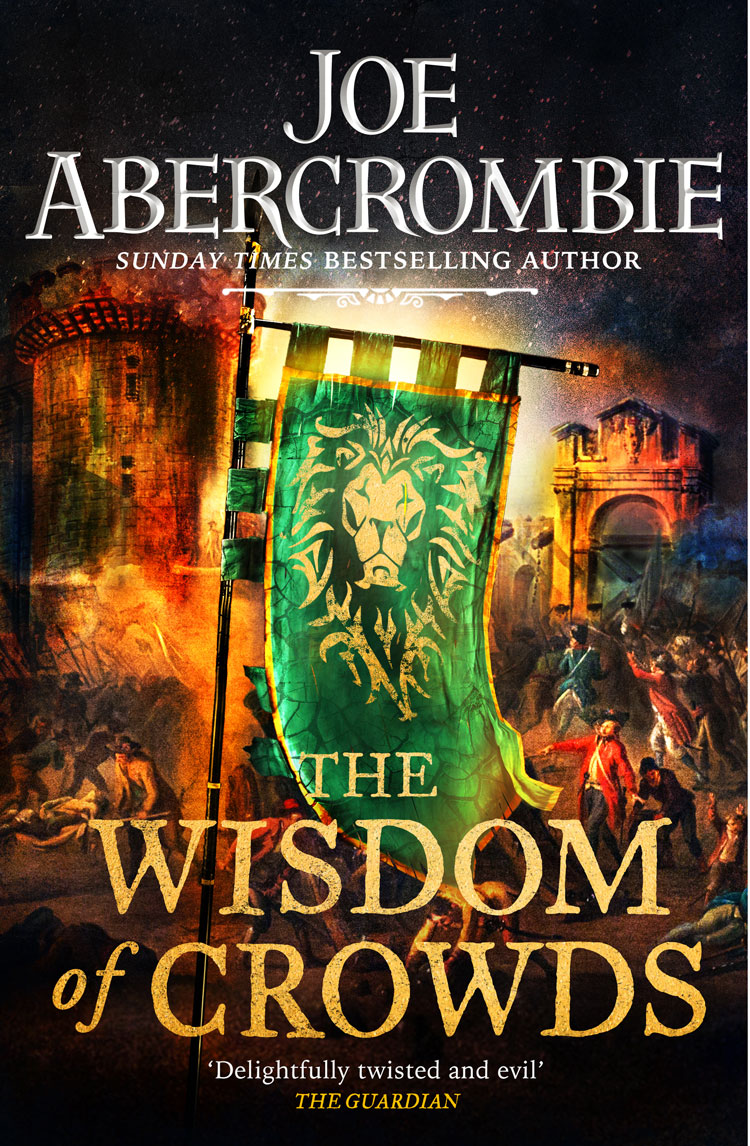
Although it’s not something I do very often, I must also point out the lovely artwork that adorns this book as well as the others in this trilogy. Well done to Gollancz and Tomas Almeida, not only for the cover but for some stunning endpapers too. Easily one of the best sets of covers I’ve seen in years to celebrate the writing of one of our genre’s current best.

I’ve said it before and I’ll say it again – no one does these stories like Abercrombie. For all of the copycat writers and the hysterical harbingers of rip-off writing that seem to tread a very similar path, Joe’s voice in telling these tales is special and unique. And this latest book in his latest series shows Joe at this best. It is as good as you can expect.
But where does he go next?
Thoroughly recommended – a definite book of the year.
The Wisdom of Crowds by Joe Abercrombie
Book Three of the Age of Madness
Published by Gollancz, September 2021
ISBN: 978 0575 095 960
529 pages
Review by Mark Yon