 As it’s October 1st, we begin our traditional countdown to Halloween here!
And we’re beginning with a classic. Randy Money has had a look at a book from a writer who has influenced many modern writers.
“There are with every man at least two evil spirits.”…
“With wicked genii there is also a fluent speech, but harsh and grating. There is also among them a speech which is not fluent, wherein the dissent of the thoughts is perceived as something secretly creeping along within it.”…
Translations of lines from Swedenborg’s Arcana Celestia quoted in “Green Tea”
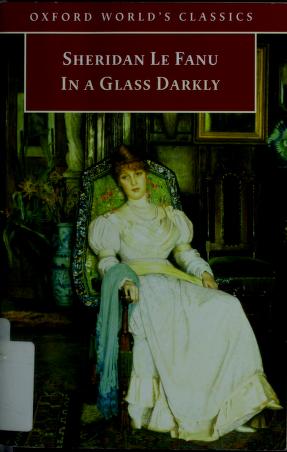
Joseph Sheridan Le Fanu was a contemporary of Charles Dickens and Wilkie Collins, and if not as instrumental as Dickens in popularizing the ghost story, was arguably more important in its development. Containing three short stories, a novella and a short novel, the first edition of this collection as published in 1872, the year before Le Fanu died, and has become one of the titles most closely associated with him, along with the novel Uncle Silas.
Each story is briefly introduced by the compiler of the collection, an unnamed medical secretary for the late Martin Hesselius, a German physician who specialized in matters metaphysical and its effects on his patients: “Here and there a case strikes me as of a kind to amuse or horrify a lay reader with an interest quite different from the peculiar one which it may possess for an expert.” Being a mere secretary, he cannot himself claim expertise and so through this conceit, Le Fanu distances himself as writer and invokes the plausibility of scientific study; in other words, there could be volumes concerned with in-depth medial analysis, but this volume is for the entertainment and edification of the layman, ingeniously suggesting a background Le Fanu does not have to fill in.
The first three stories tie together as an exploration of the spiritual world seeping into our own, starting with one of Le Fanu’s most widely anthologized stories, “Green Tea”: The Rev. Mr. Jennings has a problem with his nerves. For a long time, he has studied the works of Swedenborg, focusing on the philosopher’s belief in an unseen, spiritual world, and supporting his studies late into the night with the help of stimulants, first copious amounts of black tea and later equally ample draughts of the title tea. And then he begins to see something, something not quite focused, something animated and a bit like a monkey …
“Green Tea” has long been a favorite of mine and seems to me a link to both the ghost stories of M. R. James because of the nature of its apparition and to the ghost stories of Henry James because of its focus on the state of mind of the Rev. Mr. Jennings. It is one of the earliest stories I know of to merge the ghost story with psychology.
If the Rev. Mr. Jennings was an innocent too concentrated on his studies for his own good, In “The Familiar” Sir James Barton was a mostly decent man, except for one episode, the result of which returns to haunt him at what should be the happiest time of his life.
The third story, “Mr. Justice Harbottle,” details the consequences of a life spent misusing judicial power, as revenge is wrought by the spirit of an innocent man condemned to death. That may seem like too much of a plot summary, but the power of this story isn’t in the plot, but in the telling, the imagery of which has lost little power over a century and a half.
After that trifecta, Le Fanu included a light-hearted short novel, with intimations of the supernatural, but more of a mystery, The Room in the Dragon Volant, since assumed identities play a part in an enjoyable story. Even if it feels a bit out of place with the others, it does share a running theme in the collection.
The collection’s last story, “Carmilla,” is another title for which Le Fanu is famous. Carmilla arrives at the door of a small, isolated schloss through a carriage accident. The owner agrees to look after the stunned young woman in part because she would provide a companion for his lonely daughter, our narrator, and partly because Carmilla’s mother desperately needs to rush away on urgent business. Not long after Carmilla settles in, our narrator begins to fall ill.
Generally viewed as the best early vampire story and an inspiration for Dracula, “Carmilla” has been either directly filmed (The Vampire Lovers, 1970) or acted as an inspiration for films (Vampyr, 1932; Dracula’s Daughter, 1936) or television shows. (IMDB lists eight different movies with attributions to the novella.) “Carmilla” is also credited as the first vampire story to introduce a whiff of lesbianism, which tends to be emphasized in the filmed versions. The written story proceeds at the pace of seduction and betrayal, the mystery obvious to the reader but not immediately so to our protagonists, and so all the more suspenseful. “Carmilla” has been a favorite of mine since I first read it as a teen, a story I’ve reread at least four times and this time, as with the others, with pleasure.
Returning to Le Fanu after several years, I again marvel at how easy he is to read. Like Dickens and Wilkie Collins, Le Fanu wrote clear, direct prose, and in unbelievable situations, his characters act in believable ways. He may use a slightly more formal language than contemporary writers with the occasional passage more verbose than current fashion, still these stories retain much of their power and their energy, remaining crisp, enthralling and re-readable story telling.
IN A GLASS DARKLY by Joseph Sheridan LeFanu (1993; Oxford University Press)
382 pages
ISBN: 978-0199537983
Review by Randy Money