Recognition of Shirley Jackson’s influence on horror and literature has perhaps never been higher than at the moment. The recent movie Shirley (2020), with Elisabeth Moss as Ms Jackson has no doubt raised awareness further. My own first dealings with Shirley’s work was through the Robert Wise directed movie The Haunting (1963), an adaptation of her book The Haunting of Hill House (1959) – it is still a Halloween favourite here. The book I then read, and reread for a Halloween review here a few years ago.
One novel of such genre importance might be enough, but Jackson is also known for her We All Live in the Castle (1962), an unsettling tale of teenage adolescence, and I understand in the US that The Lottery (1948) is a secondary school staple. (If I’ve got that wrong, I’m sure someone will let me know.)
What is most noticeable to me is that like the tone of most of her work, much of Jackson’s reputation has impressed by means of stealth. She is an author whose influence today is remarkable yet often generally unnoticed. There is an Award – unsurprisingly, The Shirley Jackson Award – which is well-regarded, although not as widely recognised as say the Hugo or Nebula awards.
And this, I think, is the attraction. Jackson’s prose is remarkably precise and yet often surprisingly mundane, describing a 1950’s world of domestication, shopping, home-making and ritual. From the perspective of 2021 it all appears rather quaint.
But what Jackson does is hint, little by little, that this perception of domestic bliss is really wrong, and that beneath the façade of ideal homes there is a darker, nastier, more sinister side lurking. Think Peyton Place rather than Nightmare on Elm Street. Hitchcock does this as well, so too David Lynch. Jackson’s work at times is all about the personal – individual neuroses, that feeling of fear when things are not right, or safe.
The feeling I often get at the end of reading a Jackson tale is usually one of unease. Things are not quite right. I’m tempted to suggest that to me it is rather like reading an M R James ghost story but set in a 20th century context.
However, Stephen King, Neil Gaiman, Victor LaValle, Paul Tremblay and Jonathan Lethem amongst others have all recognised Jackson as an influence on their work.
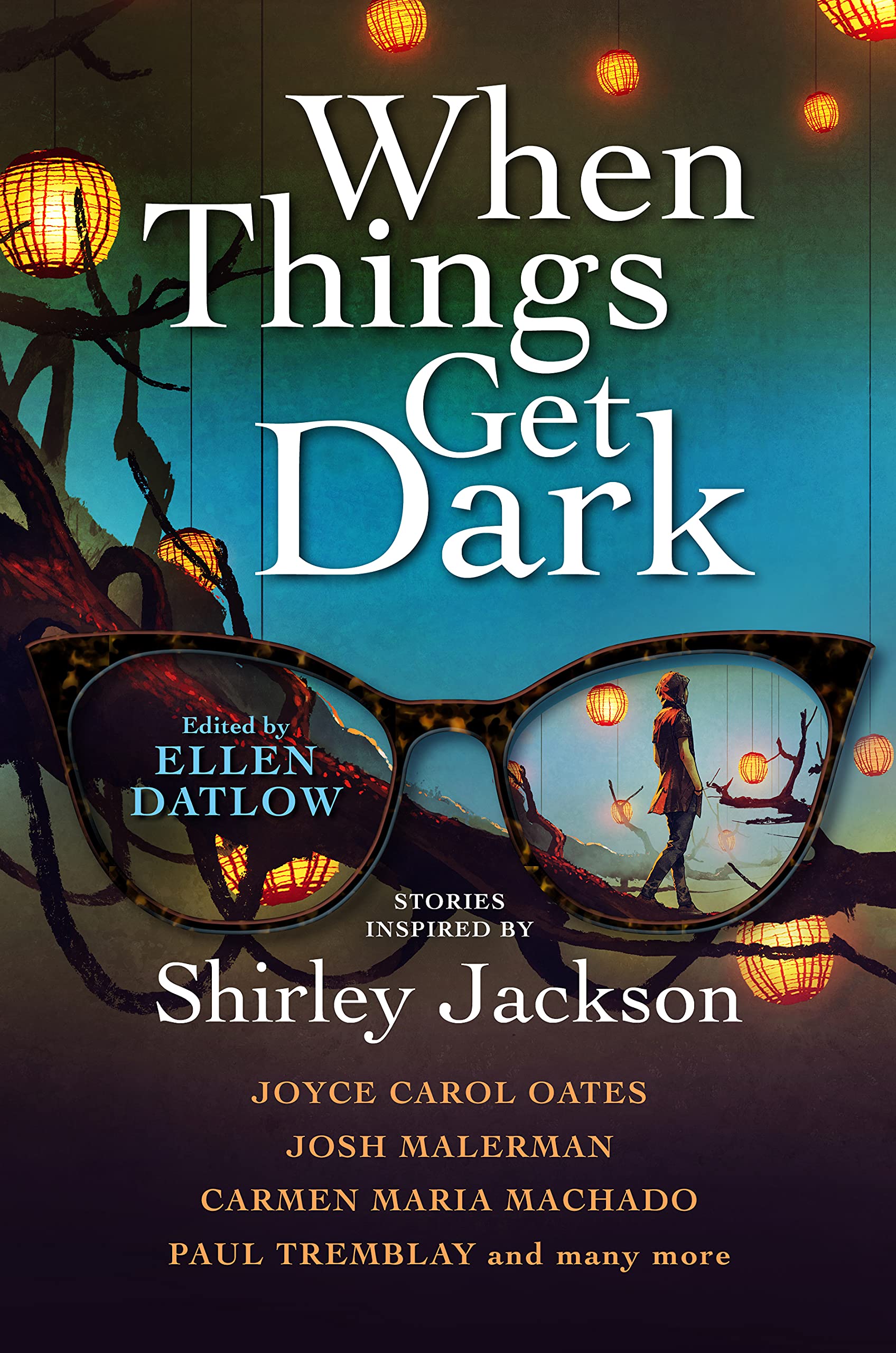
Perhaps then it is rather fitting and not a surprise that When Things Get Dark arrived for review, it arrived quietly at my desk. Edited by Ellen Datlow, it is a collection of short stories that pay homage to Jackson – not, as the introduction is quick to point out – about Jackson herself, but in the words of Datlow, “What I wanted was for the contributors to distil the essence of Jackson’s work into their own work, to reflect her sensibility.”
So here we have fifteen authors all willing to pay their collective respects to Ms Jackson – not to copy her style but to create that same feeling of unease, to have that sudden twist in the tale or just make the reader realise that things here are weirder than they look.
The roster is quite impressive – Josh Malerman, Joyce Carol Oates, Paul Tremblay, Richard Kadrey, Elizabeth Hand and many others. Some of these are recipients of the fore-mentioned Shirley Jackson Award, others have declared an interest and an acknowledged influence of Jackson on their own work.
The book begins with M. Rickert’s Funeral Birds, which is what I would describe as what I expected from a Jackson type story, about a person who hangs on at funerals. By comparison, Gemma Files’ Pear of Anguish is perhaps the book’s most visceral and perhaps most unsubtle story as it brutally tells of teenage witchcraft. Josh Malerman’s Special Meal is one of the shortest, in some strange dystopian cancel culture. Kelly Link’s Skinder’s Veil is the longest and last story in the collection. It is also one of the oddest, about one of the strangest housesittings I’ve ever heard of. I also liked Jeffrey Ford’s story of a strange neighbour, The Door in the Fence.
I found that When Things Get Dark was one to take your time with. The prose is often to savour, and I liked the fact that the tone varied from story to story. Some are clearly filled with repressed anger and hate, others more gentle, more allegorical, with a little moment when “normal” turns to something-else and makes the reader revaluate what they’ve read.
In short, this is a classy collection that grabs your attention with its range and quality. A recommended read for those who like their chills provoked at Halloween.
When Things Get Dark, edited by Ellen Datlow
Published by Titan Books, September 2021
342 pages
ISBN: 978 178 9097 153
Review by Mark Yon