
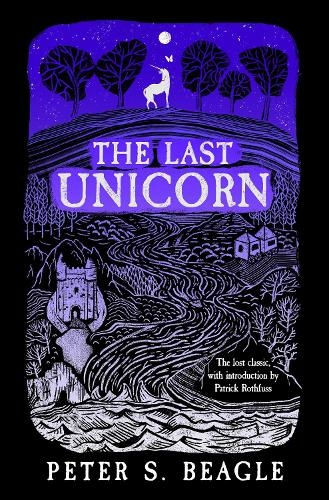
 For those who don’t know The Last Unicorn is a much-loved Fantasy story first published in 1968. For lots of legal reasons, it has not been in print here in the UK for decades.
There are lots and lots of people out there who love it. Patrick Rothfuss does, for one. In the new Introduction to this edition, Pat says, “The Last Unicorn is the best book I have ever read. You need to read it. If you’ve already read it, read it again.” In 1987, Locus ranked The Last Unicorn number five among the 33 “All-Time Best Fantasy Novels”.
So… I tried. Being a “Child of the 60’s” myself, I thought that this would be right up my street, especially as Pat is SO enthusiastic about it. And Neil Gaiman… and lots of others.
But… no.
The Last Unicorn is one of those books that if you read in the 60’s with additional support of perhaps other recreational assistance, you might like. It’s the sort of fantasy that tells of a Fantasy land that is innocent and other-worldly, that made me think of that song about Puff the Magic Dragon by Peter, Paul and Mary (and yes, I still love that one.)
But that was it. I could admire the skill, the word-smithery, the point…. But for me it is dated in a book that should be timeless but clearly isn’t.
I know there are fans out there, but as much as I wanted to like it, I couldn’t. I struggled to finish it.
I did try to approach this one with no expectations. In my defense, I wasn’t expecting a gritty, no-holds barred action adventure, to be fair, but what I got was some twee, weak, limply-told, soggy fantasy with minimal characterisation and cliched actions that seemed to be full of meaning and yet meaningless. Whilst I can see that there are some who will appreciate the ethereal melancholy and innocence that permeates the book, generally I think that this is a product of the 60’s that has not dated well. Clearly, I am an old grump who has lost that sense of childlike innocence.
I think that most of the sales here will be by older readers wanting to know what the fuss is about, or those who have read it and liked it years ago and are wanting to revisit (as Pat suggests.) It may work for them. Whilst I’m always in favour of old books being rediscovered, to show where our genre has been, it doesn’t always mean that they work for everyone.*
Unfortunately, (and the reason for this review being published – I don’t normally review books I don’t like) I have a horrible feeling that this will be bought, with the best of intentions, as a gift for someone just starting to read Fantasy, by someone thinking it is a well-liked and respected book. Well, it is respected. And I’m sure that there will be some who love it. Regrettably, in my opinion a modern young reader will hate it, and never risk Fantasy again, thinking all Fantasy books are like this one.
My advice would be to try it, but be prepared for not liking this one. If you are looking for books that show why fans like Fantasy today, this isn’t it. In my opinion, there are better books out there. And if you’re a young reader who wants to try ‘old stuff’, don’t try this one first – go to Tolkien’s The Hobbit, or Ursula K LeGuin’s Earthsea books.
Like Pat says, though, perhaps I need to read it again… it just won’t be for a long time. A disappointment.
*I’m reminded here of an old story. When Arthur C. Clarke and Stanley Kubrick were looking for inspiration for 2001: A Space Odyssey, Kubrick asked Clarke to suggest movies to look at. Clarke suggested one of his favourites, Things to Come (1936), based on an H. G. Wells book. Kubrick’s response after watching it was “Arthur, remind me never to watch one of your recommendations again.”
The Last Unicorn by Peter S Beagle
Published by Gollancz, August 2022
298 pages
ISBN: 978 1 399 60696 7
Review by Mark Yon

I must pick nits with the beginning of this sentence from your review: “It’s the sort’ve fantasy that tells of a Fantasy land . . .”
I hope you’re aware that “sort’ve” is a contraction for “sort have” and not an alternate way to spell “sort of.” That kind of mistake really throws the rest of your review into serious doubt, at least as to your ability to judge and critique one of the most important aspects of the book, which is Peter S. Beagle’s magnificent use of language.
I know THE LAST UNICORN isn’t for everyone. It’s incredibly lyrical in a way that most people are either very likely to love or to hate, but it does the reader an enormous favor by making that fact apparent even in its opening sentences:
“The unicorn lived in a lilac wood, and she lived all alone. She was very old, though she did not know it, and she was no longer the careless color of sea foam, but rather the color of snow falling on a moonlit night. But her eyes were still clear and unwearied, and she still moved like a shadow on the sea.”
Most people can tell from those opening sentences whether this story is going to be one they will enjoy or not. For me, those lines hit a storytelling sweet spot, although I know there are readers for whom Beagle’s language is more irritating than fingernails on a blackboard. It is very much a tale that enjoys being read out loud, one whose cadences and rhythms hail from from a different age of storytelling. Personally, I love the language of this book and the story that it tells, though I never found it to be as emotionally engaging as the works of Tolkien or Le Guin, whose works you recommended as alternatives to Beagle.
I can appreciate your not caring for the story, or for its lack of real character development (which is so very important to most modern readers). I get that. I really do. But I found your ignoring of the book’s lyricism to be troubling, because that truly is one of its selling points.
I also found your claim that the tale was a “twee, weak, limply-told, soggy fantasy” to be an extreme mischaracterization. There is no aspect of this story that I would ascribe any of those four adjectives to.
Just my two cents.
Thanks Charles for your comments, giving a counterview to mine. I’ve changed that sentence.
And you may have hit one of my issues on the head there. The lyricism is a key point of the book. I have read similar books and coped well with such a style, but here I struggled.
Where some find the lyricism charming and appropriate, I didn’t. I totally understand that others might see it differently.
Your view seems to reflect what many others feel about this well-loved book. I was hoping to do so too, and was very surprised when try as I might I couldn’t.
But I was determined to be honest, which I have tried to be.