

 Thought I’d go back to basics with this one. The Stars My Destination (also known as Tiger! Tiger! In the UK, where it was first published as a novel in June 1956) is one of the most celebrated science fiction novels of the 20th century. I decided to remind myself why on a reread.
Gully Foyle is my name
And Terra is my nation.
Deep space is my dwelling place,
The stars my destination.
Context first: The Stars My Destination was Alfred Bester’s second science fiction novel. His first, The Demolished Man, was published in 1952 and was the recipient of the first Hugo Award for Best Novel in 1953. (As I type this, we have just held the 80th Worldcon …how time flies!) His second novel, published in 1953, was a contemporary novel, with no science fictional content. The Stars My Destination was seen as his return to SF.
There was some relevant history, though. Bester had been writing science fiction since the 1930’s. His first story published was “The Broken Axiom”, published in Thrilling Wonder Stories in April 1939. Previous to these, since the 1940’s Bester had worked on writing stories for comics, including Superman, The Phantom and The Green Lantern. It was Bester who wrote “The Lantern Oath.”
This book, despite being nearly 70 years old, still has a lot to enjoy. I was rather expecting it to have dated, which it has in places admittedly, but actually not as much as it could have. There’s a lot here that modern readers can engage with. Alfred worked in television, and it may therefore not be a surprise that there are visual elements in both of these SF novels. Text is given in different forms, running across the page diagonally, in blocks and so forth.
At its heart The Stars My Destination is a revenge story, deliberately based on Dumas’s The Count of Monte Cristo (because you can borrow from the classics, right?) The lead character is hard-done-to from the start, but despite all of the odds survives and returns to wreak his revenge, having being abandoned in space.
Most impressive is the way that the main character, Gully Foyle – a murderer and a rapist – becomes a symbol of vengeance in this book. Despite all of his unpleasantness, Foyle becomes a character the reader roots for, his actions the vengeance of the common man upon the wealthy elite. I was surprised at how shocking these traits were – and more so when you think that they were published in the fairly straight-laced 1950’s.
It is a journey both physical and symbolic. When Gully has to take on an alias to remain in disguise, as his pseudonym of “Fourmyle of Ceres” he is witty, literate, well-spoken, a character light-years away from the near-monosyllabic survivor seen at the beginning of the book. Strange characters exist throughout, with even stranger relationships. He almost meets his match in a woman who is his equal (again, unusual for the 1950’s!) as he attempts to take on enigmatic business leaders in his search for the crew of the spaceship Vorga who left him.
Why has the reputation of the book lasted? Authors such as Thomas Disch, Carl Sagan, Samuel R. Delany, Robert Silverberg, Joe Haldeman, Harlan Ellison, Michael Moorcock, William Gibson, Neil Gaiman and Stephen King (who even named a memorable story, “The Jaunt” after this novel) have all mentioned the book’s influence and importance in SF. Well, what strikes me most is the fact that the book is filled with a mass of ideas, more so than a typical novel of the time. We have science fictional elements such as Jaunting (teleportation) and the McGuffin of PyrE (a mega explosive), but also many non-genre elements as well, such as synaesthesia, strange cults, nuclear terrorism and even a world dominated by social media and celebrity. It is this wealth of ideas compressed into one novel that made it memorable for me.
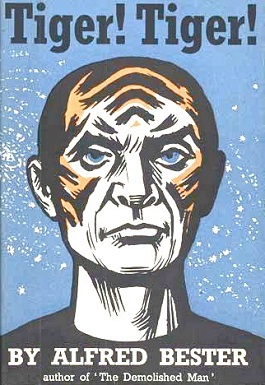
One of these ideas – the idea of tattoos signifying a criminal or a dangerous person – amused me a great deal. Gully Foyle would actually blend in fairly well with some of today’s exhibits! But of course, depicting criminals by tattooing them was commonplace in Victorian times, as many a Dickens novel will attest. Here it is a sign of pride and tribalism, although it makes life difficult for Foyle by having to rein in his emotions continuously, lest others see his tattooed tiger stripes which reappear when he is emotional.
The impression of mega-industries with their family names recognisable today – Esso, Greyhound, Cola, IBM – make this feel like the Southern families of Gone With the Wind combined with the Kardashians today. What was described in the 1950’s feels even more appropriate today. We have big business calling the shots, manipulating and dealing, doing all it can to make a profit.* With a change of the names to such as, let’s say, Elon Musk or Jeff Bezos or Richard Branson, it doesn’t feel that dissimilar to the media frenzy of today. It is remarkably astute for a book nearly 70 years old. Neil Gaiman has said in the past that it was “the perfect cyberpunk novel”, and I can see why as many of the elements we will recognise in cyberpunk in the 1980’s are here.
Despite being based on an old classic, much of what we see here is revolutionary, especially for 1956. We have different text styles presented in different ways, as it was in Bester’s first novel, The Demolished Man. It is almost New Wave in its way of presenting different information in different styles – a decade before New Wave appeared. It is easy to see why some of the New Wave writers embraced TSMD, with its anti-establishment stance and its determination to tell a prose story in new ways. Mike Moorcock is a big fan, saying that in 1957 the novel “made me think SF might be worth a go”. Michael Moorcock’s top 10 science fiction novels | Books | The Guardian
Most of all the cyberpunk elements are still contemporary. At times it is almost pulpy, it is grubby, it doesn’t hold punches – there’s a hint at a rape scene, for example! – which in the 1950’s should have put it in the darkest shadows of pulp fiction. And yet it is so gloriously baroque that it holds your attention. These days I can see it as an HBO series.
The end of the novel doesn’t quite hold the potential of the first part, although it is an interesting journey along the way.
Overall The Stars My Destination shows that Bester was in the 1950’s a supernova of talent, and this alongside The Demolished Man, are his pinnacles of excellence. Destination was Bester’s last science fiction novel for 19 years.
If Destination was just a good read, uncomfortable at times, yet an entertaining page-turner, that would be enough for me to recommend it. However, I think that The Stars My Destination is worth reading, not just for all of the above but also to see the influences it has clearly had on other SF work since its publication. It was ahead of its time and despite its age still has the power to impress today.
*Again, it is quite amusing to me that Bester soon will leave SF writing to work in television and magazine editing, which will reduce his fictional output to very little for decades. Corporate business, all about the profit – what is Alfred trying to tell us?
The Stars My Destination by Alfred Bester
First published in Galaxy Magazine in 4 parts, October 1956 to January 1957
Published as a novel, as Tiger! Tiger! by Sidgwick and Jackson (UK), June 1956
197 pages
ISBN: 978-0575094192
Review by Mark Yon





Excellent review. From my perspective, very much on-the-money. I just read this for the 2nd time. I read “The Demolished Man” in the 1970s but it took me a long time to get around to this. Both books are fairly unique in Science Fiction. I can’t think of another SciFi book I’ve read which is based on a “Revenge Plot”. Which is probably why he turned to “Monte Cristo” as a model for building this protagonist. Heinlein would never have attempted this — there was too much of an underlying social and political mission in his work. He also stuck to nice, safe, likable protagonists. People Aristotle would have called “aristos” — characters with whom you would be willing to climb a mountain. Although I haven’t yet read everything by Asimov, Clarke, and Williamson, I don’t think any of them would have pursued something like this either (well — maybe Jack Williamson would). It is a tricky story on which to build your reputation, although I can completely see why Michael Moorcock enjoyed it.
Thank you, Glenn! What can I say: we try our best.