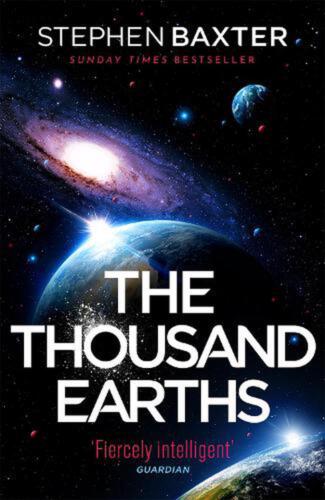
 Never let it be said that Stephen Baxter does stories on a minor scale. His last novel Galaxias (reviewed HERE) dealt with the dimming of the Sun. This time the scope is epic, both in space and time.
The Thousand Earths has initially two story strands. We have one whereby in 2145 John Hackett is one of a crew of a spaceship who are going to travel to Andromeda, a round trip of five million lightyears, but which will take 5 million years relatively.
Much of the first part of the book though seems to be smaller in scale, revolving around the lives of two sisters, Ish & Mela. Told by focussing on Mela, it seems like a fairly typical space colonisation tale, which becomes much vaster when it is revealed that the girls and their parents are on an Earth-like planet surrounded by a thousand (well – 999, I guess) others.
This gives us a human aspect to the story, more so when we are told that their Earth is slowly disappearing into a void known as The Tide from which there is no return. There is a permanent flow of immigrants away from The Periphery where the land meets The Tide, but their landscape is shrinking, and the planet is expected to disappear altogether in 30 years.
Returning to Hackett, his story is similar to that of Reid Malenfant, last read of in World Engines: Creator (reviewed HERE), in that Hackett has returned to an Earth which is not his. Like Malenfant, he is a man out of time, adrift in a future that is increasingly difficult for him to comprehend – and in this case a future where his striving for change is seen as a threat to the human’s Eloi-like existence. Hackett, with fellow travellers Rava Pogee, another astronaut from the past (but Hackett’s future) and Icsoba, one of the people of this Earth five thousand years ahead of Hackett, decide to travel again, this time five billion years into the future.
As the plot develops, Hackett travels further in time and becomes a travelling observer, whose purpose seems to be to carry memories from the past into the far future so that they are remembered. Others join him in his journey. It is this human trait of a need to discover, a restlessness that can only be reduced by continuing that journey, that propels Hackett billions of years through the novel.
I’ve mentioned before how much I love these big ideas that Stephen adds to his novels. In The Thousand Earths Stephen looks at the idea of the Fermi paradox – the conflict between the lack of clear, obvious evidence for extra-terrestrial life and various high estimates for their existence – and midway through this novel throws out an amazing answer that if you haven’t come across before (he has looked at this idea before in the Manifold Trilogy of Time, Space and Origin) may make you applaud at its ingenuity.
What impresses me most in this novel especially is that Stephen manages to do that tricky thing of combining what can be seen as big but unemotional science (see The Cold Equations by Tom Godwin, for example) with characters who have heart.
This human quality is shown through an interesting dichotomy between two religious factions on Mela’s planet, which become more important as the world’s end becomes imminent. It doesn’t help that Mela’s father Tenn is a Perseid, a religion with “a human warmth” determined to do their best for “the Immies”, whilst her estranged mother Salja is a Starrist, believing in “cosmic austerity” and involved in trading property before it disappears into The Tide. (How did those two ever get together?)
In covering deep space and time, Stephen manages to capture the epic grandeur and progression of the universe until its near-death, bogglingly Stapledonian in its scale, whilst simultaneously describing the smaller scale responses of the characters on one planet. Although there are a thousand Earth-like planets our focus is on one. There, the girls, and Mela especially, are a sign of optimism against adversity, whilst the comparatively emotionless Hackett is the scientific everyman, the capable and efficient pilot and scientist whose interest to explore often defines the genre’s idea of an SF protagonist. Hackett feels like a much more pleasant version of Reid Malenfant.
One of SF’s main tasks, often surreptitiously, is to get readers to examine current issues through a science-fictional lens. It will therefore be no great surprise that Baxter manages to explore, with a little remote distance, the issue of refugees and asylum seekers that is one of our own world’s major crises today. As the issues become more acute on Mela’s Earth, I found that it was not too much of a leap to compare this with those crossing the Mediterranean or the English Channel today.
In a more universal manner, Hackett’s need to continue his journey of exploration and not rest seems to call to a basic human urge, that of the need to explore, to discover – and to survive. The science behind the story is quite boggling, but as we travel billions of years it all connects nicely.
There are a couple of coincidences towards the end to tie things up, but they were not really deal-breakers, if a little convenient. I did question why Mela’s people, knowing the end was in sight, didn’t spend time developing spacecraft to escape their planet, although you can argue that they didn’t have the time or the resources. It may be down to human inertia, and the ignoring of the inevitable until it is too late.
Nevertheless, this is perhaps the most enjoyable novel of Stephen’s I have read in recent years. Once I started this one, it was difficult to put down. The Thousand Earths has big ideas presented in a human manner, one where the needs of individuals are examined under a galaxy-crossing, time-travelling backdrop. It is a winning riposte to those who have claimed before that Stephen writes big stories but cold characters, as here we have both characters to engage with and astonishing progression in time and space. Fans of Stephen’s books should love it.
The Thousand Earths by Stephen Baxter
Published by Gollancz, September 2022
588 pages
ISBN: 978 1 473 22890 0
Review by Mark Yon