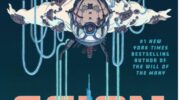
Here’s the much-anticipated return of a classic Fantasy character, albeit one that has been here for a while. In 1961 we saw the publication of The Dreaming City in British Science Fantasy magazine, which introduced us to Elric, a very different personality to that of the usual hero of the time.
For despite being such a seminal character now, Elric, 428th Emperor of Melniboné is not a hero with the traditional values of loyalty, honour and valour. He is not, say, an Aragorn or a King Arthur. Instead, he is an albino weakling, a person who has betrayed and been deceived and who has killed out of hate and jealousy. He survives on sorcerous herbs and the strength given to him by his sword Stormbringer, which constantly demands souls as payment to Lord Arioch, a King of Chaos and whom Elric is in thrall to.
This is quite different for the time, although these days not so unusual. And I think because of that, for those who are unaware, it is quite important to realise what an important influence Mike’s stories – and Elric in particular – have been to readers and writers over time. Some of Mike’s key elements – not just an antihero character with a dark past, in an unhealthy relationship with a demon-possessed sword, not just a Fantasy universe but a multiverse, not to mention a long-time ongoing battle between Chaos and Order – were not particularly new even to him in the 1960’s, but have become almost commonplace these days, taken on by others, rewritten and diluted to become almost normal in the 21st century. I’m pretty sure you can think of your own examples here, but to me any reader of a fantasy story with a brooding main character, arcane magic and a genial, garrulous companion may find Elric and Moonglum familiar.
This may also be because there have been comics, games and even music that have used Mike’s ideas and world. Authors such as Alan Moore, Michael Chabon, Neil Gaiman and Tad Williams have all said how important Mike’s writing and his characters have been to the world of sword and sorcery writing, not to mention themselves, as well as others.
Whilst Mike has said for years that he is not interested in going back to revisit his most famous character, we seem to be at a point of renewed interest. This year the previous stories have also been reprinted in three lovely hardback omnibus volumes from Saga Press. And whilst it could be said that at the age of 83 (on the 18th December) Moorcock has no need to return to perhaps his most famous character, here he does.
Elric has a long history, nearly as complex as his publishing history (but that’s a story for another time.) It may not be a surprise then that in Citadel we begin in what appears to be in the middle of an ongoing story. I understand that it has been said in the pre-release material that in chronological terms, Citadel comes after Elric of Melnibone (1972) but before The Sailor on the Seas of Fate (1976), but Moorcock chronicler John Davey has said that in terms of the overall saga’s internal narrative chronology (Citadel is) between two novellas, ‘Kings In Darkness’ and ‘The Flame Bringers’, which fall just before the final volume, Stormbringer.
Wherever the specific chronological position, briefly what has gone before (for those who don’t know) is that Elric has betrayed his people, the Melnibonéans, caused the destruction of his kingdom of Melniboné and its city Imrryr, killed his cousin Yyrkoon, who attempted to overthrow him but in doing so also murdered his young lover Cymoril.
We take up the plot in three stories.
In the first story (adapted from the story ‘Red Pearls’, written for the 2010 anthology ‘Swords & Dark Magic: The New Sword and Sorcery’, edited by Jonathan Strahan and Lou Anders), and now with his new lover Princess Nauha and his stalwart companion Moonglum, Elric has left the Young Kingdoms of the World Above and his betrothed Zarozinia to sail to the World Below, a dangerous journey. There they go to the city of Hizs, where they meet Lady Forentach, who looks like one of Elric’s Melnibonéan race, but who is actually a Phoorn, a race similar to Melnibonéans but who have mated with dragons . Elric finds himself then on a quest for the White Sword in order to get what he needs and finally end his dependence upon Stormbringer, the Black Sword, he must get for Lady Forentach two red pearls – the Eyes of the Skaradin.
We follow this quest to Nassea-Tiki. Elric obtains the Eyes, but also finds that the quest is really nothing more but a family squabble. This is the shortest part of the novel and feels like a traditional Elric adventure story.
The second story is a revision of the short story Black Petals, first published in Weird Tales in 2008. In it Elric and Moonglum with cousin Dyvim Marluc, and Princesses Viricias and Semilee travel up a river to Soom, an ancient deserted city, in search for a rare flower from whose seeds Elric may be able to find a cure for his albinism and thereby reduce his dependence upon Stormbringer. I must admit that on following the journey into the jungle it reminded me a little of The Crystal World (1966) by Moorcock’s friend J. G. Ballard, but other readers may feel that it is all a bit like Conrad’s Heart of Darkness – but with added monsters, carnivorous things, ancient gods and feral cannibal tribes, admittedly.
The quest to gain the flower seeds is unsuccessful, but leads to the third story, the longest part of the book. Continuing their journey two years after the events at Soom, Elric and Moonglum rescue Empress Melaré, another Melnibonéan-like albino, captured by bandits.
Agreeing to help Melaré defend her sacred city of Kirinmoir against rising threats, Elric and Moonglum also hope to find there an ancient map that will lead them to the moonbeam roads and the land on the other side of the world again. They also find that beneath the outwardly peaceful nature of the city there is there held a dark secret, and with Elric’s arrival fulfilling a prophesy, the city becomes part of the ongoing war between Chaos and Order. Without giving too much away, this last part of the stories involves sacred bees, blue honey, ancient gods, dragons, underground mazes and dream-imagery, as well as lots of links to other Elric stories.
So: what to say of this new(ish) novel? First of all, it is lovely to return to Elric’s strange, mercurial world, filled with vivid prose, imaginative imagery and inventive characters that fits right into the mythos of the older writing. Some younger readers may find that Moorcock’s turn of prose takes a little getting used to, but to me it deliberately homages some of Mike’s original inspirations, that of Edgar Rice Burroughs, of Tarzan and John Carter fame, Poul Anderson (The Broken Sword) and even Clark Ashton Smith, Robert E. Howard and the florid nature of H P Lovecraft.
As you might expect from a plot with such a Weird Tales vibe, the book is filled with strange names and strange places, giving that other-worldly feel to the story, although Elric is definitely not the musclebound hero of Howard’s imagination. Should you wish to look at the world of Elric visually, you can do – but only in the Tor (US) edition, for if you compare the US with the UK edition, the Gollancz (UK) edition does not have the glorious map end-papers of the Tor (US) edition (also given in the new Saga Press editions), sadly.
Thinking of Elric, he is as dark, brooding, enigmatic, cruel and as alien as ever, and yet still retains that sense of tragedy that so endears him to long-time readers. If anything, in this novel version the sad nature of Elric is ramped up to 11 here to epic levels of melancholia.
Interestingly, one of the elements of this novel that surprised me most was the details of Elric’s companion Moonglum. So often the lighter comedy relief in the older tales, the counterpoint to the White Wolf’s near-eternal sombreness, is given here a much more complex characterisation, in that there is less of the comedy and more emphasis given to his other attributes – his companionship, his loyalty and his swordsmanship that go further to explain the relationship between the two characters. I found this version much better, a fuller, more complex personality than I remembered from before.
Overall, the stories in Citadel may not be essential to the overall story arc, but for anyone who has wanted a new Elric story, they are fine, and in my opinion are worthy of a place in the overall Elric mythos. They colour in the details of Elric’s saga, rather than add bold new outlines to the picture of Elric’s long history. You do not have to have read any previous Elric stories – there’s enough explained as you go along – although you have to follow carefully to see how it all comes together in the end. There’s a lot of references to Moorcock’s other work should long-term fans find it fun to find them.
The Citadel of Forgotten Myths is a glorious return to one of Fantasy’s greatest characters that I stayed up reading much more than I should have, It does not pander, yet enhances what has gone before, adding a technicolor vividness to the complex multiverse of Elric.
If this is Mike’s last return to one of perhaps his most-beloved characters, he goes out in a memorable manner. You have been missed – welcome back, Elric!
The Citadel of Forgotten Myths by Michael Moorcock
An Elric novel
Published by Gollancz, December 2022
322 pages
ISBN: 978 1 399 690037 8