
Richard S. Swan has had some success self-publishing about a half-dozen science fiction novels. With The Justice of Kings, his fantasy debut from Orbit, Swan bursts onto the traditionally published scene and kicks off the Empire of Wolf trilogy. The novel is told from the first person perspective of Helena Sedanka, the law clerk of Sir Konrad Vonvalt, a King’s Justice of the Imperial Magistratum of the Sovan Empire. Not unlike Watson relaying the events of Sherlock Holmes’s investigations, except that Vonvalt is not an independent investigator. He is the Emperor’s voice, he is judge, jury, and executioner, when necessary.
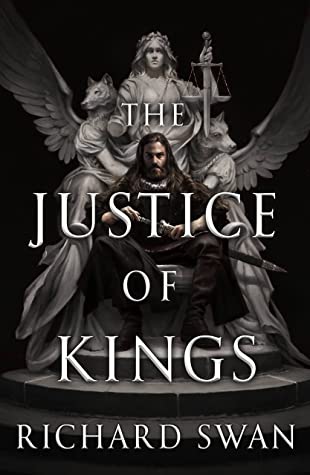
Action, intrigue, and magic collide in this epic fantasy following Sir Konrad Vonvalt, an Emperor’s Justice, who is a detective, judge, and executioner all in one—but with rebellion and unrest building, these are dangerous times to be a Justice . . .
The Empire of the Wolf simmers with unrest. Rebels, heretics, and powerful patricians all challenge the power of the Imperial throne.
Only the Order of Justices stands in the way of chaos. Sir Konrad Vonvalt is the most feared Justice of all, upholding the law by way of his sharp mind, arcane powers, and skill as a swordsman. At his side stands Helena Sedanka, his talented protégé, orphaned by the wars that forged the Empire.
When the pair investigates the murder of a provincial aristocrat, they unearth a conspiracy that stretches to the very top of Imperial society. As the stakes rise and become ever more personal, Vonvalt and Helena must make a choice: Will they abandon the laws they’ve sworn to uphold, in order to protect the Empire?
The novel, in the form of Helena’s notes, starts when Vonvalt is investigating a small town not practicing the religion of the empire, which might just be home of a witch. Konrad Vonvalt is Accompanying Vonvalt on this investigation is the aforementioned Helena (19 years old the time) and his “protector” Dubine Bressinger. At Vonvalt’s disposal are two powerful, magical/supernatural weapons. The first is the Emperor’s Voice, which compels those he interrogates to speak the truth to him. The other power is the necromantic ability to animate the dead, depending on how recently they’ve been killed and the state of their remains. Similar to the Emperor’s Voice, the dead are compelled to reveal the truth to Sir Konrad. After a short investigation in the hinterlands were a town is suspected of not conforming to the Empire’s religion, Vonvalt resolves the issue, though he gets some pushback from a rather zealous priest for compassionate towards the offenders leading to a conflict of wills.
From there, the main mystery takes hold – the suspicious murder of a noblewoman. When Vonvalt, Helena, and Bressinger arrive and begin their investigations, they realize there is a deeper conspiracy afoot. It wasn’t a simple, random murder. Also under concern and somewhat connected to the murder is the daughter of the woman murdered was sent to a kloster prior to the events of the novel, but nothing has been heard from the girl since she entered the kloster.
That’s the gut of the story – a murder mystery/conspiracy story. The world of the novel is at the precipice of a shift in power, and much of the conflict is between secular law and religious law. Those kinds of conflicting ideologies make for great story and Swan does a very good job of presenting this conflict through his characters. Vonvalt is looked upon as one of the highest of his order of Justices, he’s got a very strict definition of the law, he views the law as above everything else. But what makes Swan’s novel so enthralling is largely his voice as a writer, or at least how that voice comes through Helena’s reflective narration years after the events of the novel. I like that it was told from her “notes” rather than from any reflective remove of time through Vonvalt’s diaries. Utilizing this narrative structure allows for some foreshadowing and some very sharp hooks that will dig in at the end of some chapters that will keep you reading. Helena’s story of how she came to be with Vonvalt unfolds at a nice pace and helps to inform their relationship, especially as the novel reaches its conclusion.
The magic and supernatural are present, but somewhat subtle. The power of the Emperor’s Voice is not employed very often, but the way in which other characters speak about this compulsion gives it even more weight in the story. The necromantic powers of speaking to the dead are conveyed with even greater awe, instilling even more fear into many of the characters. Especially the kind of minor, side and inconsequential characters who inform the world and help to flesh out the details. There are minimal scenes that feature Vonvalt speaking with the dead, but they are very powerful and hint at the dangers that are inherent when one seeks to cross or straddle the line between the living and the dead. These two magics of the Justices are just hints of other magics that lie in wait beneath the surface, which should play out in The Tyranny of Faith. I’m very pleased I have a copy of book two and have already started reading it as of the writing of this review.
I’d seen very good things about The Justice of Kings for the past year from my esteemed colleague Mak here at SFFWorld (Mark’s review: https://www.sffworld.com/2022/02/the-justice-of-kings-by-richard-swan/) as well some of my book review peers. Despite all that praise, I was still impressed more than I expected by the time I finished the book. Swan’s novel is one of the best series starters and fantasy debuts I’ve read the past decade. He has absolutely captured a “voice” in this tale. With the story told in the first person, I was reminded of one of my favorite series of all time, Robin Hobb’s Elderlings/Fitz books.
Highest recommendation.
© 2023 Rob H. Bedford
Orbit Books | Trade Paperback
August 2022 | 413 Pages
https://www.stonetemplelibrary.com/ | Twitter: @Richard_S_Swan
Review copy courtesy of the publisher





Interesting how people have different tastes – I thought this book was terrible and a slog the whole way through.
Fair point – but if people didn’t have different tastes, then Forums like ours would have little to discuss, Dave! Sorry it didn’t work for you; all I will say is that two of the SFFWorld reviewers (including me) liked both books very much. However we do occasionally allow other lesser mortals who have not realised their error to talk to us in the Forums. *grin*