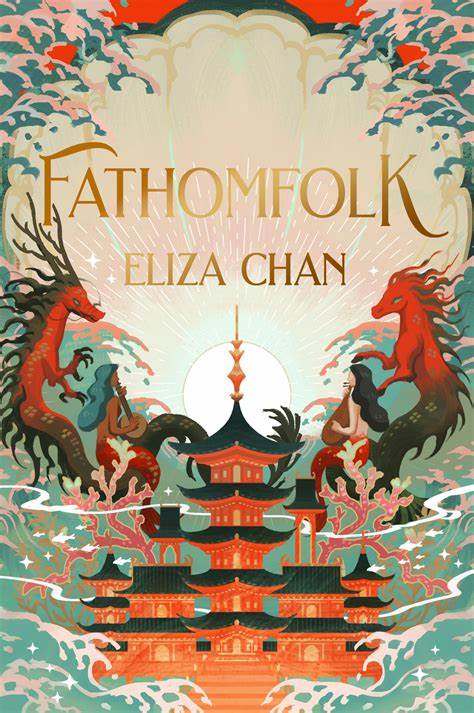
 At its simplest, Fathomfolk is a fantasy tale of underwater folk. More than that, though, Fathomfolk is a story about differences – differences between land and sea, differences in lifestyles, differences in society – and how land-based humans live alongside human-like sea creatures.
Combining elements of East Asian folk-stories and mythology with an otherworldly fantasy setting, Fathomfolk is a story that focuses around three main characters. Kai is a political chess piece, a member of the Fathomfolk aristocracy, a water dragon (able to change his shape between dragon and human) and also the Ambassador for the Fathomfolk in the city of Tiankawi, the political liaison between humans and the water creatures. He is kind, generous and hardworking, trying to change the social system from within. Integration is not easy, nor entirely successful. Not only does he have political opponents who do not wish to see him be successful, but the merging of the two groups has created an underclass that Kai is determined to remove, but not always without considerable sacrifice on his part.
His lover Mira is a relative newcomer to Tiankawi, a half-siren,and is the first non-human to be recently promoted to the rank of captain in the chinthe, the city guard. Her relationship with Kai and with humans is often regarded with suspicion and jealousy, but as a result, despite experiencing bigotry regularly, Mira is determined to show her enemies through her actions that fathomfolk deserve to be part of the city as much as humans.
The third member of our main group is Kai’s sister Nami, banished to Tiankawi by their royal mother as a result of minor misdemeanours. Young, spirited and easily impressed, her arrival in Tiankawi without an entourage quickly leads to her seeing the shanty areas of the city dominated by refugee fathomfolk, and notice the inequality and injustice at first hand. She finds herself attracted to Firth, the leader of a terrorist group known as the Drawbacks – something that will have consequences in the novel.
Nami also becomes entangled with the villain of the piece, a sea-witch named Cordelia. Like others such as Kai, Cordelia can change shape and often uses this to her own advantage. Cordelia’s presence on land is as a demure human named Serena, married to a minor diplomat, but in the sea is the head of a gangster-like empire dealing in drugs.
As we discover the characteristics, means, and motives of these characters we also find out about the city of Tiankawi. The cityscape itself is also impressive, ranging from high-tech multistorey environments with cable cars, heating and lighting generated by the Onseon Engine to the run-down squalor of the fathomfolk shacks. There’s a lot of worldbuilding here, which slows the pace a little, but also manages to create a pleasingly detailed vision of a vast metropolis.
Socially, such an impressive city is riven with discord. Political scheming between the different classes is paramount here. There are issues with refugees, migration and social inequality, with the sea people having to live with the consequences of human water pollution. The fathomfolk are also often feared by humans, so have to wear a bracelet that limits their actions with humans, being unable to hurt them, even in self-defence. Really, it is a story that manages to cover many real-world ills, that of ‘outsiders’, refugees, migrants, bigotry, class war and inequality, all of which lead to changes in the novel. The action sequences, when they happen later in the novel are also well done.
Such a complex setting means that Fathomfolk is a slow build of a novel, which means that it may seem a little slow at first – knowing your differences between humans, water dragons, sirens, kappas, kelpies, and sea-witches takes a bit of getting used to. There were times particularly near the beginning when the novel felt rather like a darker, adult version of The Little Mermaid movie!
However, once the main characters are established and their motivations are made known, Fathomfolk becomes an engaging world with social and environmental issues that will resonate with a contemporary reader although thinking through some of the practical elements around the main plot may raise more questions than answers.
As a debut novel Fathomfolk is impressive and undoubtedly ambitious in its aims, even when parts of the story didn’t entirely work for me. Nevertheless, Fathomfolk is entertaining, pleasantly different and with relevant social and environmental messages that don’t overpower the plot.
FATHOMFOLK by Eliza Chan
Published by Orbit, February 2024
432 pages
ISBN: 978 035 6522 395
Review by Mark Yon