Imagine that we’re back to 2010. The huge success of the movie Iron Man in 2008, with over $500 million made means that Marvel has decides to think about a sequel. This becomes the logically titled Iron Man 2. Set mainly six months after the first Iron Man movie, it becomes the third film in the MCU. The movie made $623.9 million at the box office, and was nominated for Best Visual Effects Oscar for that year.
If you remember, the plot follows on from the first movie where Tony Stark declared that he is Iron Man. Six months later, the consequences of that numerous. Stark is being poisoned by the palladium fuel used to provide energy to his heart. Not only that, but Stark is now being asked to hand over Iron Man technology to the US military, weaponizing the suit for the good of the country. When Stark refuses, this leads to the military covertly working with Justin Hammer (played by Sam Rockwell) One of the earlier Iron Man suits is stolen to develop an alternative – War Machine, played by Don Cheadle as Stark’s friend James ‘Rhodey’ Rhodes. At the same time Russian scientist Ivan Vanko, played by Mickey Rourke, develops his own technology and uses it to pursue a vendetta against Stark Industries because of something Stark’s father did. We also see the introduction of the Avengers and in particular Red Widow (played by Scarlett Johanssen) and Nick Fury (played by Samuel Jackson.)
To the book, then. As you should expect, The Art of Iron Man 2 is a book designed to look at the work done in the production of the second movie and is a 224 page, large ‘coffee table’ format tome, with heavy glossy paper. There are seven chapters and a foreword by director Jon Favreau.
In Chapter One, there’s a quick recap of the context by Kevin Feige, the producer, with further commentary from Louis D’Esposito, visual effects co-producer Victoria Alonso, Favreau and various members of the creative team who show us how the IM2 movie builds up things bigger from the first movie and how the IM2 movie tries to take elements of the original comic strip but make them work in a film.
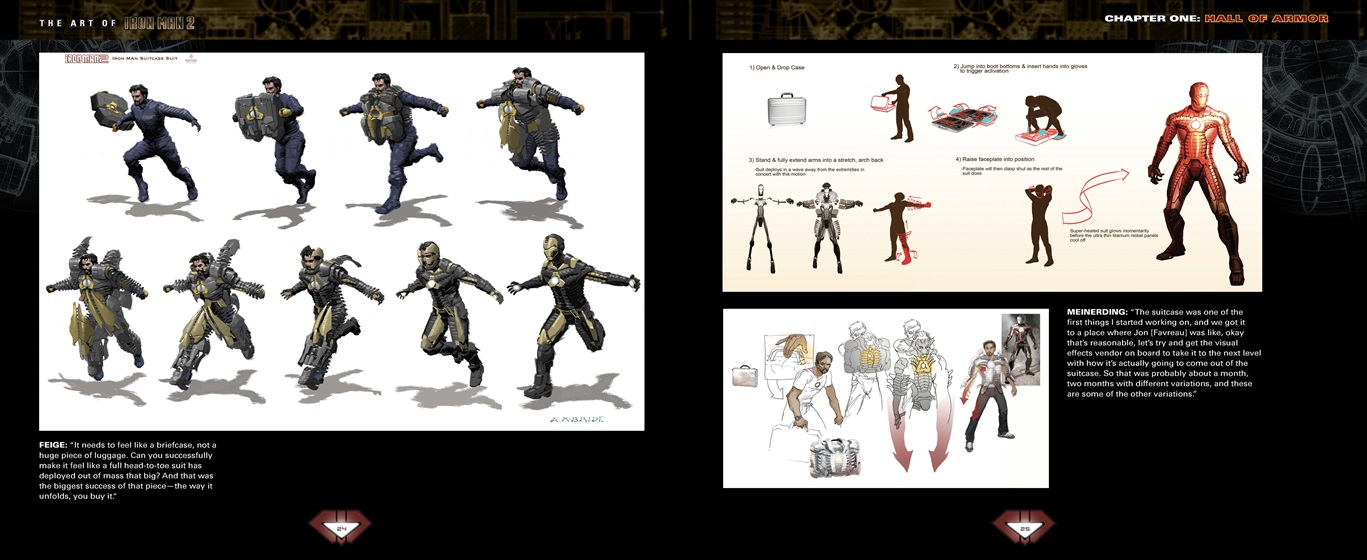
One of the things I found interesting was how Iron Man’s briefcase that turns into his outfit, which was originally in the comic, is made possible in the movie. It’s a very cool part of the movie.

©2024 MARVEL
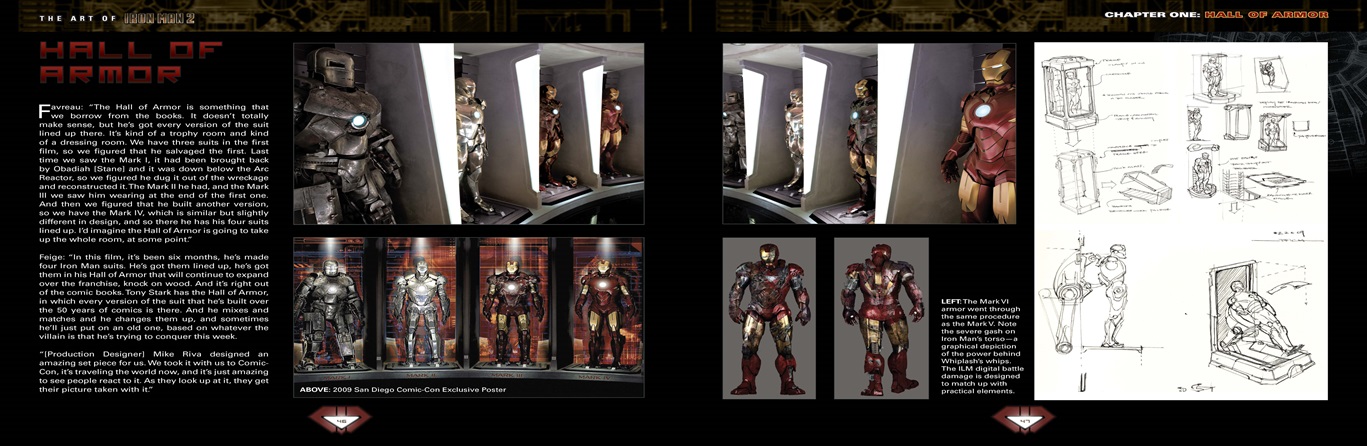
The chapter then goes on to the Iron Man Hall of Armour in Stark’s workshop, where we have the previous versions of the other Iron Man suits on display. The development of the suits is shown – think similar, but different and better – as well as the display of the suits, even if the producer suggests it is a little bit unnecessary.
©2024 MARVEL
In Chapter 2 we look at some of the other characters on Stark’s side, such as War Machine, Black Widow and Nick Fury, showing costume designs and artwork, with commentary from Feige, Favreau and costume designer Mary Zophres amongst others.
In Chapter 3 we look at the enemies, with the background to Whiplash explained as well as the changing evolution of Justin Hammer and his various military drones.
In Chapter 4, we look at the major sets at Stark’s mansion the Stark ‘74 Expo and the present day Stark Expo. The comments are from the voices of Favreau and Zophres again, but also with set decorator Lauri Gaffin, lead modelmaker Tony Bohorquez and production manager Michael Riva.
In Chapter 5 there are two sequences in storyboard form – the action at the beginning of the movie with Stark arriving at the Stark Expo and the drone battle towards the movie’s climax – to show how storyboarding is an essential part of planning the movie before production.
Chapter 6 looks further at technology and gadgets. Feige, Favreau and Prop Master Russell Bobbitt provides the commentary on how Iron Man’s chest light was redesigned, as well as Stark Tech such as the Prismatic Accelerator. Zophres talks about Tony’s racing car outfit and production manager Michael Riva and visual effects co-producer Victoria Alonso explains the head-up displays used in Iron Man’s and War Machine’s suits.
Chapter 7 is a much briefer one, dealing with marketing, which shows some of the initial poster designs. It would be nice to see some more post-event, when such things are clearer.
©2024 MARVEL
In summary then, the look of the book is great, with most pages being white text on a black background, which allows the many photos and graphics to stand out. Costumes, gadgets, and the images are all in phenomenal detail, although I did find that one CGI image is pretty much the same as another CGI image after a while.
The main attraction of the book is clearly for those who want to know more about the movie, and gain knowledge about the making of the movie that you may not get elsewhere. There is an assumption that you know the movie well, which may be a little limiting if you haven’t seen the film in 15 years! (In the interests of research, I did rewatch the film before writing this review.) With that in mind, though, it is important that the quotes and text in the book are not from the stars of the movie but from the backroom people and how they manage to put the movie on screen.
Having said that, I think that perhaps a more detailed reminder of the actual plot would have been useful, although clearly that is not the point of the book.
It would have been also nice to have given a little more context in places – where this happened and why. An update at the back of the book to show you what’s happened in the 15 years since the movie came out would have given this a little something extra.
Nonetheless, The Art of Iron Man 2 is impressive, as coffee table books of such kind should be, and as something produced in the early days of the MCU, this book is an interesting and informative book about the early days of the development of the MCU that fans will appreciate.
THE ART OF IRON MAN 2
Published by Titan Books, Reissue, February 2024
224 pages
ISBN: 978-180 3364 933
Review by Mark Yon
©2024 MARVEL