The Vagrant has helped to lead a rebellion against the forces who wish to subjugate his home of Thanet. Lucavi, the God-Incarnate is ready to clench his fist one last time to decimate the populace and become immortal. Cyrus Lathan is at a cross-roads, how much does he give up of himself to become the Vagrant and stop the God-Incarnate. Additionally, unbeknownst to many, a god long-thought to be dead got better and is masquerading as another person entirely. Thus, the stage is set for The Slain Divine, the conclusion of David Dalglish’s Vagrant Gods trilogy.
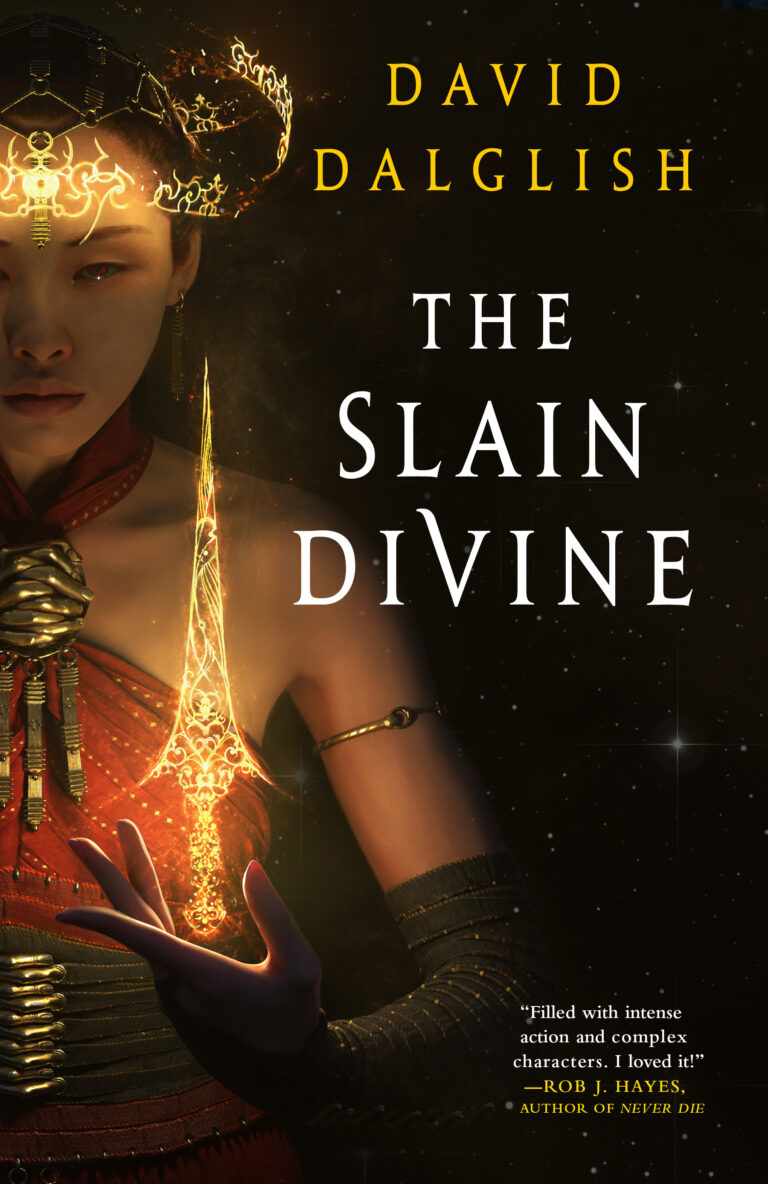
The Everlorn Empire’s grip on Thanet is tighter than ever. The God-Incarnate himself has arrived on its shores to crush the struggling rebellion and carry out his final, sinister plan: he will sacrifice the entire island in order to rise, reincarnated from its ashes.
The rebellion is struggling to separate allies from enemies, and to figure out a way to stop the slow destruction of everything and everyone they care for. Meanwhile, Cyrus is disappearing deeper beneath the vicious mask of the “Vagrant”. Under the mantel of the legendary assassin, he may be strong enough to take down the Empire, but at what cost?
After a fun and revealing prologue, Dalglish picks up almost immediately on the heels of the previous novel in the series, The Sapphire Altar. That makes for a dive into action breathtaking. The powers aligned with the God-Incarnate taking dominance while Cyrus/The Vagrant and his allies attempt to stop that grasp for power. A lot of the book deals with the temptation of power. How do already powerful people deal with ascending to the next level – is it a jump worth taking? Is it something that will erase who they are in favor of the god taking over? What happens when a person loses the power of a God? What of those seeking power only to be denied? Dalglish runs this theme of godhood through many of his characters in The Slain Divine. Beyond that, plot/story-wise, there isn’t much left to discuss given The Slain Divine is the third and final book of the trilogy. Suffice it to say, Dalglish builds extremely well on what he laid out in the first two volumes of the trilogy and adds a couple of new wrinkles into the story in this series finale.
While Cyrus is the lead and deservedly gets a lot of the focus, secondary characters like Arn, Mari, and Keles were just as fascinating. Mari proved to be an extremely formidable power in her own right, she can assume the form of other gods, a unique twist on the shape-changing power that fits the rule of cool. The fact that she and Arn have a romance that blossoms over the course of these two books, two warriors who complement each other, is something that elevates both characters. As for Keles, she was a much-needed counterbalance to Cyrus and his inner turmoil with the god-like presence of the Vagrant taking greater prominence over Cyrus.
The layers Dalglish folds into the plot are just deep enough. In some stories when there are two primary forces at odds with each other, a third wild-card power can be annoying. Quite the opposite with Soma/Dagon in this series. The ancient aquatic god revealed at the end of The Sapphire Altar becomes a fairly prominent power player in the finale. It was a wild card I thoroughly enjoyed and not only because of the Lovecraftian nod with the name of Dagon.
The Slain Divine is a successful conclusion to the Vagrant Gods trilogy. It sticks the landing, as the saying goes. Some plotlines may have wrapped up a little conveniently or easily, but overall, the ending was earned.
Vagrant Gods is a fun, enlightening, engaging trilogy that feels built to be binge-read. I read The Sapphire Altar about 14 months ago, so it took this old brain of mine a bit to get settled back into this world and the characters. When I did, I really felt like I was catching up with friends I hadn’t seen in a while in a good way. Especially Arn and Mari.
Dalglish told a well-planned, well-executed story over the course of three thick novels. Wonderful world-building, a great take on gods, thought-provoking examination of godhood, and quite simply, a fun story. The world seems large enough that it has room for more stories, certainly. Regardless, Dalglish has several finished series available to read. Based on how much I enjoyed this trilogy, Dalglish is yet another author with a deep backlist I intend to explore.
Highly recommended
© 2024 Rob H. Bedford
Trade Paperback | 477 pages
Orbit Books | January 2024
Author Website: http://ddalglish.com/wp/ | Twitter: @thatdalglishguy