 One of the most frequently used characterisations in fantasy is that of the outcast or outsider. In fact, I would say that for many fantasy readers this idea of not belonging is one of the genre’s key attractions. How many readers do you know that have been seen as outsiders for just wanting to read, for example? Such differences create division, and many fantasy novels use this idea to great effect.
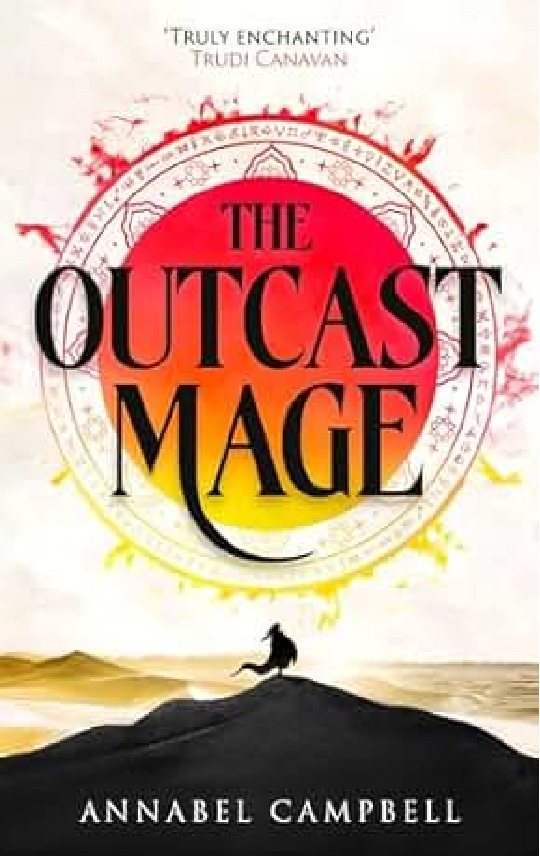
I was reminded of this when reading The Outcast Mage, a debut novel that uses the divisions created by those seen as outsiders and outcasts for plot purposes. As the title suggests, this is a story about outcasts and magic, and the people affected by it – those with, and those without it.
The book is filled with elements that are divided in some way or another. To emphasise the fantasy element, he city of Amoria is a crystal city set under a glass dome held up by magic. Whilst magicians live a pretty well-off life in Amoria, in a type of gated community for the elite rich, with the most of the poorer, un-magic-ed populace outside.
Even within the city there is division – within the city those enhanced with magic have a tiered social system, with Lieno at the top of the pile, and Mita (trainee mages) at the bottom. The magicless people in Amoria are of even lower standing, often derisorily called ‘hollow’.
Into this situation we are introduced to a variety of different viewpoints. The main focus is on Naila, a trainee mage. Taken from her family after being tested for magic at a young age, she finds herself at wizard training university (The Academy of Amoria) and is doing badly. Unlike her counterpoint classmates, most of whom are younger than her, she does not seem to be able to perform magic.
By contrast, Larinne Tallace is an Lieno Senator, one of the middle-rank of magic users. Her role in the book is mainly to show the political aspect of the world, but the situation is complicated by the fact that she has a close relationship with Haelins Akana, who is widely regarded as the greatest magician of their age, despite being ‘hollow-born’.
It is also for that reason that Haelins feels a responsibility to mentor Naila.
There are other relatively minor characters that will no doubt become more important later. For example, Entonin is a priest from the neighbouring country of Ellathia. He is secretly visiting Amoria, which is unusual as the two places have been at war for decades. With Karameth, his mercenary and taciturn sidekick, Entonin gives the reader an alternative, more objective observation of what is going on in Amoria, because as a priest of Ardulath, he has been brought up to despise the use of magic.
The key note of concern is that there is not only the ongoing and rising unrest between Amoria and Ellathia. The main focus of this unrest is Oriven, a magician who is stirring up unrest between the different factions in the city, whilst denying all responsibility. I thought of him perhaps deliberately as a Trump or Farage figure, charming and engaging with the masses, but who is covertly manoeuvring a power-grab by becoming the Allyn (High Consul) of the Senate and Council. He begins the book by creating a riot at a mass rally and uses this to enforce the use of his Justice police force. Dailem, Larinne’s sister, becomes a Justice, causing division in her family group, particularly between her, Larinne and her daughter, Naila’s friend, Ko’ani (Ko.)
As you can see from this, Annabel manages to spin a lot of plates at once here. As the first book in a series, there’s a lot of setting up to do here – places, characters, settings are all brought to the table before being put in peril. The book also touches on the now-contemporary themes of race, refugees and religion that seem to underpin many of our current global unrest.
Although there is inevitably a lot of information-dumping as the world and its characters are introduced, I did not find it too taxing. The characters are easily identifiable, so that even though the book has different chapters from different points of view, I found them easy enough to follow. The characterisation is one of the strengths of this novel, as the characters are engaging enough to keep you reading.
Whilst there are admittedly moments that seem a little familiar – there are touches of Hogwarts whilst in the Academy and possibly even Dune, with its Middle Eastern desert scenes, in terms of setting, for example, the situations are unusual enough and the characters are engaging enough to win the reader over.
I did feel that the book was a nod back to more classic fantasy. Trudi Canavan has been quoted in the publicity and I can see why. The Outcast Mage has the feel of an older-style fantasy novel, whilst also adding contemporary elements to its charm – slow-burn romances, with the often-used tropes of ‘found family’ and ‘friends to enemies’, all give a sense of familiarity to the novel that readers will appreciate.
Although there is some pay-off by the end of the novel, the ending is rather open, obviously leading to the idea that the next book will lead to bigger things. Whilst The Outcast Mage is clearly just the first part of a lengthier story, I was not disappointed by the end. In similar situations, if the book leaves you wanting to know what happens next, I count that as a success. This one does.
In summary, The Outcast Mage is a great start to a new fantasy series that was very readable and quite engaging.
© 2025 Mark Yon
Hardcover | Orbit Books
THE OUTCAST MAGE by Annabel Campbell
January 2025 | 448 pages
ISBN: 978 035 6524 184
Review copy courtesy of the publisher, Orbit Books