It’s been over 85 years since the first appearance of Batman, the grim vigilante upholding justice from the shadows. Like Superman, he was first published in the comic books, not long after the arrival of his super-hero friend. (Superman was first published in Action Comics on April 18th 1938, whilst ‘The Batman’ was first published in Detective Comics on March 30th 1939.)
I think that it’s fair to say that although interest over that time has waxed and waned, he, like his DC counterpart Superman, has been a consistent figure in American culture, if not globally. They are often thought of as similar, but they are really quite different. Whereas Superman is a man of Krypton, given superhero abilities as a result of that birth, Batman is a human being who relies on his training, Bruce Wayne’s millions and the gadgets he surrounds himself with. The point that Batman was ‘just a man’; whilst Superman had abilities, Batman relied on gadgets that he could buy or make. Whilst Superman could fly, Batman needed a mode of transport that was more down-to Earth.
None of these is more identifiable is the Batmobile, the car used by Batman in his various guises and incarnations over those 85 years, from armoured vehicle versions to the sleek and sophisticated. Although my own experiences have been mainly through comic books, then television in the 1960’s and then film from the 1980’s, the book’s authors point out that the Batmobile has actually been immortalized in nearly every imaginable medium, including not just comics, TV and films but also toys, and video games. This expanded edition covers the developments over the last decade, from the supercharged Batmobile from Zack Snyder’s Batman v. Superman to the gritty, DIY muscle car from Matt Reeves’ The Batman. The book also shows how Batman and the Batmobile reflects the times they were created in and the changing technology of their time.
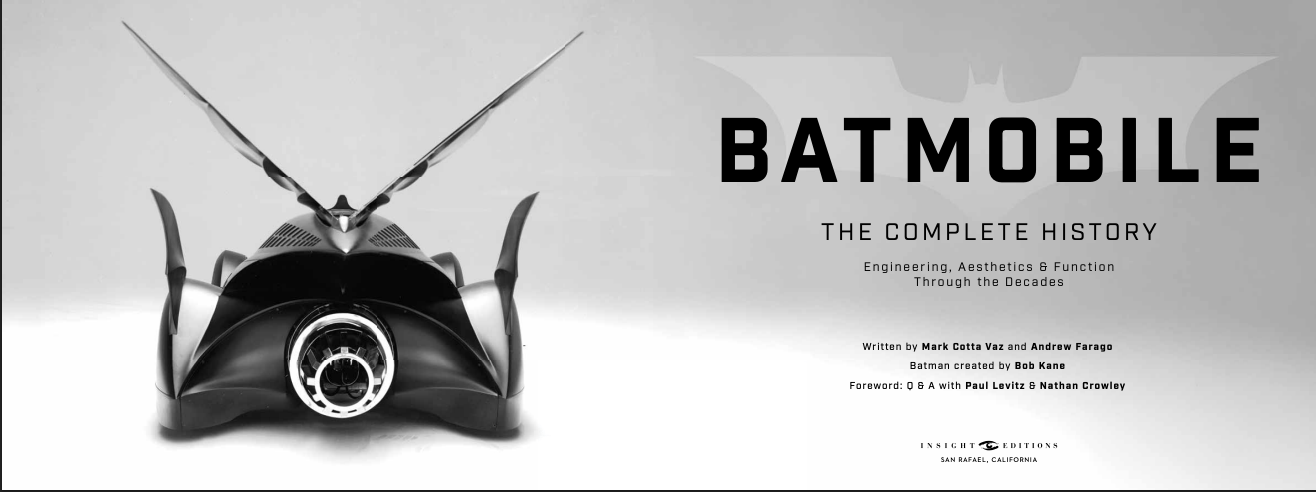
“An icon of American car culture, the steel and metal embodiment of an obsessed and driven crime fighter.” (page 26)
The book has 14 chapters, which go through these changes. Chapter 1 puts the Batmobile into perspective with the character itself. Chapter 2 deals with the comic-book version of the 1930’s, when the car was initially an afterthought but over time was especially adapted. In 1944, we got a vehicle specifically named ‘the Batmobile’ – and the Batplane, again a sign of its times.

Chapter 3 looks at the car which I guess most fans (like me) were introduced to – the 1960’s Batmobile from the iconic TV series starring Adam West as Batman. (It was also an influence on young Christopher Nolan, too.) There are lots of great photos here, as well as patent drawings. Interestingly, but perhaps not too surprisingly, it was built mainly for looks and not performance – it had no power steering, which made it awful to drive! But it was front and centre part of the extravagant TV series.

Chapter 4 looks at the Batmobile of the 1980’s and 1990’s Tim Burton movies. Burton’s detailed sketches with explanations on form and purpose, of how things should look and work, are excellent. Here, the car becomes less camp and more of a weapon – according to designer Anton Furst, the car became “the most brutal expression of an image that suggests sex and violence”.

Chapter 5 deals with the gaudy, fluorescent imagery of the Schumacher era. An attempt to take the Burton imagery and add a campy element harking back to the TV series, the vehicles are definitely an acquired taste, and not mine personally, but the imagery here is impressive, admittedly, and definitely makes an impression!
Things then took a pause in the movies.

Chapters 6 and 7 look at the various vehicles of the Nolan trilogy of the 2000’s, where the vehicles become more functional and more militaristic. This perhaps the section with most detail. There’s some nice interviews with Nolan and various production staff that explains the thinking behind the redesign. The Batmobile become less ‘car’ and more ‘tank’ here.
Although there is little mention of The Animated Series here, Chapter 8 shows details of The Lego Movie, which clearly deserves its place in the Batman canon. Some of the production sketches shown here are stunning.
Chapters 9 & 10 bring us the Snyder years of Batman vs Superman and The Justice League, with its older Batman played by Ben Affleck. Computer production has now come to the fore, and we have the development of new vehicles such as The Flying Fox, perhaps the most versatile of Batman’s aircraft, and the Knightcrawler, both of which are given details here.

Chapter 11 passes the baton to Robert Pattinson’s The Batman, and as perhaps befitting the step back to basics, we have a car which is an adapted muscle car – or as one person puts it, “raw, real and you have to visually feel it.” (page 176.) With its V10 engine, the point is that stealth has gone – you are expected to hear Batman coming. The car is designed to intimidate, and the details given reflect that.
Chapter 12 deals with the Flash movie, and the welcome return of Michael Keeton as Batman. Here the car is a vehicle that is deliberately adapted from the Burton vehicles but with visual elements of the Snyderverse.
Chapter 13 deals with Batman: Caped Crusader, a return to the Animated Series in a deliberately Film-noir style. Echoing the style and art of the Animated series, the artwork here is impressive.
Lastly, Chapter 14 brings the book up to date by showing that the Batmobile has not just evolved in the movies, but also in the comics. It is a nice summary of events to this point.
Summing up then, Batman: The Complete History is a lovely looking book with impressive photos and design images. There’s some nice fold-out pages to allow you a detailed look at some of the vehicles, both inside and out!
More importantly, and what elevates this above many of these similar coffee-table books, is that the text has something meaningful to say. These details enhance the images, make points that are both relevant and interesting, and are important to making the reader realise how significant this vehicle has been to the Batman throughout all of its versions. Printed on glossy paper, this updated version is a great and surprisingly engrossing read. Recommended to all Batman fans.
All images © Titan Books
© 2025 Mark Yon
Hardback | Titan Books
BATMOBILE: The Complete History by Mark Cotta Vaz and Andrew Farago
October 2025 | 228 pages
ISBN: 978 1835 415 986