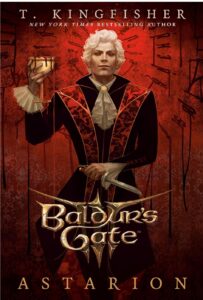
 Astarion Ancunin was supposed to be a magistrate, not a vampire spawn. He was supposed to serve the law, not the vicious vampire lord Cazador Szarr. And he was supposed to drink fine wine, not rat blood. Alas—the city of Baldur’s Gate cares little for what’s supposed to happen.
Though he has been powerless to resist his master’s bidding, haunting the nighttime streets to fetch warm blood, Astarion has never surrendered his hope. One day, this nightmare must end. He just has to find out how.
When the vampire lord announces a twisted competition for his favor, an opportunity presents itself in the form of a rare prize . . . and an unlikely alliance. The blood of a dead god is buried deep beneath Baldur’s Gate, and, to get it, Astarion will need the help of a handsome Aasimar paladin named Hahn den Suriel.
There are just a few problems. Astarion is not supposed to trust his fellow spawn. He’s not supposed to go out into the city for his own ends rather than the vampire lord’s. And he’s certainly not supposed to strike a deal with a stranger whose golden eyes can snare even a blackened, undead heart.
But the city of Baldur’s Gate cares little for what’s supposed to happen.
I wanted to start off this review by being transparent about my relationship to Baldur’s Gate 3. Despite being an avid gamer, I have not played through the game because, to be frank, the game just isn’t a style of game I enjoy.
I know, I hear the cries of BG3 fans screaming at me that this is a heinous crime (and trust me, fans of the game are very outspoken about their adoration of BG3), so I am truly sorry for not having first-hand experience of the game.
That being said, when the game came out, I was completely bombarded by the complex and extensive lore of the world, and I ended up consuming an unhealthy amount of videos showing off gameplay and dialogue, which was enough to pique my interest in the story of Baldur’s Gate 3. and this book. One thing in particular stood out very quickly, people were going completely wild for the incredibly sexy, campy, sarcastic vampire elf that is Astarion. So, it was no surprise to me that if any character was going to have its own novel, it was of course going to be him. So, while I recognise that there is no substitution for playing the game in its entirety to fully grasp the world of Baldur’s Gate 3, I hope it gives some reasonable context to say that I understand the premise and just how much this game means to its fans.
This book is best described as a prequel. It starts off by dropping you right into the moment that Astarion is turned into a vampire, where we learn a lot about what led him to this moment. He’s about to die very imminently and so the only way to survive is to become the spawn of a vampire lord named Cazador, to which he has very little choice, beginning his torturous life as a slave to his cruel vampire master.
One thing I thought this book does very well, especially at the beginning, is introduce you to Astarion’s personality, through his inner monologue and conversations with other characters. It does this without feeling too ‘on the nose’, and while fans of the game will already know his personality, it does a great job of immediately painting a very vivid picture of who Astarion is, even for those who are new to the character. Astarion is dripping in sarcasm and wry insults when he deems things not to his taste. Let’s just say his love of silk will become clear to you very quickly.
The book then takes us on a journey of showing us the moments that shaped Astarion where the narrative frequently flips between the past and present, giving context for key personality traits or events. I enjoyed reading about his childhood and family dynamics, which is drip fed throughout the book, leading to some interesting reveals and letting you know that he really has always been this precocious. It makes you feel that with his life choices and upbringing, it was almost inevitable that he ended up where he did.
Readers should however approach this book with some caution. There are trigger warnings in the beginning of the book and they aren’t to be taken lightly. T Kingfisher continues not to shy away from dark subjects, and Astarion’s story is no exception. Cazador is an incredibly cruel master, who takes complete delight in torturing and humiliating his spawn and this is written about in quite graphic details – Astarion’s suffering is very intentionally visceral, at times making for a very uncomfortable read if you are at all squeamish. This torture is key in understanding why Astarion ends up becoming a very self-serving character, who seems to hold no affection for anyone but himself. It also goes on to form an integral part of the books plot, where Astarion sets off on a seemingly suicide mission to win Cazador’s approval and promise of being turned to a true vampire by his master.
I did feel this core mission was a weaker part of the book, given how much time is spent on it. While it allowed for some interesting world-building and action scenes, along with a maybe all-too-convenient love interest thrown into the mix, it did lead me to believe that this was building up to a major plot point with a big payoff. However, as the book started to draw to a close, I started to feel a little deflated at the lack of closure I got from the story and it felt that I spent a big chunk of the book reading about a plot that was ultimately a meandering side quest. It does feel it was maybe an intentional choice by the author, but it leaves the book ending feeling really quite hopeless and defeatist.
But this does bring me onto another point, is this just simply a drawback of prequels? I have it on good authority from those who have played BG3, that the game does already give a lot of Astarion’s background, and because this book follows his life before the events of the game, we already know how things turn out for Astarion, so the book is ultimately low stakes given we know the character can’t die and does eventually escape Cazador. I was left questioning who this book is actually aimed at, is it just for fans or is it also trying to appeal to those who haven’t played the game?
This isn’t a criticism of the writing itself, throughout the book I really enjoyed T Kingfisher’s dark story-telling and characterisation of Astarion, and found him to be a likeable and witty character that you are really rooting for. So maybe this is more a case of the book’s premise itself being the core issue. The same fans of BG3 also told me that they felt other characters in the game were much more interesting in their opinion, and that it felt like Astarion was only picked for a novel because of how viral he went, and I found myself coming around to their thinking.
I think it’s also important to note that this book has had a strong reaction from fans of the game. Before it was even on sale to the public, it was getting review-bombed with 0 stars by fake accounts on reading apps, and very passionate Reddit threads full of spoilers of leaked scenes, taken completely out of context with rage over how the author has depicted certain things.
With all that being said, I still felt the book was worth reading if you are at all interested in the character or BG3, it’s well written and an overall enjoyable read, especially if you don’t crave strong resolutions at the end of a story. Astarion is a fun character, whether you love or hate him, and it felt like the book at least does him justice for fans or even those who, like me, have (sadly) not played the game.
© 2026 Lydia Harris
Hardback | Titan Books
Baldur’s Gate 3: Astarion by T. Kingfisher
October 2026 |288 pages
ISBN: 978-1835419588