 Here at Hobbit Towers we have reached Autumn. Suddenly the nights have got longer and it feels just a little colder; which means that it’s possible to get more reading in!
As we approach our usual run up to Halloween in October I start to look for those darker reads too: not necessarily out and out gore but things a little bit chillier. Think more M R James than Shaun Hutson or Thomas Malfi, perhaps.
Which brings me to this. I have read and reviewed a few of Joanne’s books recently. Although she may be best known for her non-genre book Chocolat, she has recently carved herself a little niche in reimagining folk tales and fairy stories as well as Norse legends, which I have generally enjoyed. They are generally much darker and creepier than the ones you may have read as a child.
This is a little different to those. It’s set in the now, for a start. And it involves an electricity pylon…..
Now I’m not a regular watcher of those home DIY ‘do-upper’ programmes like Homes Under the Hammer, but a phrase I have heard them repeatedly say is “Never buy a house without having seen it first”.
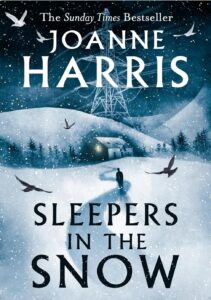
I was reminded of this upon reading Joanne Harris’s Sleepers in the Snow, for there the main character does exactly that – and the consequences are as you might expect.
Mind you, no damp, no horror stories behind the wallpaper – just horror of a different sort.
To begin with, the book reads like an introvert’s idea of heaven- the house our main character buys (he is nameless for much of the book) on the Yorkshire Moors is fully furnished and in reasonable condition, bearing in mind that it is a cottage in the middle of nowhere. Pots and pans, bedding and even the previous owner’s clothes and things are all still there, but generally it seems like just the place he needs after a divorce – quiet, with nobody around to disturb him. The nearest village – and the shops – are a five-mile walk away.
The only issue is that behind the house there is a 60-metre electric pylon that was conveniently missing in the estate agent’s details.
When the book begins in September, the house charms with its view of nature and its homely feel. Even the pylon is not as obtrusive as it first appears if you look outside in a certain way, and the low-level noise the electric wires make outside are surprisingly comforting.
The new owner has been clearing out some of the previous occupant’s belongings but he has found that he likes what is there and is happy to keep them. This includes the diaries of the previous owners, a couple who were found dead in the snow together, not far from the cottage.
Only as nights start to draw in, and the weather takes a turn, so does the house. The cosy isolation becomes menacing, animals begin acting strangely, and it seems someone could be watching the house. Green tennis balls keep appearing everywhere, but this seems more peculiar than scary, odd but not threatening.
Over the rest of the novel things become strange and weirder. Things appear and go missing, and animals that are glimpsed but never really seen lurk in the shadows. The proximity of the electric pylon seems to create random voices, bursts of dialogue and yet limit radio and television signals, creating greater isolation.
All of this ramps up by the end in December and things come to a head amongst an isolating thick snowfall.
The author herself describes the book as ‘odd and reclusive‘ in her Acknowledgements, written in four months in a cold bleak winter in Yorkshire. And if ever you had to find an atmosphere to read an appropriate book in, that would be right. The chilling coldness almost appears to be coming off the pages!
It should not be a great surprise that the book deals with isolation and loneliness, a social distancing, an internalising of thoughts and emotions.
In terms of tone, the book is suffused with Hauntology: (“a range of ideas referring to the return or persistence of elements from the social or cultural past, as if to haunt the present.” says Wikipedia.) As we continue to read, we find that the past impinges on the present, reminds us of what has been and then imprints on the present, and this is reflected in the nods to folk history and the area’s ancient past mentioned in the book.
Over time, the perspective of the main character becomes odder, more disjointed, more fractured – as things get stranger, the reader is left wondering whether this strangeness is real, the product of isolation or an over-active imagination, induced by stress? Is it the effects of living close to the electric pylon who seems to generate random voices and noise on the narrator TV and radio? Is it the consequences of dementia?
What is impressive is that most of this book is the internal monologue in the head of the main character, although there are interludes. It’s not easy making the focus of a 260-page book the thoughts and actions of one character who is isolated, yet Joanne never makes it dull. It’s subtle but stylistically very clever.
Sleepers in the Snow is the sort of book that as you read makes you look at shadows in the corner of a room, or suddenly start to notice the creaks and clicks of your house settling at night. With that in mind, it’s possibly not a book to read alone late at night. In fact, describing it as ‘Haunting’ doesn’t begin to define it….
Sleepers in the Snow is a book built on stealth, creating a place that should be wonderful and yet isn’t. It is definitely a Winter book (snow!) which made me appreciate sitting in the warm with a nice cup of tea reading this. As the seasons move towards the dead of Winter here, I would say that this is the ideal book to read. It is unsettling, but in a wonderfully creepily quiet way.
© 2026 Mark Yon
Hardback | Gollancz
SLEEPERS IN THE SNOW by Joanne Harris
October 2026 | 260 pages
ISBN: 978 13996 0479 6