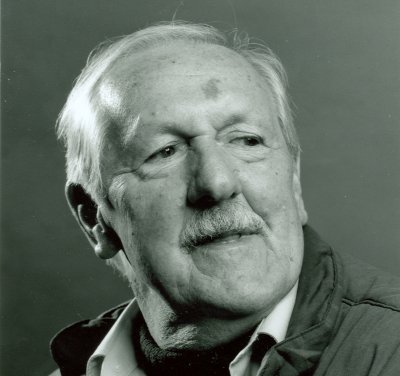
 We’re just hearing of the sad death of Brian Aldiss, OBE on his 92nd birthday (19th August 2017). His impact on British SF is immeasurable, not only an author but an active advocate of the genre since the 1950’s. In tribute, here’s our last interview with him, back in June 2015 as he was approaching his 90th birthday. RIP, Brian.
————————
SFFW: Hello, Brian: many thanks for giving us some time here. Welcome to SFFWorld.
I’m writing these questions as Open Road Media are releasing some of your older work in the USA as e-books. I’m very pleased to see that some classics are there myself.
Of the current list (Hothouse, An Island Called Moreau, Dracula Unbound, Enemies of the System, Frankenstein Unbound, Report on Probability A, Super-State, The Malacia Tapestry, The Salvia Tree and Other Strange Growths and White Mars Or, the Mind Set Free) it must be said that there’s quite a range from your eclectic career. Have you got any particular personal favourites in that list?
Hi, Mark, nice to hear from you. So here come a few answers.
Setting aside that relatively scatty–don’t read unless blind-folded– “Report on Probability A,” I’d have to show a vague romantic love for “Hothouse.” Its origins were unusual. I was in the British army and sent to Burma to fight the Japs. We won. So I was given leave in Calcutta.
While in Calcutta, I hired a ferry boat across the River Hoogley to the Botannic Gardens, grand and extensive. There I found myself confronting THE WORLD’S LARGEST TREE–not growing upwards like a sequoia, but outwards like a blister.
Quite a sight. When I finally got back to Britain, I found an article by Aldous Huxley’s brother in a science magazine. So I got the idea for a short story, which I sent to F&SF. They liked it, and so did the readers, so I just kept on; it was a case of the idea running away with me.
SFFW:How comfortable are you generally with seeing the re-appearance of older work? Is it something you’re happy to do, reaching a potentially new, wider audience, or are they something from your past but something you’ve moved on from?
Oh, I guess I’m for the wider audience! On the whole I have always pleased myself, writing what moved me to write, not what I was told to write. So – well, the element of luck or ill luck whistles into life like windy weather.
SFFW: From that list, I’m interested with the Moreau, Dracula, Frankenstein connection – all horrors in their own right, originally from HG Wells, Stoker and Shelley. But what was your take on these seminal works?
All those excellent horror novels have their fated original impulses. Like poor Mary Shelley, whose mother died very shortly after Mary was born. I guess in those days bloody doctors did not wash their hands, eh?
SFFW:Your love of Herbert George Wells I know from your residency as Vice-President of the International HG Wells Society. Can I ask what it was that drew you to him originally?
H.G.Wells was unique. Everyone read him in his days. And he was a stylist, Turn to page one of War of the Worlds . A friend of mine and I have a two-man fan group based solely on one word on that first page and on the skill of its placing:
“intellects vast and slow and UNSYMPATHETIC….”
Wonderful!
SFFW: Am I right in saying that The Saliva Tree was written in homage to HG?
Sorry, I can’t remember what SALIVA TREE was about. Not trees – I had done trees. True, I hadn’t done saliva. Perhaps I wrote this during the year I spent in Yugoslavia.
SFFW: Moving a little more up to date, in recent years you seem to have been more interested in the planet Mars, both with White Mars (in the list) and Finches of Mars. I recall White Mars appearing at about the same time as Kim Stanley Robinson’s Red/Green/Blue Marsseries about fifteen years ago. It was a very different future to that proposed by Kim’s, if I remember right, and even more so than HG’s. Could you explain your thinking behind it?
One uses Mars because it is just about plausible that human beings might live there one day. I had grown sick of the stories about men – always man – marching about in martian jungles; so that my novel (FINCHES, I mean) has a lot of women, and a New York professor agreed with me that lighter gravity might affront the pregnancy cycle – in which I have a certain painful interest.
SFFW: Let’s move away from the current book list a little.
One of our favourites of yours amongst the SFFWorld team is Billion (later Trillion) Year Spree, which is the book of SF criticism you co-wrote with David Wingrove, who we’ve also interviewed here before. I think one of the reasons that I personally liked it was that you put forward some ideas about SF that shook things up a little. ‘The True History of Science Fiction’, I believe it was subtitled. How do you see it yourself these days? Have your views changed?
I don’t know enough about SF these days to hold any particular opinion. Every dog has its day I will say that in the past, the day dawned when I became sick of the shallow opinions of those who thought that an illiterate fellow in New York, a fugitive from Lichtenstein or somewhere, had invented SF. I consulted no one, I sucked up to no publisher. I simply sat down at my desk and wrote a history of SF, which I called “Billion Year Spree.” That book has its faults but does not muck about. The update – naturally – followed later, and my book is now available in Chinese.
SFFW: I’ve just made a quick calculation that you are now into your sixth decade of professional writing, which is quite amazing. (Though I should have realised – I did enjoy singing “Happy Birthday” to you at LonCon in August!) Lesser mortals would have given writing a rest a long while ago! What is it that keeps you writing?
Thanks for singing “Happy Birthday” at the London con. That was a wonderful experience.
Age and writing? There are probably thousands of old folk who at this very hour are dying from BOREDOM. Boredom’s a killer. I’m enjoying myself – and writing an appallingly long novel. (I have fallen under the influence of Tolstoy.) And I write and illustrate – the tax officials list me as an ARTIST, by the way – a multi-volume hardcover A5 Journal. I am now completing Volume 81. These volumes are stored in a big white German safe behind my kitchen. When I die this priceless collection will go to the Bodleian Library here in Oxford. It will be my second life.
SFFW: Thinking back, how did you start writing? Was there a particular book or moment in your life that spurred you on?
Legend has it that I wrote several little tales when I was three. My mother took care of them, binding them in slices of unused wallpaper. Luckily, these tales have been lost. But at school, aged about fifteen, I wrote SF stories concerning the adventures of Whip Donovan. These I illustrated with watercolours. The stories are hard-cover and look quite grand.
The twin volumes turned up in an underground store in Swindon. A facsimile edition will be published for my ninetieth birthday, later this year. Amazing!
You think this is great, eh? You try waiting seventy-five years for publication….
SFFW: Undoubtedly, the science fiction field is a genre that has grown in style, maturity and complexity over the years. As a Grand Master, do you find yourself still reading for entertainment much? Or do you tend to read away from the genre?
I read very little. At present I am reading a book on ‘Magna Carta.’ This charter, centuries old, declares that a man is as good as a king, and has kept our rather dodgey little islands more or less stable over the centuries. A clause from that amazing charter still appears in our constitution.
If I may venture to say so, when you rightly kicked the British out of your dominions, you should have retained the Magna Carta, in order to resolve some of your present problems.
Most evenings, I go for supper to the house of my darling dazzling lady love – or else I take her out to one or other of Oxford’s many restaurants. And we probably watch TV. In the States, you have Hollywood but no equivalent to the BBC (no adverts, right?) Mind you, the USA has better SF magazines…
SFFW:Once again, thank you very much for your time, Brian. And let me be one of the first to wish you a very happy 90th birthday in August!
A London publisher, Harper Voyager, has started reprinting everything I ever wrote, decade by decade. It’s an enormous bit of luck and must prove something or other, I have just written them four intros to their four-volume set of all my stories published in the 1960s. Perhaps they won’t mind if I send you a scrap of one relevant here.
“Should an author concern himself about who his readers are? Should he worry about what they think of his writings? Is not the world full of better and more cogent concerns?
These questions I raise without, hardly surprisingly, being able to answer them.
I raise them because I have been so entirely a writer all my long life, for ever concerned with what to say and why I choose – or why I have been chosen – to say it.”
And then it’s Goodbye, my friends, and thanks for getting in touch, and please forgive small errors in what has necessarily been written in haste. All best regards!
I lift a glass to you – Brian