And so it begins: our now traditional SFFWorld countdown throughout October down to Hallowe’en. Each year we take the month to highlight things old and new with a Hallowe’en-ish feel – books, movies, TV, anything that we think might be worthy of your attention.
In a few days, we’ll post about the new movie that seems to be taking the world by storm….. but to start with, here’s our review of an old favourite from Stephen King – the book, IT, first published in 1986. Over to our custodian of all things Horror (but not horrible), cultish and occultist, Randy Money, for his take on the novel:
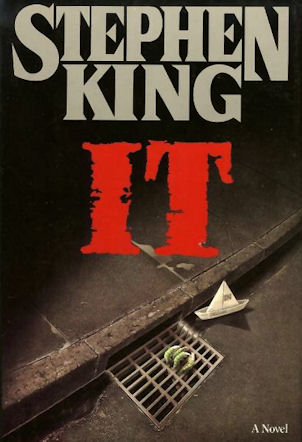 IT by Stephen King (Viking, 1986)
The terror, which would not end for another twenty-eight years – if it ever did end – began, so far as I know or can tell, with a boat made from a sheet of newspaper floating down a gutter swollen with rain.
— first paragraph
“They float,” it growled, “they float, Georgie, and when you’re down here with me, you’ll float, too –
….
“Everything down here floats…”
— Pennywise
Derry, Maine, another New England town in the tradition of Castle Rock, Arkham, and Innsmouth, is imbued with a simmering, submerged evil which may be able to suppress recognition of its activities and existence in the townspeople, or which they may just be ignoring. Roughly every 27 years a series of deaths, murders, massacres, of which most victims are children seem to erupt for a time and then subside, the outside world taking little note. In 1958 a group of eleven and twelve-year-olds – Bill, the leader, Ben, Beverly, Richie, Mike, Stan and Eddie – face the latest outbreak after Bill loses his little brother. Each of them encounter Pennywise, the clown, who takes on the forms of their fears, and somehow they survive to meet each other and join forces against a being only children seem able to comprehend and believe in. Their belief makes them vulnerable, but also lends them power. But immortal evil doesn’t die easily and when the seven become adults they are called on again to face the cause of more children going missing or dying.
King’s novel follows parallel story lines, shifting between the events of 1958 and 1985. Mike remained in Derry after the others left and he calls the others back, and only he remembers what they saw and did in 1958, most of it anyway, the power of It erasing memories in those who leave. Returning to Derry triggers their recollections, memories that hit harder than punches, but which also prepare them for what follows.
A lot happens in IT, too much to summarize, and most of it to children, so our willingness to suspend disbelief rests on our acceptance of Bill and the others as children thinking and acting as we believe children do. This has always been a strength of King’s and he spends a good deal of the early portion of the novel delineating and developing the main characters each of whom begins as a stereotype: Ben is the fat kid, Bill stutters, Richie is the wiseass, Stan a neat freak, and Eddie a hypochondriac. Mike gives King the chance to examine small town race relations. As one of the few Blacks in the area and going to a church school rather than public school, Mike is not really known by the others and is introduced to them by a common enemy, Henry Bowers, who with his budding gang terrorizes smaller kids. Mike’s experience, and what he learns from his father, indicates the outlines of the evil in Derry while adding to it the evil of racism, giving IT a dimension I can’t recall in other King novels I’ve read.
Beverly, meanwhile, is male fantasy, the poor girl on the cusp of puberty, so beautiful even at that age that better-off girls ostracize her and all the boys fall in love with her, but also so smart, brave and resourceful they like her. To an extent Beverly’s idealization – and Grady Hendrix argues persuasively that all of these children are idealized – is balanced and grounded by the relationship between her and her father in which a submerged sexual tension leads to abuse; their relationship contrasts with the indifference of Bill’s father and the closeness between Mike and his father, and also acts as foundation for scenes late in the novel in which young Beverly makes a decision that arguably works within the narrative, but which I found deeply unsettling all the same. To King’s credit, he does not paint that decision as uniformly positive since, though unremembered by the older Beverly, it echoes throughout her life in unhealthy ways. And that’s true for the others as well: To some degree each is successful in adulthood but that unremembered past informs their lives and their self-assessments, and not always positively.
About Henry Bowers, their nemesis and chief antagonist aside from Pennywise, he is something of a stock character in King’s work, the bully, stupid, mean and slow, who is yet relentless. King gives him his due, though, sketching in his trajectory from ugly childhood to more or less unwitting puppet of Pennywise, his background explaining though not excusing his behavior while also outlining his thought process and attitude.
Frequently King wears his influences on his sleeve. In IT he alludes directly to old movies that the kids have seen; Pennywise takes on the faces of fears and Ben sees him as a mummy while Richie and Bill encounter him as the titular character from I was a Teen-age Werewolf. The older Bill sees a house and thinks “whatever walked there walked alone,” a phrase from The Haunting of Hill House and a not altogether unfitting description of Derry. Not mentioned by King, but I think underlying the novel’s take on Pennywise the clown and his allusions to the circus, is Ray Bradbury’s Something Wicked This Way Comes. As with Jim and Will in Bradbury’s novel Bill, Ben, Beverly and the others only stand a chance against evil by banding together, and like them Beverly and the boys find power in laughter, Beverly in particular remembering their fellowship in terms of laughter, how whenever they were together, even with the threat of Pennywise hovering near, they amused each other. Fart jokes, the affectionate shushing of motor mouth Richie and his inept impersonations, the high spirits of being with others who accept you and like you, gives each a chance to establish individuality and independence from family and learn how it feels to have friends, which in turn contributes to their merging as a group opposed to Pennywise.
This is a long novel, 1,138 pages in the old hardcover I read, easily more than the page count of some trilogies on my shelves. While I had a sense of King wrestling with the material and struggling to shape his story which leads to some repetition and awkward exposition, I found the novel immersive, King orchestrating emotional swings from highs to lows with almost every chapter. I’m sorry I didn’t read IT when it first came out and I can see myself reading it again someday.
Titles of Similar Interest:
Something Wicked This Way Comes by Ray Bradbury
The Snowman’s Children by Glen Hirshberg
“Struwwelpeter” by Glen Hirshberg
Sharp Objects by Gillian Flynn