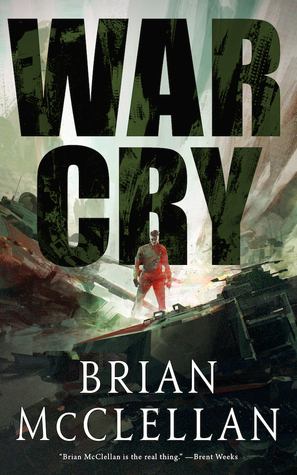
 Another month, another Tor.com novella…
One of the great things about these novellas is that authors can try new ideas and stories, often different from the work they are known for. More in-depth than a short story, but not as complex as a novel or a trilogy, Tor and other publishers have for the last few years brought back this rather unfashionable mode of story-telling.
It has been successful too – see Tor’s recent Nebula and Hugo Award success with Martha Wells’ first Murderbot story, All Systems Red, for example.
Like Martha before him, Brian is best known for his Fantasy writing. His Powder Mage series (five novels, and nearly a dozen novellas so far) have also won Awards (Promise of Blood won the Morningstar Award for Best Newcomer, 2014).
For this novella, it’s a new setting, with new characters. War Cry feels more contemporary than any of his previous work.
The beginning of this novella reads like many a fairly modern war story. It could be the Spanish Civil War of 1936 or Stalingrad in 1941, with talk of propaganda leaflet raids, machine guns, propaganda radio, worn-out carbines and an army on the cusp of defeat. It’s only after a couple of pages that mention is made of Teado’s platoon’s real job – a platoon that uses sorcery and magic to get the job done.
The only problem is that things are increasingly tough – their side in the war are losing, supplies are running out, equipment is failing and soldiers are beginning to desert – or, at least, think about it.
A chance at a resupply mission, albeit risky, is undertaken with some enthusiasm – not only does it mean that the might have food and viable weapons to use, but it gets them out of the foxholes they’re stuck in and relieves the boredom and tension of being unable to make much of a difference. After hijacking what they hope is a new supply of enemy food, Teado, separated from the rest of his platoon, finds instead something else that could change the course of the war.
The mixture of relatively modern warfare and witchcraft is nothing really new – Poul Anderson was doing it with his Operation Chaos stories back in 1956, for example, Heinlein had something similar by showing us magic being used as a business strategy in Magic, Inc. (1940) and in 2015 there was a good anthology edited by John Joseph Adams named Operation Arcana which covered similar ground. Even Lord of the Rings has medieval battles with added magic.
But what Brian does here is breath life into old tropes. His use of different magical types is interesting. Teado is a Changer, who, rather like werewolves, can change his form at will. Bellara is a Smiling Tom, who can use magical illusion to make things seem invisible. There’s also mention of Fire-Spitters and Wormers, although they are not really seen in this story.
War Cry is a Fantasy story, admittedly, but at the same time it shows the reader basic human universals – warfare is horrible, but at the same time it is something that for the sake of freedom and liberty has to be done, friends and loyalty is important.
In fact, most of all, this is a story of honour and betrayal. Teado is torn between defending his comrades and leaving what seems to be an increasingly senseless war. He is also a teenager who makes a huge mistake which has consequences for his friends. By the end there is resolution, although not without cost, and things are more complicated than they at first appear.
So: if the idea of these novellas is to entertain, has War Cry worked? Yes. Teado is likeable and sympathetic and the characterisation is brief but adequate, enough to give us the idea of what is going on before focussing on the pace and the plot.
The other success is that the story also introduces the reader to a new world, which I’d be very happy to read more of. The ending is partly left to allow this to happen.
In short, War Cry is a terrific success. It sets its stall out quickly, is readable in one session and remains memorable throughout. Like Martha’s series, I’m hoping to read more from this world in the future.
War Cry by Brian McClellan
Published by Tor.com, August 2018
96 pages