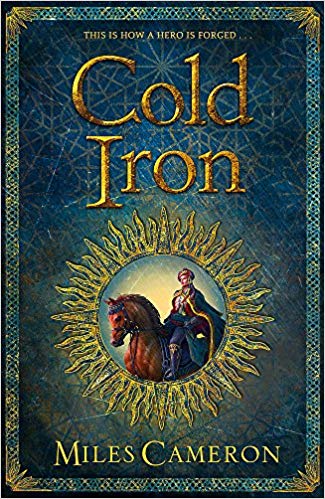
 For lots of different reasons, authors often feel the need to change their name when writing different stories. For Stephen King it was Richard Bachman, for Tom Holt it was (and I think still is) K J Parker. In the same way, perhaps, it is not a great secret that Miles Cameron is also historical writer Christian Cameron. He’s not entirely new to Fantasy writing, though. I really liked The Red Knight (reviewed here) the first in the now five-book series, The Traitor Son Cycle, although its rapidly changing points of view did frustrate some readers.
Cold Iron is a new series and a fresh start. And the good news is, it’s very good indeed.
From the publisher: “Aranthur is a student. He showed a little magical talent, is studying at the local academy, and is nothing particularly special. Others are smarter. Others are more talented. Others are quicker to pick up techniques. But none of them are with him when he breaks his journey home for the holidays in an inn. None of them step in to help when a young woman is thrown off a passing stage coach into the deep snow at the side of the road. And none of them are drawn into a fight to protect her.
One of the others might have realised she was manipulating him all along . . .
A powerful story about beginnings, coming of age, and the way choosing to take one step towards violence can lead to a slippery and dangerous slope, this is an accomplished fantasy series driven by strong characters and fast-paced action.”
So where does this book get it right? From the start, it is clear that the author is an experienced writer with a considerable amount of knowledge used to enhance the novel. The prose is tight, precise and skilfully developed, with few of the common errors often seen in less-accomplished work. Things develop smoothly and logically, and details are dropped into the plot carefully without massive info-dumping. There is clearly a well-developed backstory and history that is drip-fed to the reader to give a sense of the wider world that don’t feel bolted-on.
The world-building is imaginative and detailed, enough to make the reader feel like they are wandering through the streets, fighting or living in the decrepit hovels of ‘The City’. Though the city itself is not named, there’s a really nice sense of place here that I haven’t felt as strongly about since reading Scott Lynch’s The Lies of Locke Lamora, in its imaginative details of buildings and streets. The world is medieval-esque, but with touches of other cultures and ideas that are combined to make a world that seems to work. Whilst there are admittedly medieval elements shown, this one is more Bradley Beaulieu’s Sharakhai than Steven Erikson’s Malazan, though there are aspects of both here. The city feels like a huge Mediterranean-style urban area, and the society a combination of Renaissance and Roman Italy.
Secondly, the characterisation is excellent. Aranthur is charming, polite and blithely-unaware of his effect on other people. He often seems to go where he feels he should, unknowing of his own limits. We do not have young characters able to achieve magical things within hours, without a logical and reasonable explanation for it. The story takes its time to unfold and does not make massive leaps of faith or coincidence. Any action is given reason that is appropriate. Whatever happens seems right, logical and sensible, and this creates a feeling to the reader that the place seems real.
Most of all, there is an almost casual level of detail that is so well-done that this feels as if you are there. The details on horses, weaponry, housing and urban and rural life given are not superficial, nor are they there to show off to the reader the writer’s knowledge and research. Duels are described in detail, the effects of weapons used grimly effective. It is the sort of thing that is written so well that it feels like it can only be written from experience. It’s thoughtful and clever and yet eminently accessible. Miles knows what details to include and what to leave out, managing to balance details of weaponry, horses and fencing with religion, magyk and politics.
Of course, none of this would work unless there is a plot to follow and develop. Most of all, perhaps, Cold Iron is a story about choices and how decisions made can lead to unexpected consequences, be they good or bad. As the book progresses, Aranthur finds himself drawn more to a life of swordsmanship than study, although it is clear that he has some magical (or magikal) ability, which is why he’s at college.
I guess that if the author had wanted, he could have made this a historical novel, but I liked the point that this is unashamedly a Fantasy novel. The fantasy element is integral to the story and not just bolted on, with mention of ‘magyk’ essential to the plot and the use of crystals for generating various magikal actions being an important element. What was a nice development was that the fighting and fencing, that Aranthur clearly develops a taste for, affects his magikal abilities. Indeed, much of the book is about the choices he has to make, and being a young man, it is not always clear which is the right one.
In terms of plot, there’s a bildungsroman-esque story of the growth of Aranthur, in that ‘farm-boy to important-person’ kind of progress. It’s quite old-school in its style and tone, though there are definitely grim moments. As Aranthur is an Arnaut, from the less progressive South, he is unused to many of the social and cultural aspects of ‘The City’, which would normally limit a person’s progress. Here it seems to be less of an issue, although by making Aranthur someone ‘on the outside’ it does allow both the author and the plot to observe events with a degree of objectivity and also discuss aspects of racism, immigration and inequality.
Such actions do lead to two weaknesses in the book, although at least one is commented on by the characters themselves. It is quite uncanny how Aranthur makes progress socially and politically through the book, as the people he meets and aids are often then connected to others. It is not for Aranthur to start socially low and remain low, for by the end of the book he is known by academics, military leaders, swordsmen, princes and even the Emperor himself. Whilst it could be argued that there is a degree of manipulation on some of the character’s part for this to happen, there were times when this aspect of the novel seemed rather too frequent and coincidental.
The second issue is that there is an unusual pace to the novel. To begin with, there are no separate chapters in the novel – somewhat different to the Traitor Son series – although there are breaks in the narrative. It is the antithesis of the Traitor Son series, I think deliberately so. I didn’t find it to be too much of an issue, but some readers might.
Perhaps more frustrating is the fact that, having spent 350 pages of the novel in “Book One”, the last 80-or-so pages end on a rather abrupt note that will clearly be continued in Book Two. Whilst things are resolved in these last pages, the imbalance and the abrupt conclusion does seem a little odd. When the whole trilogy is complete, I suspect that it will be published as one volume where such issues will be less apparent.
Despite this, my overall impression is that Cold Iron is a terrifically good novel that epitomises how good Fantasy novels can be when done right. This is an author with a tale to tell and the skills to do so admirably. I couldn’t put this one down. Reading this story, compared with other recent Fantasy novels I’ve read, felt like I was reading a university-level piece of work compared to essays written at high school. Put this up there with The Name of the Wind and, more recently, Twelve Kings for me. Definitely one of my best of the year – I look forward to the next book with excitement.
Cold Iron by Miles Cameron
Masters and Mages, Book One
Published by Gollancz, September 2018
ISBN: 978 1 473 21767 6
438 pages
Review by Mark Yon