 Crickets chirped the last few bars of their nightly song. But Kill Creek circled the house like a moat, and within this keep, this stronghold of silence, nothing stirred. Only the tallgrass made a sound, swaying even when there was no breeze, its dry, husky top bristling like the warning rattle of a viper.
From Kill Creek
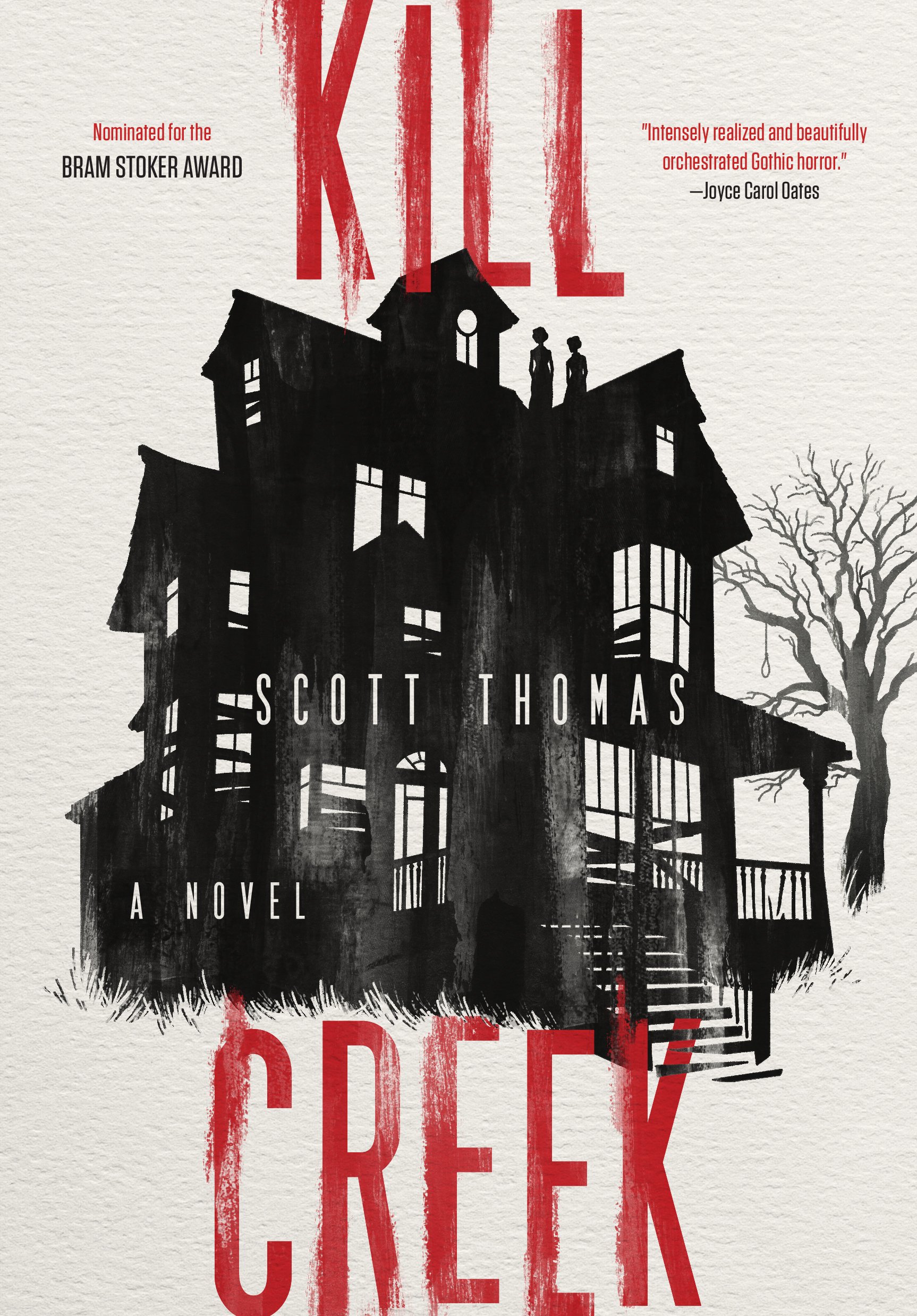
There’s little surprise in a writer for television devising a high concept plot for his first novel: In Scott Thomas’ Kill Creek, four major horror novelists spend a night in Finch House while being interviewed for a podcast: In Kansas history Finch House has a reputation of being haunted and the night is Halloween. Perhaps more surprising is that Thomas handles the complexities of his concept, characters and setting well, providing a satisfying narrative throughout.
Sam McGarver has had four successful novels, but is fighting writer’s block, something in his past impeding his writing and breaking up his marriage. T. C. Moore doesn’t believe in writer’s block, brimming with brutal ideas that always lead to minutely described fictional bloodshed and mayhem; a self-made writer who emerged from a past as painful as Sam’s, she’s hungry for the deal that will change her from niche writer to house-hold name. Daniel Slaughter writes Christian horror for young adults in the belief that it will show them the horrors of an immoral life; but sales have slipped and some of his fellow believers are questioning, when not condemning, his methods. Finally, there is Sebastian Cole, the grandmaster of the genre, whose gracefulness and discretion as a writer inspired Sam. And annoys T.C. Although still a force in the genre, it has been a while since Cole’s heyday. Each is questioning their future while dragging their past behind them like chains: Will they fade away or will they solidify – or re-establish, in Cole’s case – their careers? The interview seems like a potential publicity boost, and not just for the writers but for the Finch House as well.
If this were a movie – it has been in development for television since 2018 – one would plausibly expect this foursome to be played by actors who specialized in certain stock characters. And you can justifiably call these stock characters, but Thomas invests time and attention in establishing them as individuals with distinctive lives, voices, manners and thoughts. In their development and that of his premise and setting, I sense the influence of Stephen King and maybe Peter Straub, but the novel doesn’t come across as derivative, more that those writers established methods of laying out the elements of a horror novel that a first-time novelist has tapped into. Consequently, the early part of the book is a slow burn with Thomas planting hints and innuendoes of darker things to come, and the second part reveals those darker things.
One aspect of the novel is open to criticism. The first third may exhibit first novel jitters as Thomas overwrites some of his descriptions, using terms and analogies as ominous as he can conjure. Sometimes it leads to too many one after the other, other times it leads him to worn, tired analogies. This smooths out once the set-up ends, the atmosphere he’s reaching for is established and the plot-dominoes begin tumbling over.
That criticism aside, this was an engaging story I’d recommend to anyone who enjoys haunted house stories, and maybe especially anyone who enjoyed Richard Matheson’s Hell House, since a central theme about notoriety and fame resonates with that novel. Maybe a bit more than most, this novel succeeds on whether or not you find the premise and characters plausible in the telling. I do, and so I was entertained.
KILL CREEK by Scott Thomas (Inkshares, 2017)
416 pages
ISBN: 978 1942 645 825
Review by Randy Money