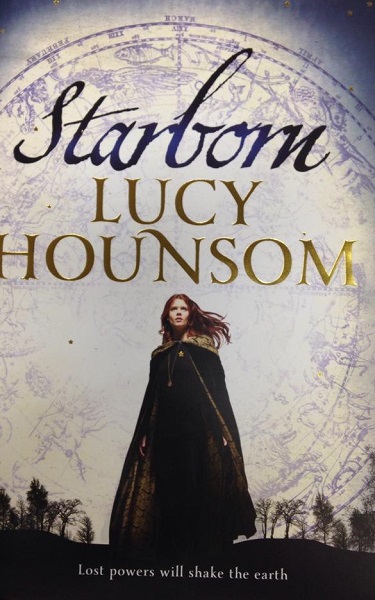
 Kyndra’s fate holds betrayal and salvation, but the journey starts in her small village. On the day she comes of age, she accidentally disrupts an ancient ceremony, ending centuries of tradition. So when an unnatural storm targets her superstitious community, Kyndra is blamed. She fears for her life until two strangers save her, by wielding powers not seen for an age – powers fuelled by the sun and the moon.
Together, they flee to the hidden citadel of Naris. And here, Kyndra experiences disturbing visions of the past, showing war and one man’s terrifying response. She’ll learn more in the city’s subterranean chambers, amongst fanatics and rebels. But first Kyndra will be brutally tested in a bid to unlock her own magic.
If she survives the ordeal, she’ll discover a force greater than she could ever have imagined. But could it create as well as destroy? And can she control it, to right an ancient wrong?
When interviewed here at SFFWorld recently, Lucy said that ‘I wanted to create a protagonist to challenge the concept of traditional heroism. Garion of The Belgariad, for example, exhibits the traits of a hero from the beginning: he’s compassionate, hardworking, down-to-earth and generally a nice guy, who the leaders of the world’s nations end up glad to follow. Kyndra on the other hand can be diffident, a tad inconsiderate and young for her age, despite the fact that, like Garion, she’s had a pretty secure and comfortable upbringing. Those traits echo the destiny awaiting her, which is not wholly a hero’s destiny.’ Having now read the book, I can see what she means.
There’s much about this book that initially seems traditional, in a good way. Its characters are as well realised as those of David Eddings’ Belgariad series and will no doubt resonate with those looking for something similar. There’s a deceptively casual feel to their mannerisms and their conversations that is not easily done yet remarkably familiar when read. It’s not beyond the realms of possibility for the reader to see Kyndra as a female version of Garion and Bregenne and Nediah as Polgara and Belgariath, but with Bregenne/Polgara being the stronger of the two.
This familiarity can be felt too with its narrative, which begins as a coming of destiny tale, and with what seems to be a quest plot that would not feel out of place with those novels of the 1980’s and 90’s. Its main characters are good, there are heroes and heroines from a long-gone past, continuing the fight across the centuries, battling against something unutterably evil. Their challenge is huge, their destination unknown, their destiny unclear.
If that had been the end of this tale, then I suspect that many readers would be happy. However, what Lucy does is take these elements of comfort and then gives them her own spin. In the first part of the book we have home fires, warm fireplaces, beer and good food. We have strange cities, ancient libraries, airships and aerial ports. It is not too much of a surprise therefore to think ahead and accept that Kyndra is a youngster who clearly has a destiny to fulfil. This is further apparent when Kyndra finds herself troubled with visions from the past whilst the world around her is subject to The Breaking, a storm that appears at random and with increasing strength.
The second part of the book shows Kyndra travelling to a new city, Naris. There she makes new friends and has to submit to an initiation, which has consequences for everyone involved. This may initially sound rather like some alternative version of Hogwarts, but having set things up with standard tropes in the first part, Starborn now becomes a tale that goes where the reader doesn’t expect. There’s talk of ‘magic’, though here it is ‘cosmosethic energy’, based around solar and lunar power, and not every character is as clearly defined as we thought they were.
The reasons for this were explained by Lucy in her SFFWorld interview, when she said, ‘It’s said one man’s heroism is another man’s tyranny. That idea lies at the heart of the story and Kyndra’s character reflects my desire to explore it. The more I move away from the Tolkienesque fantasies of the 70’s and 80’s, the more heroism becomes a concept rather than a character trait. And like any concept, it’s open to interpretation and discussion.’
Lucy should be applauded for setting things up so convincingly to begin with that when the changes happen in the third part they are quite shocking. The last section is an examination of what makes a hero or heroine, and how, when given responsibility, and unlimited powers, people can make right and wrong choices. And as such, having taken a darker turn, what happens at the end may not be what everyone wants.
Starborn is a solidly crafted, accessible, big fat Fantasy book that you can immerse yourself in. It is a tale that both comforts and surprises, and is pleasingly assured for a debut novel. For those readers with a yearning for a novel with a Trudi Canavan / David Eddings type vibe, but with a contemporary twist, Starborn may be just the ticket.
Starborn by Lucy Hounsom
The Worldmaker Trilogy, Book One
Published by TOR UK April 2015
ISBN: 978 1 4472 6845 1
496 pages
Review by Mark Yon, March 2015