 Hello, Clay and Susan: many thanks for giving us some time here. Welcome to SFFWorld.
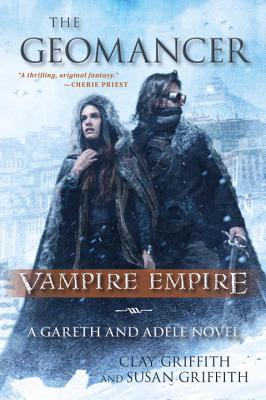
First of all can you tell us a bit about your new novel, The Geomancer?
Yes, THE GEOMANCER is set in the world of the VAMPIRE EMPIRE trilogy and will contain many of the characters and situations that fans of that series recognize. It focuses on the two main characters from the trilogy – Adele and Gareth. The story begins about a year after the events in the trilogy ended. It is intended to stand alone, so new readers can enter the world and understand it, and get to know the characters without having read the trilogy. And as with the trilogy, THE GEOMANCER is a big sweeping epic of war and power on a grand scale, but at its heart it is a book about relationships and characters trying to understand themselves and their place in the world.
I think it’s safe to say that The Vampire Empire trilogy left your fans craving more. Did you already have plans for more before you finished the trilogy or is The Geomancer a result of the “demand” from the fans?
Yes and no. When the trilogy ended, we were content for that to be the end if that’s how it worked out. The story and our characters had reached a logical conclusion based on the events they had lived through. Of course, we had a lot of ideas for what could come next, so when there was an interest in more books, we were more than ready.
Even though The Geomancer stands well on its own I still feel there are more to this story. Do you have plans for more books about Adele and Gareth?
We would love to. Adele and Gareth have so much more they can experience. The world we created is in a state of flux and that spins off a lot of stories. There are vast sections of the globe that readers haven’t seen such as the Americas. And we could even take supporting characters and tell their stories.
You have a somewhat different take on the whole vampire story? How would you describe what you write and what do you feel makes it unique?
Our goal was to give readers something familiar yet different. There is a huge audience for vampire stories, and always will be. So on the one hand, you don’t want to promise your reader that they’re going to be reading a vampire story, and then give them something so different it really isn’t a vampire at all. But you do want to freshen the myth enough so they feel they’re not just reading the same old same old. In our world, vampires are not undead humans; they are a parasitic species that co-evolved with humans. But our history was real history up until 1870 when events in our world took a different path, and all the traditional vampire mythology existed. So our premise was that the vampire myths came about to explain the behavior of these mysterious creatures. So we went back to the prevalent myths and gave our vampires traits that could be explained in some fashion by many of the old myths. But our vampires are not supernatural; they are preternatural.
How did you start writing? Was there a particular book or moment in your life that spurred you on?
Clay: I’ve always wanted to write. I wrote stories when I was a little kid to amuse myself. I suppose that desire came from comic books, so I blame Stan Lee, Jack Kirby, Steve Ditko, and John Romita (among many others). If I had the talent to draw, I might’ve gone that direction, but that’s really hard. I’m still amazed at artists who can transfer an image in their heads to paper.
Susan: I was always obsessed with books and how they told stories. They could take me places and meet new people and learn about new things. That was huge. I couldn’t get enough and the stories didn’t always go where I wanted them to go, so I began writing my own my stories. Then I couldn’t stop. Tarzan of the Apes by Edgar Rice Burroughs was a big influence, as well as the Madeline Brent novels. Both showed adventure writing but with a sharp focus on the characters. And of course, comic books.
You are a married couple and you have been writing together for quite some time now. What made you go down this road instead of keeping your writing careers separate?
We were both writers when we met. Clay was more interested in writing comics while Susan was focusing on novels. We used to read and edit each other’s work all the time. But we ended up writing comics together first. Clay got a call from an editor (Evan Skolnick, now a top video game writer and teacher) asking for pitches for Disney comics. Clay said “No problem. I’ll have a handful of pitches on your desk tomorrow.” Clay knew relatively little about Disney stuff, but Susan is a Disney fanatic. So we worked up some ideas, and we sold a few and co-wrote the scripts. And we’ve been writing together ever since whether comics or prose.
When you work on a new idea, do you tend to work from one key idea that you then refine, or do you spend a long time maturing ideas and mixing them together until you find something that works?
Both. We tend to start with one key idea, but it still takes a long time. Sometimes having two writers isn’t a time-saving device. We want any project we’re working on to reflect both of our ideas. It’s not fun to just be a junior partner on someone else’s project. So we have to shape and re-shape projects with elements that excite both of us. We’ve carved out a little niche as “genre blenders” so we both bring our favorite elements and then pare them down until we get just the right blend to please both of us.
What is your favorite and least favorite part of the writing process, and why? Do you feel you are complementing each other in any of these aspects?
Clay: My favorite aspect is the actual writing. I love writing. I hear other writers talking with dread about it, but I think it’s a blast. The least favorite, I think, is when we have a finished manuscript and we do a read-through. One of us reads and the other listens, and we make copious notes about problems and inconsistencies. It can get very messy and contentious because that’s when we really have to tighten the themes of the book. Sometimes we realize we may have different ideas about how those themes should be spotlighted. However, we complement each other here because Susan is really good at seeing themes, and seeing when they aren’t clear enough. I’m a fan of “less is more”, but she says “less isn’t always enough”. And she’s right. It all works out and we end up with a book that is superior to anything we could’ve written separately.
Susan: I also enjoy the writing process. Alone with the story and the characters, it’s easy to get lost in the world. Once the creative gates open it’s a wonderful feeling. The editing usually frustrates me the most. That’s when all the cracks and gaps are shown. I hate having those pointed out. I know it’s for the best, but the flaws always seem to overshadow the things I’m most proud of. But I’m glad Clay can see the flaws, because most times I can’t. Once they’re exposed, we find a way to fix them, and the story is always better because of it.
Have you always been fascinated by the occult, the power of stones and such?
Oh yes. Not so much with stones etc… but the occult in general has always been a topic of interest – ghosts, monsters, fringe beliefs. Clay particularly was a horror guy growing up, and a historian by education. He’s always had an interest in the role occult beliefs play in societies, particularly “modern” societies based on reason and science. Susan comes at it from a mystical standpoint, but finds the roots of the occult fascinating.
How do you go about the marketing aspect and especially related to your online presence? Anything you’ve seen work better than other things?
We could always do more with marketing. You can ALWAYS do more. We have tried to build good relationships with book bloggers because in this world of flux on the publishing industry, they are rapidly replacing old media such as newspapers and magazines as the gatekeepers who lead readers to new books. In terms of social media, we are on Facebook and Twitter primarily, and we do have a website of our own, but we haven’t really hit our stride keeping that relevant yet. We have our individual online identities, as well as joint ones, so readers can find and interact with us a variety of ways. We try to keep the tone consistent. For example, readers won’t go to the “Clay Griffith” page on Facebook and find nothing but cute kitten pictures while on “Clay and Susan Griffith” we’re debating gun policy. We want to engage our readers in a conversation that is both fun and informative. We do talk about our books, and post reviews, and run the occasional contest or ask questions, but we try not to just post about the books. It’s a tricky balancing act, but we’ve found it’s an irreplaceable tool for reaching readers and letting fans have access to you on a personal level that wasn’t possible when we were young.
So what do you do when you’re not writing, any hobbies?
Wish we had more hobbies! We both read, of course. Clay reads more nonfiction and Susan more contemporary fiction. We are both RPG players, but with paper and in gaming. We both play World of Warcraft, but Susan is the pro at that. She engages in complex role-playing storylines based on a deep understanding of the lore, while Clay runs around looking confused and getting killed.
What’s next? What projects are you working on at the moment?
We are developing a couple of new projects that we want to pitch. We are also working on plotlines for more VAMPIRE EMPIRE books. However, this is actually the first time since 2009 that we haven’t been writing a specific book under contract. We feel unemployed!
Once again, thank you very much for your time.
You’re welcome! Thanks for asking.
* * * * * * *
Interview by Dag Rambraut – SFFWorld.com © 2015