

 When you write genre fiction in a different world, by and large, it’s easy to grasp an accent that anyone can understand. American/UK spellings aside, most of us have a commonality of language that reaches across the majority of English-speaking readers. When I write Space Opera I’m very careful to take my Northern Irish words out of the mix – eejits in space doesn’t quite have the gravitas I’m looking for, somehow. Mostly, it leaves me with a reasonably straight-forward book.
It’s somewhat harder when you set a book in a familiar place – not just using the setting, but fully immersing the book in the place.
I’ve been to London a few times, I’ve seen some movies, I can do my research. It’s unlikely I’d come too much of a cropper with writing a story using the city as a backdrop. Setting it in a London-voice, however, and in the deep point of view of someone from the city – that, I’d shy away from. I don’t know enough. I don’t know the idioms people use, or the little shortcuts they take to get home each day. I’m not a Londoner – and I’ll never fully sound like one.
I have, however, set a science fiction novel in Nothern Ireland. I chose Belfast primarily, because I’m from 15 miles out of the city, I’ve worked in and around it all my life, my parents are from the city. I know it well. Even so, it was a challenge.
After I’d written it (and when I was just about to embark on a second book set in Nothern Ireland), I captured some thoughts about the process of not just using a place as a setting, but making it a part of the book, so much so that the book could not have been set anywhere else. Making the sense of place half the enjoyment of reading the book, even for those who aren’t familiar with the place – because it’s brought alive through the characters.
Dialect. Irvine Welsh did Scottish very well. I know few authors who can capture an accent so well, and have it not annoy the reader so much that the book goes out the window. I can’t do that. If I used broad Belfast for my characters, I’d lose half my readers on page one.
However! It’s no good having characters who sound like they don’t come from the place you’ve set the book. Why use a real setting if that’s what you want? So, for me, the dialect – and I write close third with direct thoughts in the character’s voice – needed a light touch. Certain words stayed in – eejit was one, wee another (we do all say wee a lot), craic is a recognisably local word that translates well. A lot of swear words stayed in because – whisper it – the Irish, both North and South, swear insanely often. To leave them out of my 17 year old street-lad’s dialect would have been the worst fudge imaginable.
Context. That a reviewer from the great U S of A reported that he had grasped the colloquialisms because the context was clear was a huge relief. That was what I hoped – and, really, all we can ever hope for.
Niffenegger in the Time Traveller’s Wife uses Chicago as a setting without giving the reader any truck with being unfamiliar with it. Don’t know what the El is? Well, Henry catches it to work every day, and it goes around the city. It’s either a train or a tram. That’s all the reader really needs to know to visualise the scene.
Your characters would not stop to think what a word would mean. They wouldn’t say “that eejit – a local word for a likeable idiot – from down the road came to the door.” And if they wouldn’t say, or think, it, neither can the writer (at least, not in close pov, and I think it’s hard to pull off books set in a local voice in omni). When a word is used, it has to have the context to provide it, which means some clever writing.
The bar shown as being busy, and bustling, with some music playing, and laughter echoing through it? Using craic to describe it works – because craic is lively and good fun. The reader fills in the blanks and, for me at least, that’s one of the great pleasures of reading books set far from where I am. It’s a way of learning the culture, a way of understanding something foreign in a closer, more real way, than any amount of textbook understanding.
It’s what adds up to that elusive thing needed:
A sense of place. Some books use the setting as a backdrop to a story, and that’s fine. For others, it’s the focus – and that’s fine, too. For me, though, for a story to have a sense of place it must merge the two. The story must be of the place, the characters part of the land, the language, noises, the smells all of the place.
When John, my protagonist, describes the North Atlantic in early winter as a moving stone, it’s because I have visited that harbour on a cold November day. The water is grey. It moves not in gentle waves, but whole chunks of water sliding over and into each other, fighting for space.
When he notices “the air smelt of salt and seaweed and a sweet smell from the north, promising snow” it’s because I once stood at the front of a medieval castle, looking over Belfast Lough, and smelled that. I knew the sweetness of the air, and that it accompanied a cold so biting when I took a hot drink I felt it go down my throat in a line of warmth. And I know it snowed that night, inches and inches of it.
For me, it’s not possible to deliver such a sense of place unless you know somewhere. It’s what Carlos Ruiz Zafon does so well. In Marina he describes a Barcelona only someone intimate it could know. Isabelle Allende is another master of it, capturing the smells, voices and feel of a place.
For me, it brings a story alive and makes it worth reading on for – it makes the place as important as the plot and characters, not a competing element, or a distracting one, but something that sits alongside the rest and makes it both better and richer.
Certainly, when I write stories based in real places – and, apart from my Space Opera, I mostly do – it makes my stories stronger. It gives them an added element of power. It allows me to capture places I know and love and hand them to someone who doesn’t, shyly, and say: here, this is my Belfast, the place, its voice and its people; I hope you like it.
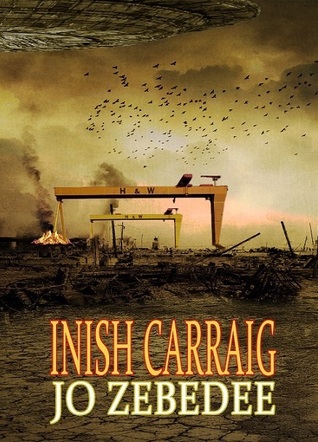 And here it is:
“They backed out and headed up the street, onto the bottom of the Cave Hill. They followed the path up the hill, and the stench from the sewage farms hit John, even worse this high up. He pulled his scarf off so it covered his nose.
Taz gave a short laugh. “You look like a twat.”
John felt himself go red, and pushed the scarf back around his neck. They kept going, the hill getting steeper now they were away from the streets. They climbed in near silence, taking their time to pick their way over the rocks in the dark, until they reached McArt’s fort and sat for a minute, getting their breath back. From here the city looked tiny.”
(Inish Carraig, Jo Zebedee, 2015)
Jo Zebedee writes science fiction and fantasy, sometimes in her Space Opera world of Abendau, sometimes on the streets of Belfast. Her second book, Inish Carraig, about an alien invasion of Belfast has just been released.





Good points, Jo. I think that, unless a story is set in the far future, it is very dangerous to use a setting that you haven’t actually visited or experienced first hand. This links to local dialects and slang; if these don’t fit, this really jars and will put off a knowledgeable reader. Swearing is strange because, although in some areas it makes up a large percentage of real dialogue, it is often toned down in books – although less so in recent TV, films, song lyrics, etc. There is nothing weirder than a galactic stormtrooper or a backstreet ninja who doesn’t use anything stronger than damn!