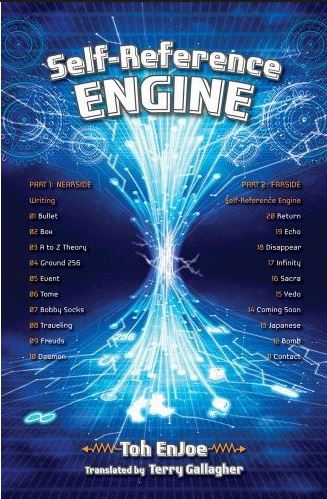
 We have talked to Japanese author Toh EnJoe about his latest book, Self-Reference Engine.
Q: Can you tell us a bit about the background for writing Self-Reference ENGINE?
The main starting point was the kind of jokes that are told on a daily basis among college students in, not science exactly, but more specifically math and physics. Students like that are systematic in the way they mess around. That attitude would be the background.
In fact, I wrote this book at a time when I was completely broke, working as a researcher. I couldn’t afford to buy books. I decided I should try to write the kind of book I would like to read myself. In that sense, the background was my own empty stomach, in a way.
Q: You touch upon the theory that we are all in a computer simulation. What do you think about this theory from a science perspective?
From a scientific perspective, the question of whether or not we are computer simulations, is not, in and of itself, that important. It may be true that we are data, data made up of molecules, we made up of God’s love, or some combination of these. What science is capable of discussing is, given a certain set of assumptions, how rich a set of results can be objectively expressed from those assumptions.
That materials are possessed of objective reality is overwhelmingly obvious, and no chink can be found in the argument. But if we think ahead to a few hundred more years of information science, and think about what something’s “true nature” will mean by then, well, that’s something that nobody can know right now. (For example, by then there may be human personalities that inhabit computer simulations.)
Q: Self-creating and self-annihilating machines. Do you think we slowly are getting there even we don’t necessarily understand the implications it will have?
There is no doubt in my mind that the number of self-replicating machines will increase in the future.
Birds lay eggs, people make babies, we make clones. We are just now at the point where we can see that 3D printers can print 3D printers. What lies down the road? Who knows? People make predictions, and they’re (almost) always wrong. My goal is to minimize the number of times people have to say, “Whodathunkit?” That is, as long as they’re trying to keep up.
Self-annihilating machines, well, that might get started when somebody sits down and starts to think about formulas for what we really mean by “recycling.” (If everything were really going to return to its “original state,” that in itself would be a kind of perpetual motion.)
Q: The Japanese language is quite different from English. I wouldn’t say lost, but do you feel something has changed in the translation process?
The characters in the book seem happier, healthier.
In the Japanese text, the characters seem to be surrounded by something like layers of thick walls. And even when that mysterious something is written about in Japanese, I wanted to get rid of it, but I was never able to.
Q: You have said that your work, in Japanese, reads as if it were translated. Can you explain what you mean by that?
If I write without really thinking about it, it ends up sounding like something translated. “Natural Japanese” is something that is very difficult for me. It has only been about a hundred years or so since the conventions of what we would now describe as “written Japanese that is regarded as something natural.”
And quite apart from that, I often play with words.
For example, in a story written in English, if a Japanese-sounding name or place name pops up, people are often surprised, and they take another look. I would love it if I could achieve the same effect when writing in Japanese.
Assuming you are not a speaker of some Slavic language, I bet you can remember how you felt the first time you encountered the name Raskolnikov, am I wrong?
Don’t you think it would be interesting if every word in a book provoked that same kind of surprise?
Q: The feedback you get from Japanese readers compared to foreign readers, would you say it’s different in any way?
Truth be told, I’ve never gotten much in the way of feedback. Many people say to me things like, “Not that I understood everything, but…” For now, people seem perplexed [by my work] no matter what their language or country.
Actually, with this kind of book, the only real question is, “Did it make you laugh, or not?” Doesn’t it ever happen to you that, maybe you’re watching some science show on TV, and even if you don’t understand everything the commentator is saying, you think his serious demeanor is really kind of funny?
Q: When writing such a book, do you spend a lot of time on research?
Basically I have nothing else to do, so I am always looking something up. I wouldn’t call it research, really, though. It’s more like I’m spending a lot of time day-dreaming. There’s all kinds of things I would like to store away inside myself for a while, see what grows out of them, what form they take, what they can power. That’s my feeling about this.
Humans only have a certain amount of time in their lives, and there are many many things we will never learn.
Q: What can we expect from you next, will there be another SciFi story?
People in Japan want to know what “genre” of writer I am, and nobody can figure it out. I haven’t figured it out myself. I don’t even have an agent, and I really don’t know what comes next.
But everything I write seems to turn into SF. In the times we are living in now, we are surrounded by science. It is unlikely that in a few dozen generations our society will no longer be supportive of technology (because of nuclear waste). These days it is hard to write a contemporary novel in which there are no cell phones, but if you took a story with cell phones back 50 years, people would call it SF. In that sense, as long as technology keeps moving forward, even historical fiction can be seen as a form of SF (from the standpoint of a hundred years earlier). For me, fiction and science fiction are synonymous.