
 As part of SFFWorld‘s ‘s Countdown to Halloween 2015, our latest interview is with ST Joshi, renowned writer, editor and Lovecraft expert.
Hello, S.T. Many thanks for doing this.
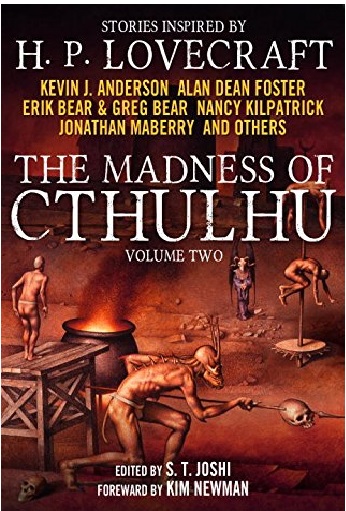
Q: We’re speaking as The Madness of Cthulhu Volume 2, edited by yourself, is being published by Titan Books in the UK. Can you tell us a little about it?
This is the second volume of an anthology that was conceived with the assistance of my American editor at Titan, Steve Saffel. The idea was to have contemporary authors use Lovecraft’s great Antarctic novella At the Mountains of Madness as a springboard for imaginative fiction, whether it be weird, fantasy, or science fiction. (The idea was conceived at the time when Guillermo del Toro was seriously contemplating a film version of At the Mountains of Madness, and we thought the book would be a splendid informal tie-in to that venture.) I was thrilled at the response that leading authors made to this idea—perhaps because the novella is so rich and wide-ranging that all manner of riffs could be made on it. It is also his most concentrated exposition of the core element of his philosophy—“cosmicism,” or the awareness of humanity’s utter insignificance in the vast reaches of space and time. At the same time, I did not feel that authors needed to focus exclusively on At the Mountains of Madness, because a certain monotony might result; so some authors used other Lovecraft tales, or Lovecraftian motifs in general, as inspiration.
 Q: The list of authors you have assembled here is very impressive – Jonathan Maberry, Laird Barron, Steve Rasnic Tem, Kevin J. Anderson and Greg Bear, amongst others. Did you have a wishlist yourself to begin with, or did authors offer you material for this book?
I have a fairly extensive “stable” of authors who like to contribute to my anthologies, and many of them expressed great enthusiasm about writing something for the story. But Steve Saffel, my agent (Cherry Weiner), and I also specifically targeted individual authors (such as Alan Dean Foster and Greg and Erik Bear) who had not written very many (or any) Lovecraft-inspired tales before, because I thought that At the Mountains of Madness would be uniquely suited to their own imaginative focus. I never want writers to produce simple pastiches of Lovecraft; I always want them to use Lovecraftian ideas as triggers for their own creative efforts.
Q: As an editor, what were you trying to achieve with this particular set of books?
At the Mountains of Madness has so many imaginative ramifications—such ideas as alien incursions from outer space; archaeological horror, or horrors buried away in obscure places; the vastness of space and time; science as humanity’s greatest intellectual achievement and the trigger of its downfall; regional or topographical horror; the quest motif—that it is capable of almost infinite elaboration by creative artists. The story also speaks to our own fragility in a world now menaced by exhaustion of natural resources, climate change, and the like. And because it is Lovecraft’s greatest fusion of weird fiction and science fiction, it allows authors of both genres to expand on its conceptions.
Q: This book, of course, adds to your enormous repertoire of work. Your reputation as a scholar of HP Lovecraft is known globally. Where did your interest in Howard and his writing come from initially?
As with so many others, I stumbled upon Lovecraft as a teenager—first in an anthology for young adults (Betty Owen’s Eleven Great Horror Stories), then in the Arkham House editions of the 1960s. I was immediately enthralled, and, curiously enough, from a very early age (my late teens at the latest) I became interested in both reading Lovecraft and studying him—his life, his work, his thought, the literary influences that affected him and his own influence on subsequent writers. By the age of 17 I was already compiling the anthology that would be my first book, H. P. Lovecraft: Four Decades of Criticism (Ohio University Press, 1980), published when I was 22. Initially my interest was focused solely on getting Lovecraft accepted by the academic community, but I eventually broadened my range so that I ventured into compiling anthologies like this one and even to writing Lovecraftian fiction myself! (I’ve written a novel, The Assaults of Chaos [2013], which features Lovecraft as the main character.)
Q: What do you think is the enduring appeal of Lovecraft’s writing?
I have always been devoted to good prose, and I think I have developed a sensitivity to some of the greatest prose-writers in the English language—from Thomas Browne in the 17th century to more recent figures such as Oscar Wilde, Evelyn Waugh, and Gore Vidal. The fields of fantasy and weird fiction are uniquely fitted to dense, richly textured prose, as the work of Arthur Machen, Lord Dunsany, and so many others attests. Lovecraft is to my mind one of the great prose stylists of the 20th century; his distinctive fusion of scientific precision and prose-poetic techniques creates an almost incantatory effect. But more than that, Lovecraft creates an entire universe of horror: many of his tales are linked and seem to take place in the same imaginative realm, so that the stories become more than the sum of their parts. It is almost as if Lovecraft wrote one huge novel in which each story is a chapter. The result is that one can get sucked into this fictional universe and never come out!
Q: How do you feel about other authors picking up from the legacy of Lovecraft’s work? Can we adapt HP’s ideas of the unknown and the cosmic and make them work in the 21st century? Are there any particular current authors who you think embody the aspirations of Lovecraft?
Some of Lovecraft’s own colleagues did write some interesting elaborations of his evolving pseudomythology (later called the Cthulhu Mythos): Robert E. Howard, Robert Bloch, Fritz Leiber, and a few others. But unfortunately, his most ardent disciple, especially after his death, was August Derleth, who never really developed a proper sense of what Lovecraft was really all about: Derleth did not understand, and could not imitate, Lovecraft’s sense of “cosmicism,” and his own tales become mere catalogues of outlandish names and places. Many subsequent writers inadvertently followed Derleth instead of going back to Lovecraft’s own writings. But over the past forty years, as the many misconceptions about Lovecraft’s life and work have been cleared away by scholars, a new cadre of imaginative writers have made some extremely interesting elaborations of Lovecraft’s work. These writers—of whom Caitlín R. Kiernan is probably the best, but with others such as Donald Tyson, Laird Barron, Jonathan Thomas, and several others not far behind—use Lovecraftian motifs as the springboard for their own ideas and conceptions; they are not writing mere pastiches. And I think that, as I mentioned before, our strange position in human and cosmic history—where our own continued tenancy of the earth is now in serious jeopardy—makes some of Lovecraft’s ideas about the future extinction of the human race and of all earth life resonate far more than they did in the past.
Q: Would you say that Lovecraft’s work is an uniquely American perspective on horror? How does he compare with, say, Ambrose Bierce and H. L. Mencken, who you also know a great deal about?
Lovecraft thought of himself as an Anglophile—he loved all things British. And while he was certainly influenced by British writers such as Machen, Dunsany, Algernon Blackwood, and others, he remained a fundamentally American writer in many senses. His chief literary influence was Edgar Allan Poe, whom he first read at the age of eight. His focus on the distinctive topography of his native land, New England, its long and unique history (settlement by Puritans, conflicts with Native Americans, the witch trials in Salem), make him a noteworthy regional writer. Lovecraft traveled up and down the Eastern Seaboard in search of “antiquities,” so he got to know the oldest parts of the American continent quite well. He never went overseas, so his perspective remained American in spite of himself. Bierce and Mencken were great journalists and satirists, and Lovecraft never had much interest in those areas of literary expression; but of course he delighted in Bierce’s misanthropic horror tales and enjoyed Mencken’s savaging of the “booboisie.” In that sense, Lovecraft shared the elitism of Bierce and Mencken—he had no use for the stupid and unimaginative!
Q: Much of the criticism of HPL today is about the person rather than his writing. Do you have any particular thoughts about the person, rather than just the writing? Based on your extensive knowledge of the person, do you think you would get on with HPL if was still alive today?
Much has been made lately of Lovecraft’s racism and anti-Semitism, but I think people fail to understand his views in the context of his times and of his own intellectual development. The matter is too involved to go into here, but let me say that racism comprises a relatively small component of his overall philosophical vision and affects his literary work only slightly. Moreover, he seems to have been an admirable individual in every other regard—kind, generous (not with money—of which he had little—but with his time and expertise), sensitive, and courteous. All his friends had the highest regard for him; some colleagues who knew him only by correspondence (such as August Derleth and Robert Bloch) felt he was one of their best friends. He was a tireless and sympathetic tutor to a great many young writers of his time. Bloch has said that, if he had known that Lovecraft was dying in 1937, he would have crawled on his hands and knees from his home in Milwaukee to Providence, R.I., to be at Lovecraft’s bedside. At his death he ended up being one of the most universally beloved individuals of his generation.
Q: What were your first interests in the genre?
I first got into the realm of imaginative fiction by reading C. S. Lewis’s Chronicles of Narnia. (As an immigrant from India, I had little knowledge of Christianity and did not understand how soaked in Christian symbolism those books were—I just read them as fascinating fantasy-adventure stories.) But I then gravitated toward horror, first with anthologies for young adults compiled by Alfred Hitchcock and Rod Serling, then with the work of Poe, Bierce, Lovecraft, and so many others. I never found much interest in science fiction, although I dutifully read some of the classic writers (Asimov, Arthur C. Clarke, Heinlein, etc.). But Lovecraft really was a kind of gateway, both to writers who preceded him (Machen, Dunsany, etc.) and those who came in his wake (Ramsey Campbell, Thomas Ligotti, etc.).
Q: What kind of books do you read for pleasure now, any favourite authors? Can you read for pleasure? (I know a lot of authors who can’t!)
I doubt that I have read for “pleasure” in decades. Most of my reading is necessarily in the weird field—I am obliged to keep up with new work in the field, and do a fair amount of reviewing of new titles. But I am taking a bit of a break by writing an extensive book on the detective story, entitled Varieties of Crime Fiction. This book has allowed me to indulge in a genre that I read quite extensively at the same time as I was discovering weird and fantasy fiction. So I’ve spent quite a bit of time reading Raymond Chandler, Ross Macdonald, P. D. James, Sue Grafton, Ruth Rendell, and others—all great fun!
Q: And finally, what’s next?
I have a number of other anthology ideas—both Lovecraftian and general—that I hope to get underway fairly soon. Anthologies have essentially replaced the magazine as the chosen venue for weird short fiction, and I feel an obligation to allow some of my favourite authors a platform for getting their work out to readers. Weird fiction still works best in the short story, not the novel. I have just published a major new edition of Lovecraft’s stories (Collected Fiction: A Variorum Edition [Hippocampus Press, 2015]), which I believe presents the most accurate texts of his tales. I am also involved in compiling several editions of “classic” weird writers for such small presses as Centipede Press and Dark Renaissance Books—editions of works by writers ranging from Robert Aickman to Robert W. Chambers to E. Nesbit and Théophile Gautier. There is no end of work to do!
Including this interview, of course! These sound fascinating, and we look forward to seeing this material appear. Many thanks for your time, S. T.
Interview by Mark Yon – SFFWorld.com © 2015





Possibly my interest in horror, weird fiction and Lovecraft bias me, but this seems one of the most fully realized interviews I’ve read at SFFWorld. By that I mean (I think) that the questions drew interesting answers that give some indication of what Joshi is about, his aims and philosophy, and the goals of his work.
Very nicely done, Mark. I enjoyed reading this.
Randy M.
Thank you, Randy. Of course, it helps that the interviewee is open to the questions and willing to give full, honest responses. ST was wonderful, though I say it myself. The only restriction was time. I could’ve kept asking questions!
Excellent.
Thank you, Jason!