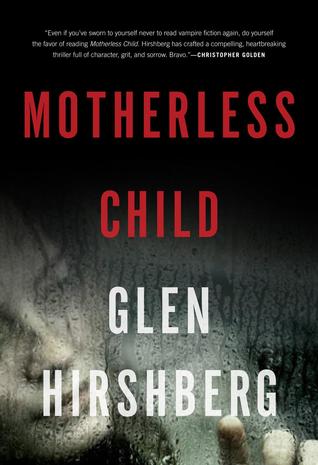
 The Halloween Countdown continues as Randy M. looks at Glen Hirshberg’s Motherless Child.
Join us in the Countdown to Halloween discussion thread
MOTHERLESS CHILD by Glen Hirshberg (Tor, 2014)
Kicking open her door, wrenching free of the seat belt, Natalie left the car and bolted straight up the nearest hill. The wind in her face less a moving thing than a force, liquid cement, slowing her. She still couldn’t hear it, but she could feel it in her ears, pushing past her mouth, pouring down her dead lungs as though into a cistern. Whistling through her ribs and around them and out. Disturbing nothing. Leaving nothing. When she hit the top of the first hill, Natalie considered stopping, or turning for Sophie, or screaming. Then she just plunged ahead, down, down, grass whipping at her ankles as she flung her arms wide to the dark, like aerials, as though they could bring her a signal. Sounds from home. A single cry from her mother’s trailer.
Shivers exploded through [Natalie], radiating from the wound in her gut. It was all she could do not to scream, though not from pain. Not from anguish. We’ve had it all wrong. All through human history. That first shocking moment of life, the world opening before us and our mouths yawning wide with the sheer, impossible shock of just being alive, of needing to do something to stay that way. What other choice could we have but to throw open our mouths and scream. For joy. For joy …
Young, single mothers in rural North Carolina, Sophie and Natalie finally get a night out. Natalie’s mom takes the babies so the two young women can listen to music at a local bar, Natalie self-conscious and uncomfortable in her post-baby body and Sophie as confident as ever in her own. Unfortunately, that’s where they meet The Whistler. The Whistler is a young man, or appears to be, who wanders the South, stopping in wherever there is a live performance and offering his whistled rendition of sad songs. The bar’s performer for the evening counts himself lucky and strums his guitar as the Whistler begins and Sophie and Natalie are entranced.
The next morning Sophie and Natalie wake up in the backseat of Natalie’s car with little memory of what happened. There is blood on them. They also find direct sunlight unbearable.
Hirshberg doesn’t state what they have become, but neither does he hide it as their hunger gnaws at them, adding desperation to their thoughts and actions. Although Natalie is his view-point character, he does not skimp on showing the depths and shallows of Sophie, and the judgments and misjudgments each makes regarding the other as they struggle against becoming like the Whistler and his mother. Natalie is the first to understand and while still able to control herself warns her mother to take the children and run and never contact her or Sophie again. Sophie, turned by the Whistler to provide company for Natalie, is the first to accept. Tension in the novel stems from their different temperaments, experiences and needs as well as the disparity in acceptance of their new condition, from how well they know or don’t know each other, from the strain new desires place on their life-long friendship.
Not native to the South, Hirshberg still captures the tone of Southern story-telling with discernable prose rhythms, cadences of speech and a heightened emotional appeal stemming from young mothers fearful of being their children’s nightmares, of being threats to their lives. And at times, as in the second quote above, Hirshberg’s narrator displays an almost Bradbury-like wonderment at the world, at the sources of sensation and joy. He balances this by never letting us forget the cost to Natalie and Sophie of their humanity, the erosion of their human sensibilities and their struggles to not to let them go.
While not my favorite work by Hirshberg – his first story collection, The Two Sams, remains a high water mark in my reading so far in the new century – as always he remains compassionate about his characters while not blind to their flaws and weaknesses. This is the first book in a trilogy, the next book available in February 2016.
More by Hirshberg
The Two Sams (story collection)
American Morons (story collection)
The Snowman’s Children
Southern Gothic
William Faulkner: Absalom,Absalom
Flannery O’Connor: “A Good Man is Hard to Find”; “Good Country People”
Manly Wade Wellman: Who Fears the Devil? (collection)
Lucius Shepard: Softspoken
Ann Rice: Interview with a Vampire
Poppy Z. Brite: Wormwood (collection)
Caitlin Kiernan: Threshold
John Jacob Horner: Southern Gods
Not your average vampire
Only Lovers Left Alive: 2013; dir. Jim Jarmusch; starring Tilda Swinton, Tom Hiddleston, John Hurt, Mia Wasikowsk.
Chronos: 1993; dir. Guillermo Del Toro
Karl Edward Wagner: “Beyond Any Measure” (from In a Lonely Place and Where the Summer Ends) (OR 2014)